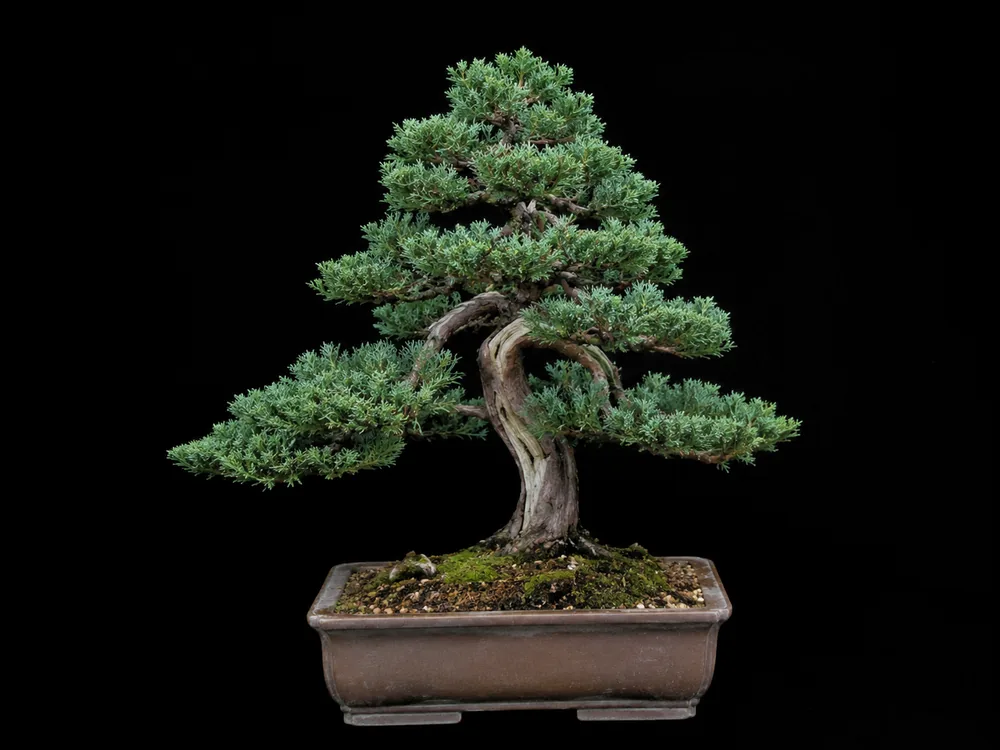
Nana Juniper (Japanese Garden Juniper) Bonsai Care
Juniperus procumbens
48 Nana Juniper (Japanese Garden Juniper) bonsai in stock, from $16.95 Shipped direct from our nursery partners, with a 48-hour live-arrival guarantee. See the trees
Zones 4 to 9, outdoor only. The single most common "beginner" bonsai sold in big-box stores. Most are lost to being kept indoors.
Cupressaceae · Evergreen coniferous shrub (low, creeping/procumbent habit)
Nana Juniper (Japanese Garden Juniper) quick reference
| USDA zones | 4–9 (some sources 3–9) |
|---|---|
| Indoor / outdoor | Outdoor only — this is not an indoor plant |
| Light | Full sun (minimum 4–6+ hours direct) |
| Water | Likes to dry slightly between waterings — hates wet feet |
| Soil | Fast-draining, gritty (akadama / pumice / lava blend) |
| Repot | Every 2–4 years (young more often) |
| Frost | Hardy, but pot roots need winter protection below ~15–20°F |
| Mature height (as bonsai) | 0.5-1m spreading; 15-40cm as bonsai |
| Growth rate | Slow; dense mounding juniper |
| Season of interest | Year-round green; bronzes in winter cold |
| Leaf reduction | Foliage pads refine with pinching, not shears |
| #1 cause of death | Overwatering / root rot, and being kept indoors |
Overview & Character
The Nana Juniper is the single most common "beginner" bonsai sold in big-box stores (Walmart, Home Depot, garden centers), usually in a small ceramic pot with a glued-on figurine. It is genuinely hardy, long-lived, and forgiving of styling abuse — but it has two non-negotiable requirements that kill more of these trees than anything else: it must live outdoors, and it must not sit in wet soil.
It has soft, prickly juvenile-type foliage in a rich blue-green that bronzes slightly in winter cold (normal, not a problem). Its naturally low, sprawling growth makes it ideal for cascade, semi-cascade, informal upright, and windswept styles, and it produces beautiful deadwood (jin and shari).
Identification
Foliage: Almost entirely juvenile, needle-type foliage — short (roughly 6–8 mm), sharp, awl-shaped needles borne in whorls of three, prickly to the touch. Color is a soft blue-green, each needle concave above with a green midrib and two pale/whitish stomatal bands near the base; it bronzes purplish in winter cold (normal). Foliage has a faint resinous juniper scent when crushed. Unlike refined Chinese junipers, 'Nana' rarely develops soft adult scale foliage.
Bark & trunk: Thin, fibrous, reddish-brown to grey bark that shreds in narrow strips; trunks are slender and often gnarled, lending themselves well to deadwood (jin/shari).
Growth habit / form: Distinctly low, creeping, mat-forming (procumbent) — branches run horizontally and mound, with sprays of foliage curving upward. This sprawling habit is the giveaway and is why it suits cascade, semi-cascade, and windswept styles.
Cones / fruit: A dioecious conifer; female plants bear small (~8–9 mm) berry-like seed cones that ripen blue-black with a waxy bloom. Cones are uncommon on cultivated 'Nana' bonsai.
Look-alikes & how to tell them apart: Most often confused with **Chinese Juniper (Juniperus chinensis)** — distinguish by growth habit and foliage: J. procumbens 'Nana' is a low ground-hugging mat carrying almost exclusively prickly whorled-in-threes juvenile needles, whereas mature J. chinensis is an upright shrub/tree dominated by soft, paired/whorled adult scale foliage.
Climate & USDA Zone
Hardy across USDA zones 4–9. It needs a genuine cold dormancy period in winter and will decline if kept warm year-round. It thrives in temperate climates with distinct seasons.
Critically: the juniper is an outdoor tree. It cannot photosynthesize adequately under indoor light and slowly starves indoors. A juniper kept inside often looks fine for weeks to a couple of months, then browns out — by which time it is usually already dead (junipers stay green for a long time after they die, which masks the problem). Keep it outside year-round.
Light
Full sun is best — aim for a minimum of 4–6 hours of direct sunlight, more is better. Strong light keeps foliage compact and the tree healthy. In extreme summer heat in hot southern climates, light afternoon shade can prevent foliage scorch, but err on the side of more sun.
Watering
This species prefers to dry out slightly between waterings. Junipers do not like constantly wet soil; their roots are prone to rot in saturated conditions.
- Check the soil before every watering. Water when the surface and top ~1/2 inch is approaching dry — but never let the entire root ball go bone-dry for an extended period.
- When you water, water thoroughly until it runs freely from the drainage holes, then don't water again until it's approaching dry.
- In full summer sun a small pot may need daily (occasionally twice-daily) watering; in cool weather it may be several days between waterings. Judge by the soil, not the calendar.
- Junipers enjoy humidity on the foliage — occasional misting is beneficial, but misting is not a substitute for proper root watering.
Drainage is everything: ensure the pot drains freely. Standing water = dead juniper.
Soil & Root Care
Soil: Use a fast-draining, open, inorganic-heavy bonsai mix. A classic blend is akadama / pumice / lava rock (roughly equal parts), adjusted grittier in wet climates. The goal is moisture retention with abundant air pockets and zero waterlogging.
Repotting:
- Frequency: young/vigorous trees every 2 years; older/established trees every 3–4 years.
- Best time: early spring, just as growth resumes, before the flush hardens.
- Remove no more than about one-third of the root mass at a time. Junipers resent heavy bare-rooting — never fully bare-root a juniper; work the soil out gradually and keep some of the existing root-zone mycorrhizae intact.
- After repotting, keep in partial shade and protected for 2–4 weeks while roots recover, and do not fertilize until new growth appears.
Root health: Healthy juniper roots are pale and firm. Dark, mushy, foul-smelling roots indicate rot from overwatering or poor drainage.
Feeding
Feed throughout the growing season (spring through fall). A balanced fertilizer works well; many growers use a slightly higher-nitrogen feed in spring to push growth, then a more balanced feed later. Organic solid fertilizers (cakes/pellets) and/or liquid feeds both work. Do not fertilize a freshly repotted, sick, or dormant tree.
Pruning & Styling
- Pinch/prune new growth through the growing season to maintain shape and encourage back-budding and density.
- Do not "pinch" by pulling — for junipers, pinch or snip the soft new tips; tearing causes brown tips. (There is ongoing debate; the safest method is to snip back to a side shoot rather than shearing the whole canopy.)
- Avoid removing all foliage from a branch — junipers do not reliably bud back on bare old wood, so always leave green foliage on any branch you want to keep alive.
- Wiring can be done year-round; the flexible branches wire easily. Watch for wire bite as branches thicken.
- Excellent for deadwood features (jin, shari) given its naturally weathered look.
Propagation & Cuttings
Ease: Easy (junipers root from cuttings). Best method: cuttings.
Juniperus procumbens 'Nana' is propagated from cuttings — this prostrate mall-bonsai staple is cloned by taking semi-hardwood heel cuttings in autumn to winter, dipping in IBA, and keeping cool and humid; rooting is reliable but slow (2–3 months). Seed is dormant, variable, and not used for this cultivar. Low branches layer where they touch soil. For bonsai, cuttings give exact clones of the fine juniper foliage, and the species tolerates the work and bends well for cascade and windswept styles.
Pests
Generally pest-resistant, but watch for:
- Spider mites (most common; thrive in hot, dry, stagnant air — look for fine webbing and stippled, dull foliage)
- Juniper scale (small bumps on foliage/stems)
- Aphids
- Juniper webworm / bagworm (caterpillars webbing foliage together)
Treat with horticultural oil, insecticidal soap, or an appropriate systemic; improve airflow to discourage mites.
Disease, Fungus & Infection
- **Root rot (Phytophthora, Pythium)** — by far the most important disease, caused by overwatering / poor drainage. Symptoms: dull foliage, browning from the inside out, soft dark roots. Often fatal by the time it's visible.
- **Tip blight / needle blight (Phomopsis, Kabatina)** — fungal dieback of shoot tips, worse in wet, humid, poorly ventilated conditions. Prune out affected tips, improve airflow, reduce overhead wetting, apply a copper-based fungicide if persistent.
- **Cedar-apple rust (Gymnosporangium)** — junipers are an alternate host; forms galls that produce orange gelatinous horns in spring. Remove galls; keep away from apple/crabapple if rust is a regional problem.
Prevention for all of the above is the same: full sun, good airflow, correct (not excessive) watering, and clean tools.
Most Common Causes of Death
1. Overwatering / root rot. The #1 killer; keep a gritty free-draining mix, water only when the surface approaches dry, and never let the pot sit in standing water. 2. Kept indoors. Junipers slowly starve without real sun and dormancy; grow outdoors year-round. 3. Mistaking a dead tree for alive. Foliage stays green for weeks after death — scratch the bark to check for green cambium. 4. Total dry-out. A small pot in full sun can dry fatally in one hot day; check daily in summer. 5. Over-aggressive root work. Never fully bare-root; remove at most ~1/3 of roots at repotting.
Seasonal Calendar
- Spring: Repot if due (early). Resume feeding. Begin pinching/snipping new growth; wire.
- Summer: Full sun; water as it approaches dry (often daily). Watch for spider mites.
- Autumn: Feed into early fall; structural pruning, wiring, and deadwood work.
- Winter: Outdoor dormancy; protect potted roots from hard freezes; minimal water (don't fully dry).
Sources
Buy a Nana Juniper (Japanese Garden Juniper) bonsai
- Small Pre Juniper Bonsai, 3 Years Old (Juniperus procumbens 'Nana') — $16.95
- Small Juniper Bonsai, 3 Years Old (Juniperus procumbens 'Nana') — $25.95
- Juniper Procumbens Bonsai Starter Kit, 3 Years Old (Juniperus procumbens) — $33.95
- Small Juniper Bonsai, Land and Water Pot, 3 Years Old (Juniperus procumbens 'Nana') — $33.95
- Medium Juniper Bonsai, 6 Years Old (Juniperus procumbens 'Nana') — $37.95
- Juniper Bonsai, Upright, 5 Years Old (Juniperus procumbens 'Nana') — $37.95
- Pre Juniper Staked Bonsai, 6 Years Old (Juniperus procumbens 'Nana') — $43.95
- Juniper Bonsai, Land and Water Pot, 5 Years Old (Juniperus procumbens 'Nana') — $54.95
See all 48 Nana Juniper (Japanese Garden Juniper) bonsai trees for sale
- All species
- Shop bonsai trees, tools & supplies
- How to Water a Bonsai (Without Killing It)
- Bonsai Soil: What to Buy, What to Mix, and What It Costs
- Why Bonsai Die After Repotting: Diagnosing a Failed Repot
- Pruning vs. Pinching: Shaping Your Bonsai
- Overwintering Bonsai: Cold-Season Care
- Indoor Bonsai Light and Humidity: Making a Windowsill Actually Work
- Root Rot on bonsai
- Overwatering on bonsai
- Underwatering (Drought Stress) on bonsai
- Winter / Frost Damage on bonsai
- Leaf Scorch / Sunburn on bonsai
- San Jose Juniper bonsai care
- Shimpaku Juniper bonsai care
- Chinese Juniper bonsai care
- Common Juniper bonsai care