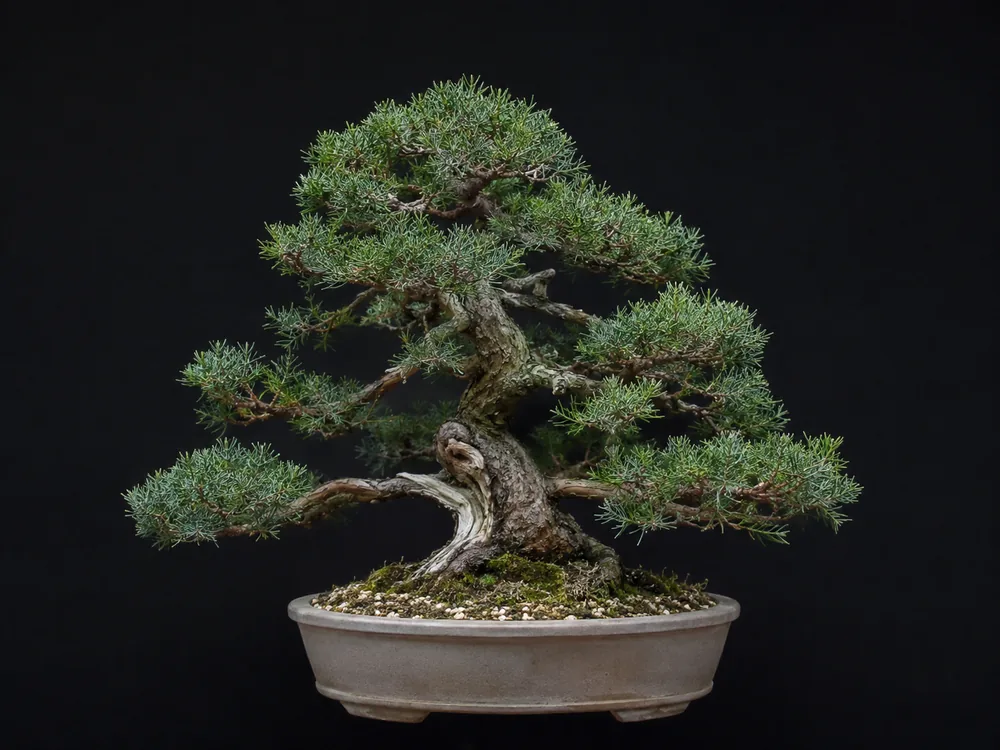
Needle Juniper Bonsai Care
Juniperus rigida
Zones 5 to 9, outdoor only. A classic Japanese bonsai conifer, distinguished from scale-leaved junipers by its stiff. Most are lost to overwatering.
Cupressaceae (cypress family) · Evergreen coniferous tree/shrub
Needle Juniper quick reference
| USDA zones | 5–9 |
|---|---|
| Indoor / outdoor | Outdoor only — needs full sun, fresh air, winter dormancy |
| Light | Full sun all day |
| Water | Slightly dry between waterings — never bone-dry, never soggy |
| Soil | Very free-draining, gritty inorganic mix |
| Repot | Every 2–4 years (young more often) |
| Frost | Hardy; protect potted roots below ~−10 °C / 14 °F |
| Mature height (as bonsai) | 8-12m wild; 25-60cm as bonsai |
| Growth rate | Slow; sharp prickly needles |
| Season of interest | Year-round; excels for driftwood jin and shari |
| Leaf reduction | Needles shorten modestly; pinch, avoid cutting |
| #1 cause of death | Root rot from overwatering; weakening from over-pinching/hedging |
Overview & Character
The Needle Juniper is a classic Japanese bonsai conifer, distinguished from scale-leaved junipers by its stiff, sharp, true needle foliage in threes, which gives a fine, bristly, characterful texture. It develops beautiful reddish-brown shredding bark and excellent deadwood (jin/shari), and is prized for refined, traditional styling.
It is a tough, sun-loving outdoor conifer that wants the same culture as other junipers: maximum sun, sharp drainage, a wet/dry watering cycle, and a real winter dormancy. Its rigid needles make it less flexible to wire than Juniperus chinensis, and (like all junipers) it must keep foliage on a branch — cutting back to bare old wood does not reliably produce new growth.
Note: the needles are genuinely sharp — handle with care when working the tree.
Identification
Foliage: Stiff, sharp, true needles borne in whorls of three, ~1–2.5 cm long, deep green with a single white stomatal band on the inner face, and a grooved upper surface; distinctly prickly to the touch — the key tell versus soft scale-leaf junipers.
Bark & trunk: Attractive reddish-brown bark that peels in thin vertical strips; readily develops silvery deadwood (jin and shari) that contrasts with the living vein.
Growth habit / form: Upright to spreading conifer with a fine, dense, bristly canopy; suits formal/informal upright, literati, cascade, and deadwood-feature styles.
Cones: Dioecious; females bear fleshy, berry-like cones ripening blue-black with a waxy bloom over ~two years.
Look-alikes & how to tell them apart: Most often confused with **Chinese Juniper (J. chinensis)/Shimpaku, which on mature growth has soft scale leaves — Needle Juniper keeps stiff three-part needles** throughout, the quickest distinction. Juvenile Chinese juniper foliage is also needle-like but in less rigid whorls and softer to the touch.
Climate & USDA Zone
Hardy in USDA zones 5–9. It needs full sun, fresh air, and a genuine winter dormancy, so it is grown outdoors year-round. The tree is cold-hardy, but exposed potted roots are more vulnerable than ground roots — protect the pot when temperatures fall below about −10 °C / 14 °F. It is not an indoor plant; indoor light is far too low and it will slowly decline inside.
Light
Full sun all day. Strong light keeps the foliage tight, healthy, and able to support back-budding and refinement. Insufficient light produces weak, sparse, leggy growth. It may be brought indoors briefly for display but must always return outside.
Watering
Let the soil get slightly dry between waterings — junipers want highly oxygenated roots.
- Water thoroughly when the surface has begun to dry, until water runs from the holes; then allow a partial dry-down before the next watering.
- Don't keep the soil constantly wet (causes root rot) and don't let it go bone-dry for long.
- Misting the foliage can help in hot, dry spells, but the key is sharp drainage and a wet/dry cycle at the roots.
Soil & Root Care
Soil: A very free-draining, gritty inorganic mix (akadama / pumice / lava). Junipers partner with beneficial mycorrhizal fungi — preserve some old soil at repotting.
Repotting:
- Frequency: young/developing trees every 2 years; mature trees every 3–4 years.
- Timing: early spring as growth resumes.
- Remove up to ~1/3 of the roots; do not bare-root — keep core roots and some mycorrhizal soil.
- Aftercare: shelter from harsh sun/wind for a few weeks; keep appropriately watered (not soggy).
Feeding
Feed through the growing season — balanced fertilizer from spring, easing nitrogen in late summer/autumn so growth hardens for winter. Many growers feed regularly spring to autumn to build vigor. Don't feed freshly repotted or dormant trees.
Pruning & Styling
- Pinching/trimming: Remove or pinch shoots that stick beyond the silhouette throughout the growing season; do not shear the whole tree like a hedge — removing all growing tips weakens it and browns the cut foliage.
- Never cut a branch back to bare old wood expecting new growth — junipers back-bud poorly on leafless wood; always leave green foliage on any branch you want to keep.
- Deadwood: Needle Juniper takes excellent jin/shari; treat with lime sulfur to preserve and whiten deadwood.
- Wiring: the rigid needles and stiffer branches make it less pliable than Chinese juniper — wire carefully and protect the bark; best in late autumn to winter.
- Suits formal/informal upright, literati, cascade, and deadwood styles.
Propagation & Cuttings
Ease: Moderate (a juniper — roots from cuttings). Best methods: cuttings; collection.
Juniperus rigida roots from semi-hardwood heel cuttings taken in autumn/winter with IBA, kept cool and humid — rooting is slower than Chinese juniper but works. Seed is deeply dormant and rarely used. It is prized as collected yamadori for its sharp needles, fine deadwood, and rugged trunks. For bonsai, cuttings clone good foliage and collected trees provide age; the very sharp needles make it awkward to handle but it takes styling and jin/shari work superbly.
Pests
- Spider mites (hot, dry conditions; stippled, bronzing foliage — a common juniper pest)
- Scale insects
- Juniper webworm / caterpillars (webbing and browning of foliage)
- Aphids
Treat with horticultural oil, insecticidal soap, or appropriate miticide; strong, sun-grown trees resist pests best.
Disease, Fungus & Infection
- **Root rot (Phytophthora / Pythium)** — from overwatering/poor drainage; the principal disease risk.
- **Juniper tip blight (Phomopsis / Kabatina)** — browning and dieback of shoot tips in wet, humid, low-airflow conditions; prune out affected tips, sanitize tools, improve airflow, apply fungicide if persistent.
- Cedar–apple and related rusts — orange galls on junipers (alternate host with apples/hawthorns); remove galls; usually cosmetic on bonsai.
Prevention: full sun, sharp drainage, strong airflow, correct watering, and tool sanitation.
Most Common Causes of Death
1. Root rot from overwatering / poor drainage. The top killer; use gritty free-draining soil and a wet/dry cycle. 2. Over-pinching / hedging the whole tree. Removing all tips weakens it and can kill it; thin selectively instead. 3. Cutting back to bare wood. Won't back-bud; keep foliage on branches you want to keep. 4. Indoor keeping. Needs sun, air, and dormancy — declines indoors. 5. Unprotected winter roots / spider mites on a weak tree. Shelter roots in hard freezes; keep vigor up to resist mites.
Seasonal Calendar
- Early spring: Repot if due; resume feeding as growth starts.
- Spring–summer: Full sun; pinch/thin shoots beyond the silhouette; watch for spider mites; water on a wet/dry cycle.
- Autumn: Ease nitrogen; do structural pruning; apply deadwood treatment.
- Winter: Wire while dormant; keep outdoors with dormancy; protect potted roots in hard freezes.
Sources
Where to buy a Needle Juniper bonsai
We don’t stock Needle Juniper at the moment. These species need similar care and we have them now — they are the closest match in our catalogue.
- Chinese Juniper — similar care, in stock now
- Common Juniper — similar care, in stock now
- Nana Juniper (Japanese Garden Juniper) — similar care, in stock now
Browse all bonsai trees for sale or find a species matched to your climate and space.
- All species
- Shop bonsai trees, tools & supplies
- How to Water a Bonsai (Without Killing It)
- Bonsai Soil: What to Buy, What to Mix, and What It Costs
- Why Bonsai Die After Repotting: Diagnosing a Failed Repot
- Pruning vs. Pinching: Shaping Your Bonsai
- Overwintering Bonsai: Cold-Season Care
- Indoor Bonsai Light and Humidity: Making a Windowsill Actually Work
- Root Rot on bonsai
- Overwatering on bonsai
- Winter / Frost Damage on bonsai
- Insufficient Light (Etiolation) on bonsai
- Spider Mites on bonsai
- Chinese Juniper bonsai care
- Common Juniper bonsai care
- Eastern Red Cedar bonsai care
- Nana Juniper (Japanese Garden Juniper) bonsai care