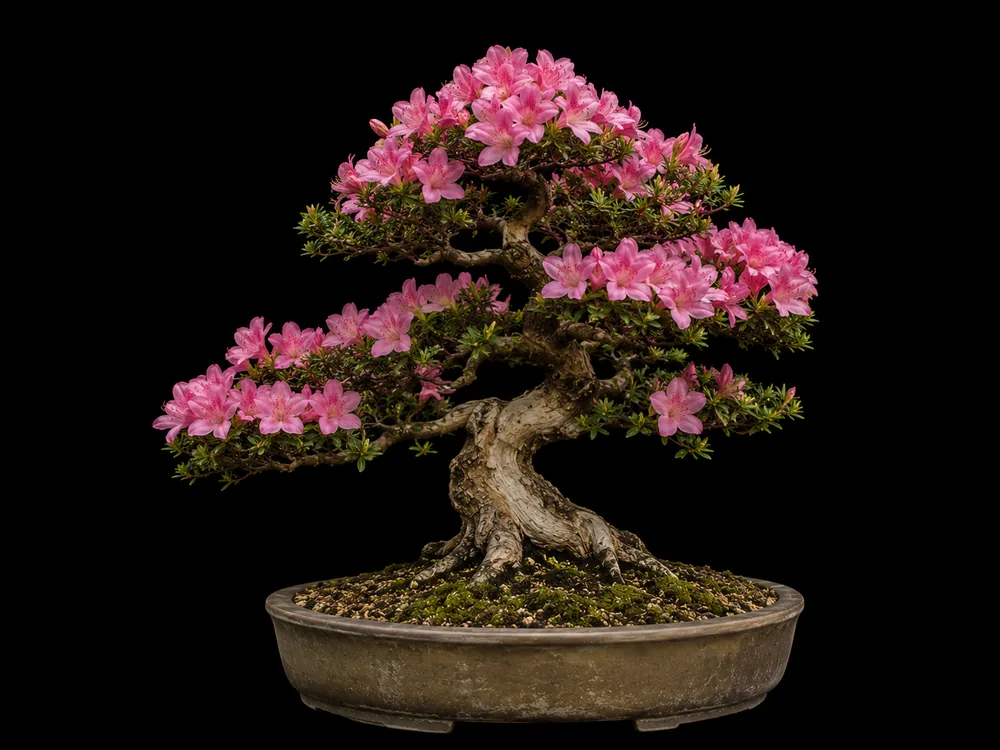
Satsuki Azalea Bonsai Care
Rhododendron indicum
8 Satsuki Azalea bonsai in stock, from $48.95 Shipped direct from our nursery partners, with a 48-hour live-arrival guarantee. See the trees
Zones 6 to 9, outdoor. One of the most prized of all flowering bonsai. Most are lost to overwatering.
Ericaceae (the heath family) · Evergreen to semi-evergreen flowering shrub; outdoor bonsai
Satsuki Azalea quick reference
| USDA zones | 6–9 (most cultivars hardy to roughly 0°F / -18°C; some to -10°F) |
|---|---|
| Indoor / outdoor | Outdoor — needs a real winter dormancy and cannot live indoors year-round |
| Light | Full sun to bright dappled shade; protect from harsh afternoon sun, especially in summer and around bloom time |
| Water | Moist — never bone-dry, but never waterlogged. Hates both extremes. Use soft/rainwater; dislikes hard, alkaline tap water |
| Soil | Pure or majority Kanuma (acidic volcanic pumice), pH ~5.0–6.0, very free-draining yet moisture-retentive |
| Repot | Every 2–3 years, in early spring before growth or just after flowering |
| Frost | Good when dormant; protect roots and flower buds in hard freezes and from cold drying wind |
| Mature height (as bonsai) | Shrub 1-2m in nature; bonsai usually 20-60cm. |
| Growth rate | Slow to moderate. |
| Season of interest | Late spring for spectacular varied blooms. |
| Leaf reduction | Good; small leaves stay compact with trimming. |
| #1 cause of death | Root rot from overwatering / poorly draining or non-acidic soil |
Overview & Character
The Satsuki azalea is one of the most prized of all flowering bonsai, grown in Japan for centuries and the subject of dedicated exhibitions and cultivar registries. A single old plant can carry thousands of blossoms in late spring to early summer, and individual Satsuki cultivars are famous for color-breaking: one tree may open white, solid-colored, striped, flecked, and edged flowers all at once from the same genetics. Foliage is small, dense, and naturally twiggy, taking well to refined ramification.
It is a slow, deliberate tree to develop but extremely forgiving of hard pruning, since it back-buds readily even on old bare wood. The trade-offs are its demanding soil chemistry, its fine moisture-sensitive root system, and a long-term tendency for the trunk to hollow or rot if water management is sloppy. Treat the roots and the water right and a Satsuki can outlive its owner.
Identification
Foliage: Small (roughly 1–3 cm), narrow lance- to oval-shaped leaves that are leathery, glossy dark green, and often finely hairy, carried alternately and densely along twiggy shoots. Evergreen to semi-evergreen — it holds most of its leaves through winter, though a portion may bronze and drop in cold. New growth is softer and lighter green.
Bark & trunk: Thin, smooth, grey-brown bark that flakes finely with age and is easily marked; old trunks develop fluting, hollows, and a characterful aged surface. The wood is brittle.
Growth habit/form: A dense, low, twiggy, mounding evergreen shrub that back-buds prolifically even on bare old wood, building fine ramification.
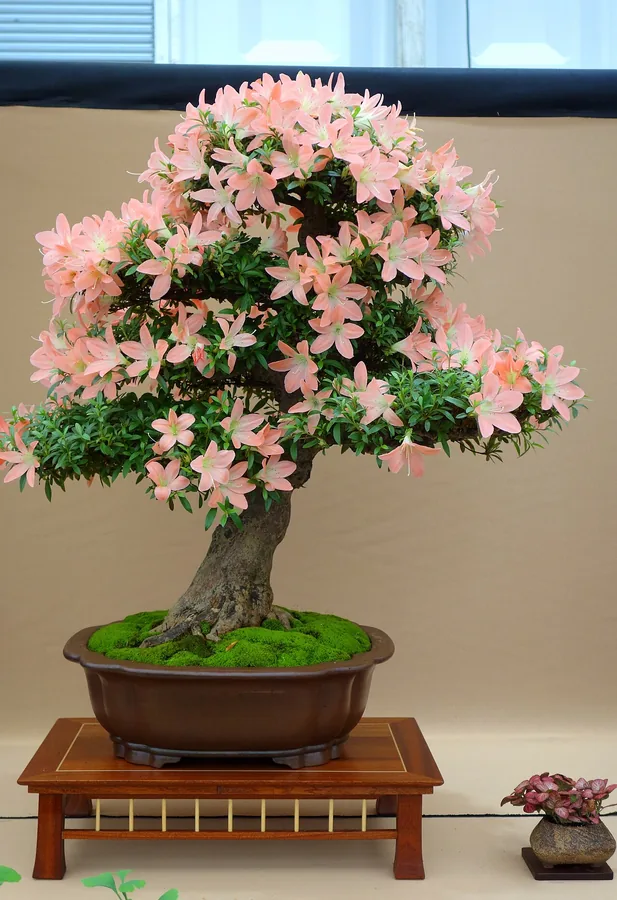
Flowers/fruit (key ID feature): Large, showy, funnel/trumpet-shaped 5-lobed flowers (often 5–8 cm across — big relative to the small leaves) in late spring to early summer, on old wood. Colors span white, pink, red, salmon, purple and bicolors, and a single Satsuki plant famously color-breaks — opening solid, striped, flecked, and edged blooms at once. Fruit is an inconspicuous small dry capsule.
Look-alikes & how to tell them apart: Distinguished from other azaleas/rhododendrons by its lateness (May–June), broad funnel flowers, and trademark color-breaking on one plant. Versus boxwood or other small-leaved evergreens, the leathery alternate leaves plus the conspicuous funnel flowers are decisive. Unlike Serissa (tiny white star flowers, foul-smelling bruised roots), Satsuki has far larger funnel blooms and no foul odor.
Climate & USDA Zone
Best suited to USDA zones 6–9. Most named Satsuki cultivars tolerate temperatures down to about 0°F (-18°C) when fully dormant, and a few are hardier still, but the flower buds and fine roots are more tender than the wood. In zones colder than 6, overwinter in an unheated garage, cold frame, or greenhouse. As a bonsai in a shallow pot the root ball is far more exposed than a garden plant, so give winter root protection (mulch, heeling into the ground, or cold storage) one zone warmer than you would for the same plant in the landscape.
Light
Satsuki want plenty of light to bloom and stay compact, but they evolved as understory and woodland-edge plants. The ideal is full morning sun with shade or bright dappled light during the hottest part of the afternoon. Full, baking all-day summer sun scorches the leaves and bleaches flower color, and intense sun on open blooms shortens the display. During flowering, moving the tree into bright shade noticeably extends how long the flowers last. Too much shade, however, produces leggy growth and poor flowering.
Watering
Moist, leaning to the wet side — but never waterlogged, and never fully dry. This is the heart of growing Satsuki. Their root system is a dense, fine, felt-like mat that wicks water beautifully but is intolerant of both drought and stagnant saturation. The soil should stay consistently damp; if the rootball ever dries out completely, sections of fine root die and the plant may not recover.
Water by deep, thorough soaking from the top until water runs freely from the drainage holes, rather than light daily sprinkling. In hot weather an established Satsuki may need watering once or twice a day. Use rainwater or soft water where possible — Satsuki are calcifuge (lime-hating), and hard, alkaline tap water gradually raises soil pH and causes iron-deficiency chlorosis (yellowing leaves with green veins). The contradiction to respect: it likes constant moisture, yet the number-one killer is overwatering into stagnant, airless, or non-draining soil. Kanuma solves this by holding water while staying open and oxygenated.
Soil & Root Care
Use Kanuma, a soft, acidic, yellow Japanese volcanic pumice that is the standard medium for azaleas. It is naturally acidic (good for a lime-hater), retains moisture, and drains freely while leaving air around the roots. Many growers use 100% Kanuma; others blend it with a little akadama or kanuma-dominant mixes. Avoid standard alkaline or loamy soils.
The root system is fine and fragile. When repotting, work gently — tease and comb out the dense pad rather than cutting aggressively, and never bare-root or remove the bulk of the fine root mass at once. Repot every 2–3 years, either in early spring just before growth begins or immediately after flowering. At every repot, inspect the trunk base and nebari for soft, dark, or rotten areas, since hidden basal rot is a common slow killer.
Feeding
Feed during the growing season but stop feeding before and during flowering, resuming once the blooms are spent — feeding through bloom shortens the display and pushes growth at the expense of flowers. Begin after flowering, in early summer, and continue into autumn. Use a fertilizer formulated for acid-loving / ericaceous plants; ordinary fertilizers and especially anything that raises pH will cause problems over time. Low-nitrogen, balanced organic feeds suit refinement; avoid high-nitrogen pushes that produce coarse growth. Iron (a chelated iron tonic) corrects chlorosis if the foliage yellows.
Pruning & Styling
Satsuki flower on old wood — the buds for next year's display form in summer on the current season's matured shoots. This makes pruning timing critical: the main structural pruning and trimming is done immediately after flowering finishes (late spring / early summer). Pruning later in summer, autumn, or winter removes the very shoots that are setting next year's flower buds and sacrifices the bloom.
The recommended cycle: as soon as the flowers fade, deadhead spent blossoms and cut back the year's growth to shape; any strong secondary shoots that push afterward can be tidied in midsummer, leaving enough time for new flower buds to set before autumn. Satsuki also throw multiple shoots from a single node, which can cause unsightly swollen "knuckles" — thin these to one or two shoots per junction. The species back-buds with exceptional vigor, even on bare old wood, so hard rejuvenation pruning is possible and reliably triggers fresh growth for building structure. Wire carefully: the wood and bark are brittle and mark easily, so use lower-gauge wire, pad it, and remove it before it bites in.
Propagation & Cuttings
Ease: Easy. Best methods: semi-hardwood cuttings; air-layering.
Rhododendron indicum (Satsuki) roots readily from semi-hardwood cuttings taken in early summer after the flush firms, in acidic, airy media (kanuma) under humidity with light hormone — this is how cultivars are cloned true. Air-layering (spring) is reliable for larger stock and to fix good nebari. Seed is tiny and won't come true. For bonsai, cuttings and layers preserve the prized flower patterns; azaleas back-bud strongly even from old wood, so heavy reduction is well tolerated on kanuma and rainwater.
Pests
Watch for azalea lace bug (the signature pest — causes silvery, stippled, bleached upper-leaf surfaces with black specks beneath), aphids, scale insects, spider mites, vine weevil (whose larvae eat roots), and whitefly. Treat infestations with insecticidal soap or neem oil, repeating as needed, and improve airflow. Lace bug in particular is a chronic problem on stressed or too-shaded plants and warrants early action.
Disease, Fungus & Infection
The dominant disease threat is root rot (Phytophthora and related fungi), driven by overwatering and poor drainage — see causes of death below. On the foliage and flowers, watch for petal blight (flowers turn brown, slimy, and collapse in wet weather), azalea gall (swollen, pale, fleshy distortions of leaves/buds), rust, and powdery mildew. Good airflow, avoiding overhead watering onto open blooms, removing fallen infected petals and leaves, and not crowding plants all reduce fungal pressure. Use an appropriate fungicide if a serious outbreak appears.
Most Common Causes of Death
1. Overwatering / root rot. The #1 killer; use airy acidic kanuma and water carefully — the fine root pad rots in soggy soil yet must never fully dry. 2. Drying out. The dense fine root ball can repel water and dry internally; soak thoroughly and keep evenly moist. 3. Alkaline soil/water chlorosis. Needs acidic conditions; hard/alkaline water causes yellowing — use rainwater and acidic soil. 4. Wrong pruning time / lost bloom. Flowers on old wood — prune right after flowering, not later, or you remove next year's buds. 5. Winter freeze / pests. Protect from hard freeze; watch for vine weevil, lace bug, and spider mites.
Seasonal Calendar
- Spring: Bloom time; prune immediately after flowering; repot just after bloom into kanuma; resume feeding.
- Summer: Keep evenly moist with soft water; partial shade in extreme heat; set next year's buds; watch lace bug.
- Autumn: Reduce feeding; protect developing flower buds; keep moist.
- Winter: Protect from hard freeze and cold drying winds; reduce water but never let it dry out.
Close-up photo reference
Compare your tree against these to confirm the species and spot problems early.

Sources
Buy a Satsuki Azalea bonsai
- Flowering Azalea Bonsai, 10 Years Old (Azalea japonica 'Sachsenstern') — $48.95
- Flowering White G.G. Gerbing Azalea Bonsai, 8 Years Old (Rhododendron indica 'Mrs.G.G. Gerbing') — $49.95
- Flowering Tropical Red Formosa Azalea Bonsai, 8 Years Old (Azalea indica) — $54.95
- Flowering Tropical Purple Formosa Azalea Bonsai, 8 Years Old (Azalea indica) — $54.95
- Flowering Tropical Azalea Bonsai, 9 Years Old (Rhododendron 'Dogwood') — $56.95
- Flowering Tropical Duc De Rohan Azalea Bonsai, 12 Years Old (Southern indica) — $68.95
- Flowering Chinzan Azalea Bonsai, 15 Years Old, 14 Inches Tall (Azalea satsuki) — $225.00
- Flowering Chinzan Azalea Bonsai, 15 Years Old, 12 Inches Tall (Azalea satsuki) — $225.00
- All species
- Shop bonsai trees, tools & supplies
- How to Water a Bonsai (Without Killing It)
- Bonsai Soil: What to Buy, What to Mix, and What It Costs
- Why Bonsai Die After Repotting: Diagnosing a Failed Repot
- Pruning vs. Pinching: Shaping Your Bonsai
- Overwintering Bonsai: Cold-Season Care
- Indoor Bonsai Light and Humidity: Making a Windowsill Actually Work
- Root Rot on bonsai
- Overwatering on bonsai
- Underwatering (Drought Stress) on bonsai
- Winter / Frost Damage on bonsai
- Leaf Scorch / Sunburn on bonsai
- Boxwood bonsai care
- Camellia bonsai care
- Cotoneaster bonsai care
- Parrot's Beak bonsai care