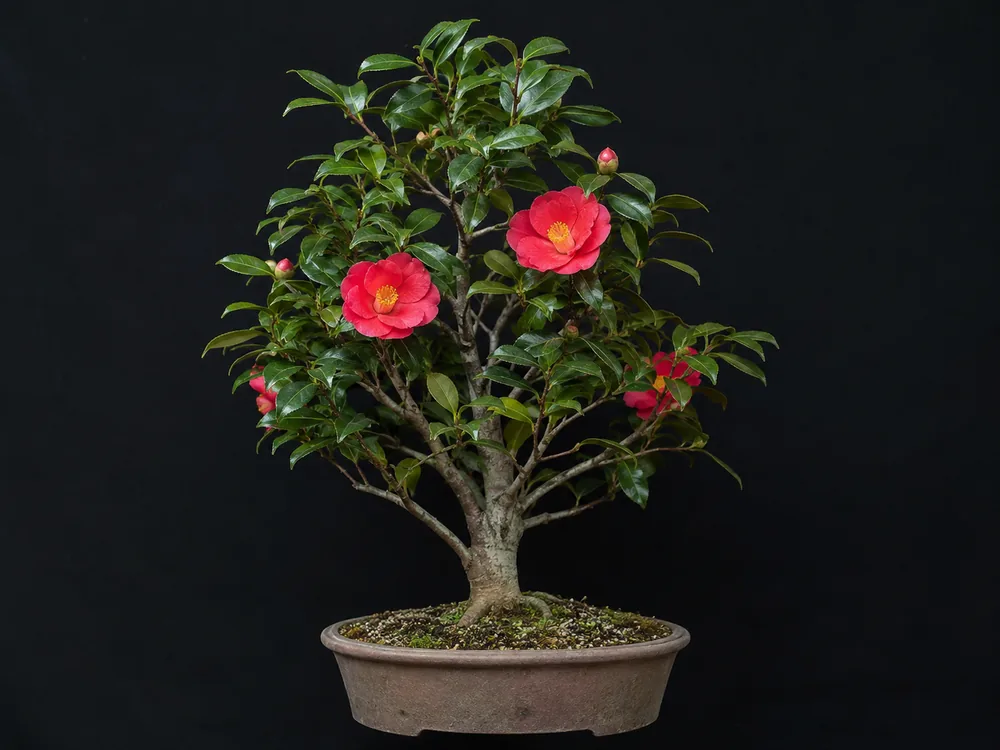
Camellia Bonsai Care
Camellia japonica
Outdoor. A classic broadleaf evergreen valued for its glossy, dark-green leaves and its large. Most are lost to overwatering.
Theaceae (Tea family) · Broadleaf evergreen flowering shrub; outdoor bonsai (cool-greenhouse in cold winters)
Camellia quick reference
| USDA zones | Roughly 7–9 (hardy to about zone 8; container culture or winter protection needed in colder areas) |
|---|---|
| Indoor / outdoor | Outdoor — cool, sheltered position; protect from hard frost rather than bringing into a warm room |
| Light | Bright shade to morning sun / dappled light; protect from harsh midday summer sun |
| Water | Keep evenly moist — never let it dry out, but never waterlogged. Lean slightly wet, drainage essential |
| Soil | Acidic (pH ~5.5–6.5), well-draining; use ericaceous/azalea (kanuma-based) mix |
| Repot | Every 2–3 years, after flowering (late spring), into fresh acidic mix |
| Frost | Tolerates light frost; protect potted roots from hard freeze and cold drying wind |
| Mature height (as bonsai) | Shrub to 6 m; 25-50 cm as bonsai |
| Growth rate | Slow-moderate |
| Season of interest | Winter-spring showy flowers, evergreen |
| Leaf reduction | Limited - naturally large glossy leaves |
| #1 cause of death | Over-watering / root rot, and use of alkaline (hard) water causing chlorosis and decline |
Overview & Character
Camellia is a classic broadleaf evergreen valued for its glossy, dark-green leaves and its large, showy flowers that appear from autumn through spring — a season when little else is in bloom. Camellia japonica flowers in late winter and spring; Camellia sasanqua flowers earlier, in autumn and early winter, and tends to have smaller leaves and a more graceful habit that some find better suited to bonsai. Flowers range from single to fully double in white, pink and red.
As a bonsai, Camellia rewards patience. It is an acid-loving plant that demands the right soil and water chemistry, dislikes its roots being disturbed at the wrong time, and concentrates much of its energy into bloom. Treated correctly it makes a strikingly beautiful flowering evergreen with handsome year-round foliage.
Identification
Foliage: Thick, leathery, glossy dark-green leaves, elliptical with finely serrated margins, evergreen and arranged alternately. Sasanqua leaves are generally smaller than japonica.
Bark & trunk: Smooth, gray to gray-brown bark that becomes finely roughened and more characterful with age. Trunks are slow to thicken.
Growth habit / form: Dense, upright to rounded evergreen shrub with stiff, well-branched structure that holds foliage all year.
Flowers / fruit: Large, conspicuous flowers — single, semi-double or double — in white, pink or red with a prominent boss of golden stamens in single forms. Japonica blooms late winter to spring; sasanqua blooms autumn to early winter. Fruit is a woody capsule, rarely significant in bonsai.
Look-alikes & how to tell them apart: Camellia is most often confused with Camellia sasanqua (a near relative), Sasanqua, and with broadleaf evergreens like Ternstroemia or Cleyera. Within the genus, tell japonica from sasanqua by flowering season and leaf size — japonica has larger leaves and blooms late winter/spring with larger flowers, while sasanqua has smaller leaves, blooms autumn/early winter, and is more open and graceful. The glossy serrated evergreen leaves plus the large stamen-centered flowers distinguish Camellia from lookalike evergreen shrubs that lack such showy blooms.
Climate & USDA Zone
Camellia is hardy to roughly USDA zone 8 (with sasanqua and some japonica cultivars varying). In its range it grows outdoors with shelter; in colder zones it must be container-grown and protected — a cold greenhouse, cold frame or unheated porch is ideal in winter. It needs cool conditions and a winter rest but is not a warm-room houseplant; central heating dries it out and causes bud drop. Provide a sheltered outdoor spot protected from hard frost, frozen wind, and scorching summer sun.
Light
Give bright, filtered light — dappled shade, morning sun, or light high shade is ideal. Camellia evolved as a woodland-edge plant and dislikes intense, hot afternoon sun, which scorches leaves and stresses roots. Too little light, however, reduces flowering. Aim for bright but protected exposure.
Watering
Lean slightly wet — the rootball needs constant moisture and must never dry out completely, yet it must never be waterlogged either. In the growing and flowering seasons keep the soil evenly moist; in winter keep it only slightly moist. Critically, Camellia dislikes calcareous (hard, alkaline) water — use rainwater or another neutral-to-slightly-acidic source, because hard water raises soil pH over time and triggers iron chlorosis and decline. Always ensure free drainage, since stagnant water is the fastest route to fatal root rot.
Soil & Root Care
Camellia is a true acid-lover and needs a well-draining, acidic mix with a pH around 5.5–6.5. An ericaceous (azalea) soil based on kanuma is excellent; avoid lime and alkaline components. Good drainage combined with consistent moisture is the balance to strike.
Repot every 2–3 years, ideally after flowering has finished (late spring), so you do not sacrifice the bloom and the tree has the full growing season to recover. Root-prune conservatively — Camellia resents heavy root disturbance — and replant into fresh acidic mix.
Feeding
Feed during the growing season with a fertilizer formulated for acid-loving plants (ericaceous/azalea feed), which both nourishes the tree and helps maintain low soil pH. Begin after flowering and feed through summer, easing off as autumn buds set; sasanqua timing shifts earlier with its bloom. Avoid high-lime fertilizers. If leaves yellow between green veins (iron chlorosis), apply iron chelate and switch to rainwater.
Pruning & Styling
Flowering occurs on the previous season's wood (old wood), so timing matters. Prune and shape after flowering finishes, before the new growth sets next year's flower buds; pruning later in the season removes the buds that will become next year's flowers. Cut back new shoots to shape and to encourage branching once blooming is over.
Wire carefully on younger, flexible branches; mature wood is stiff and slow-growing, so changes take time. Be patient — Camellia is a slow developer. Disbudding (removing some flower buds) can produce fewer but larger, better-quality blooms and prevents a small tree from exhausting itself.
Propagation & Cuttings
Ease: Moderate. Best methods: semi-hardwood cuttings; air-layering; grafting.
Camellia is propagated from semi-hardwood cuttings taken in mid-to-late summer once the flush firms, with wounding and IBA under mist in acidic, airy mix; rooting takes 2–3 months. Air-layering (in spring) and leaf-bud cuttings are common for choice cultivars. Grafting onto vigorous rootstock is used for difficult varieties. Seed is viable (sow fresh, it's short-lived) but won't come true and is slow to flower. For bonsai, cuttings and layers preserve the flower form and let you build ramification on the acidic, ericaceous regime camellias need.
Pests
- Scale insects — common; treat with horticultural oil and remove by hand.
- Mealybugs — white cottony clusters in leaf axils; treat with oil or insecticidal soap.
- Vine weevil — adults notch leaf margins; larvae devastate roots and are a serious threat in pots. Treat soil if root damage is suspected.
- Aphids and spider mites — on new growth and in dry heat respectively.
Disease, Fungus & Infection
- Root rot — the leading disease, caused by over-watering and poor drainage; roots turn brown and mushy. Prevent with acidic, free-draining soil and careful watering.
- Camellia petal blight — fungal browning and collapse of flowers in wet weather; remove and destroy fallen blooms and infected petals.
- Canker / dieback — prune out affected wood with sterilized tools.
- Leaf gall — distorted, thickened pale leaves in spring; remove and destroy affected foliage.
- Camellia yellow mottle (virus) — irregular yellow mottling; no cure, remove badly affected material and control sap-sucking pests.
- Iron chlorosis — not an infection but a nutritional disorder from high pH; correct with acidic soil, rainwater and iron chelate.
Most Common Causes of Death
1. Over-watering / root rot. The single most common killer — soggy soil suffocates roots. Prevention: acidic free-draining mix, careful watering, never let the pot sit in stagnant water. 2. Hard (alkaline) water and high soil pH. Causes progressive chlorosis, nutrient lockout and decline. Prevention: water with rainwater or neutral/acidic water; use ericaceous soil and feed. 3. Letting the rootball dry out. The roots must never fully dry; desiccation causes leaf and bud drop and dieback. Prevention: keep evenly moist, check regularly. 4. Keeping it in a warm, dry indoor room. Central heating triggers bud drop and stress. Prevention: keep it cool and sheltered; overwinter in a cold frame or cool greenhouse, not a heated room. 5. Hard frost on unprotected potted roots. Prevention: protect the pot from hard freeze and cold drying wind. 6. Pruning at the wrong time, removing flower buds, then over-stressing. Prevention: prune only after flowering, before bud set. 7. Vine weevil root destruction going unnoticed. Prevention: inspect, and treat the soil at the first sign of root damage.
Seasonal Calendar
- Winter (Dec–Feb): Japonica in bud and bloom; keep cool and frost-protected, soil only slightly moist; no feeding. Sasanqua finishing its autumn/early-winter bloom.
- Spring (Mar–May): Japonica finishes flowering — prune and shape now; repot after bloom; resume acidic feeding; new growth flushes. Watch for leaf gall and petal blight in wet weather.
- Summer (Jun–Aug): Growth and next year's bud set; keep evenly moist with rainwater; protect from harsh afternoon sun; continue ericaceous feeding; watch for scale, mealybug and vine weevil.
- Autumn (Sep–Nov): Buds develop; sasanqua begins flowering; reduce feeding as growth slows; begin moving to winter protection before hard frost.
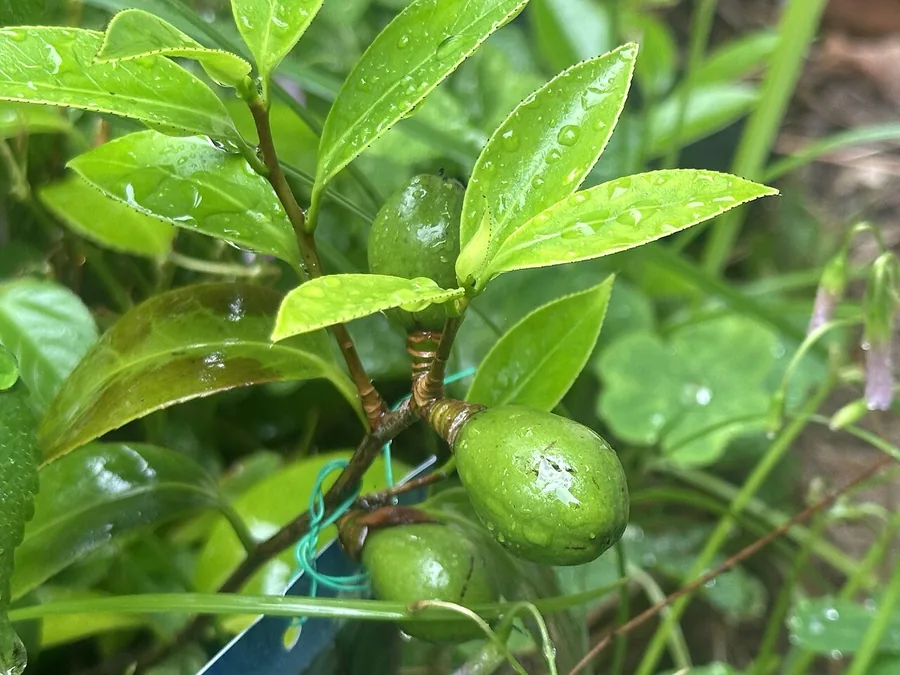
Close-up photo reference
Compare your tree against these to confirm the species and spot problems early.

Sources
- Care guide for the Camellia Bonsai tree — Bonsai Empire
- Camellia Bonsai Tree: The Ultimate Care Guide — Bonsai Haven
- Camellia Species Guide — Bonsai-En
- Camellia Bonsai Care Guide — Miyagi Bonsai
Where to buy a Camellia bonsai
We don’t stock Camellia at the moment. These species need similar care and we have them now — they are the closest match in our catalogue.
- Satsuki Azalea — similar care, in stock now
- Bottlebrush — similar care, in stock now
Browse all bonsai trees for sale or find a species matched to your climate and space.
- All species
- Shop bonsai trees, tools & supplies
- How to Water a Bonsai (Without Killing It)
- Bonsai Soil: What to Buy, What to Mix, and What It Costs
- Why Bonsai Die After Repotting: Diagnosing a Failed Repot
- Pruning vs. Pinching: Shaping Your Bonsai
- Overwintering Bonsai: Cold-Season Care
- Indoor Bonsai Light and Humidity: Making a Windowsill Actually Work
- Root Rot on bonsai
- Overwatering on bonsai
- Underwatering (Drought Stress) on bonsai
- Winter / Frost Damage on bonsai
- Leaf Scorch / Sunburn on bonsai
- Satsuki Azalea bonsai care
- Bottlebrush bonsai care
- Cork Oak bonsai care
- Cotoneaster bonsai care