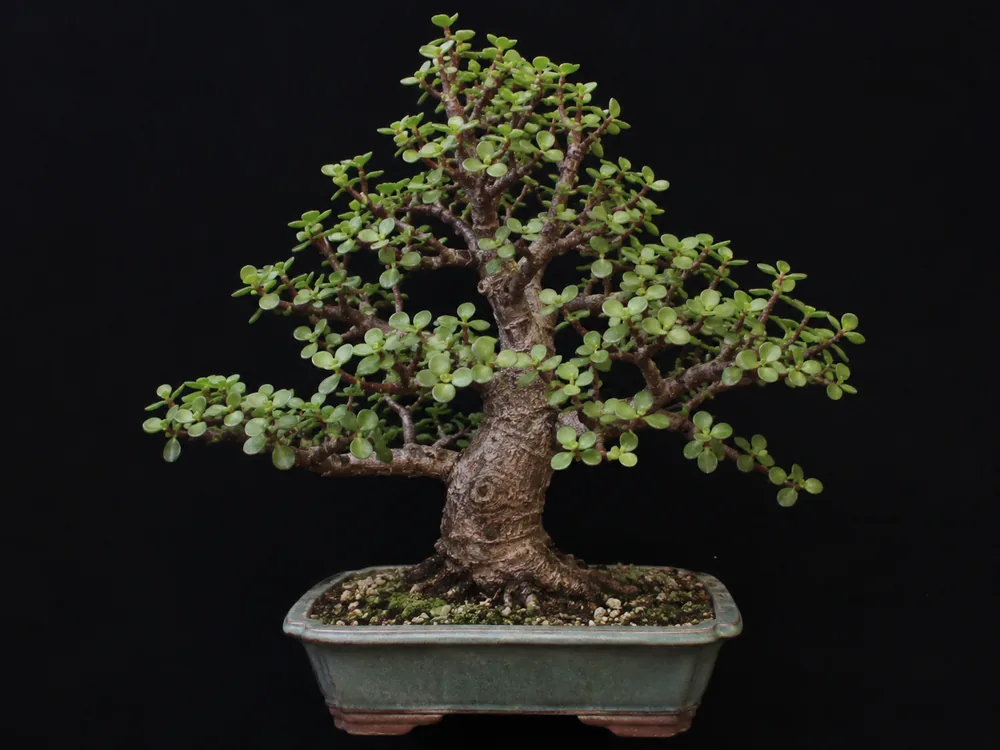
Dwarf Jade / Elephant Bush Bonsai Care
Portulacaria afra
19 Dwarf Jade / Elephant Bush bonsai in stock, from $22.95 Shipped direct from our nursery partners, with a 48-hour live-arrival guarantee. See the trees
Zones 9b to 11. The ideal beginner's bonsai and a favourite of experienced growers alike. Most are lost to overwatering.
Didiereaceae (formerly Portulacaceae) · Evergreen succulent shrub
Dwarf Jade / Elephant Bush quick reference
| USDA zones | 9b–11 (best around 10–11); no frost tolerance |
|---|---|
| Indoor / outdoor | One of the few genuinely good indoor bonsai; outdoors in warm months / frost-free climates |
| Light | Bright — full sun outdoors, brightest window (or grow light) indoors |
| Water | Dry — a succulent; let the soil dry out completely between waterings |
| Soil | Very gritty, fast-draining cactus/succulent mix (perlite, pumice, sand, grit) |
| Repot | Every 2–3 years, spring/summer; tolerates it easily |
| Frost | None — damaged below ~40 °F, killed by frost |
| Mature height (as bonsai) | Succulent to 3 m; kept 20-50 cm as bonsai |
| Growth rate | Moderate |
| Season of interest | Year-round evergreen, red-edged leaves |
| Leaf reduction | Good - small fleshy leaves |
| #1 cause of death | Overwatering → soft, mushy stems and root/stem rot |
Overview & Character
The Dwarf Jade is the ideal beginner's bonsai and a favourite of experienced growers alike. A South African succulent shrub, it has fleshy reddish-brown stems and small, round, glossy green leaves that reduce beautifully to bonsai scale. It stores water in its leaves and stems, which makes it extraordinarily tolerant of neglect and irregular watering — exactly the opposite problem from most bonsai, where forgetting to water is fatal.
It is fast-growing, back-buds readily, roots from cuttings with almost embarrassing ease, and tolerates aggressive styling, so it is wonderful for learning technique. It is often confused with true jade (Crassula ovata), but Portulacaria afra has smaller leaves, more flexible stems and a more refined branch structure, making it far better suited to bonsai. A popular variegated form ('Variegata') exists, though it grows more slowly and needs even more light.
The one rule that governs everything: this is a succulent that wants to dry out, and it rots with terrifying speed if treated like a conventional tree.
Identification
Foliage: Small, round-to-oval, fleshy succulent leaves, glossy bright green, smooth-edged, arranged oppositely along the stems. Leaves are thin-edged and noticeably smaller and flatter than true jade. The variegated form ('Variegata') has cream/yellow margins.
Bark & trunk / stems: Distinctive reddish-brown to maroon, fleshy, somewhat flexible stems when young, thickening and turning greyish-brown and more woody with age. The red-stemmed succulent look is a key tell.
Growth habit / form: Fast, freely branching shrub that back-buds along the stems; in the wild (spekboom) it forms broad, flat-topped "savanna" canopies, which bonsai styling often echoes.
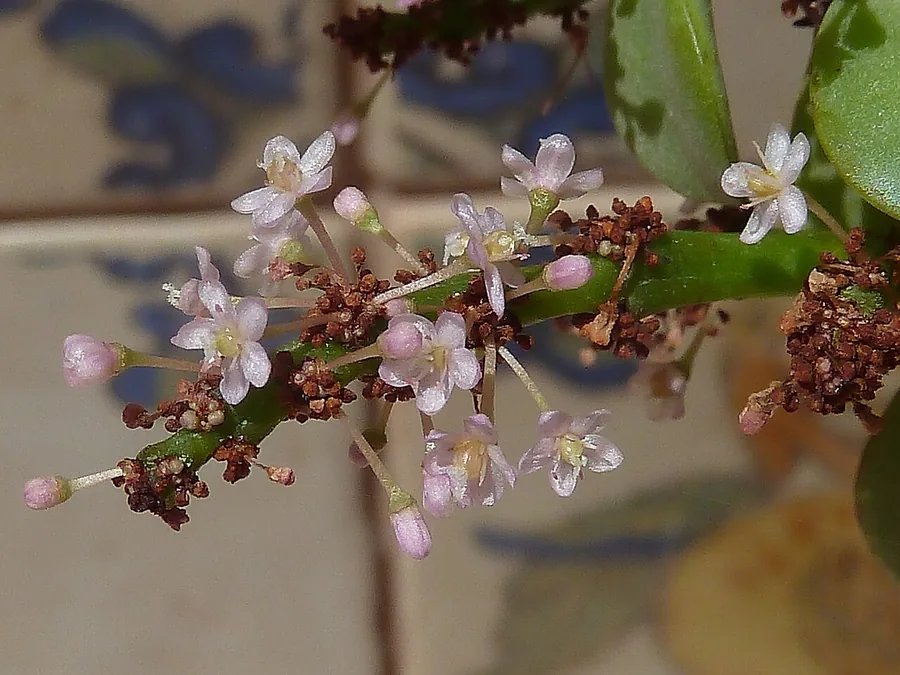
Flowers / fruit: Small, star-shaped pale pink flowers in clusters, only under good light and conditions; uncommon on indoor bonsai.
Look-alikes & how to tell them apart: Most often confused with **true jade (Crassula ovata)**. Tell them apart by: Portulacaria afra has smaller, flatter round leaves, distinctly red/maroon flexible stems, and more refined twiggy branching; Crassula ovata (true jade) has larger, thicker, more wedge-shaped leaves often red-edged, thicker green-to-grey trunks, and a coarser habit. Dwarf Jade is the far better bonsai subject precisely because of its smaller leaves and finer ramification.
Climate & USDA Zone
Portulacaria afra is hardy only in USDA zones 9b–11, growing best in the warmest end of that range (around 10–11). It has essentially no frost tolerance — tissue damage begins as temperatures approach 40 °F and frost will kill it outright. Average minimum tolerances run only down to roughly 25–30 °F for brief periods, and even that risks damage.
For almost everyone, this means growing it as an indoor bonsai (it is one of the few species that genuinely thrives indoors) and/or moving it outside only during reliably warm, frost-free weather. Bring it in well before night temperatures drop toward 40 °F. It enjoys heat and is unbothered by dry indoor air, which suits it to centrally heated homes.
Light
Give it as much light as you can. Outdoors it wants full sun; indoors it needs the brightest available window (south-facing) and benefits greatly from a supplemental grow light, especially in winter and especially for the variegated form. In good light the leaves stay small, the stems develop reddish colour and the plant is compact and sturdy. In poor light it stretches, the internodes lengthen, the foliage thins, and it grows soft and weak — and weak, etiolated growth is also more prone to rot.
Watering
Dry. This is the single most important fact about the species. Portulacaria afra is a succulent and must be watered by the soak-and-dry method: water thoroughly, then wait until the soil has dried out completely before watering again. It is far happier too dry than too wet.
In spring and autumn, water thoroughly and then let the topsoil — and ideally most of the pot — dry before the next watering. In winter, or whenever growth slows and light is low, water very sparingly; the plant can go a long time on its stored moisture. Although it is extremely drought-tolerant, it does grow faster and looks lusher with adequate water, so during active warm-season growth in strong light you can water somewhat more freely — but always letting it dry between waterings. When in doubt, do not water. Signs of overwatering are soft, mushy, translucent stems or leaves, leaf drop and general wilting/discolouration even though the soil is wet.
Soil & Root Care
Use a very free-draining, gritty mix — a cactus/succulent potting medium amended with extra perlite, pumice, coarse sand and/or fine grit, or a predominantly inorganic bonsai mix. The goal is a substrate that drains instantly and holds little water, so the roots are never sitting in moisture. Standard water-retentive bonsai or potting soil is a death sentence for this species.
The root system is small and adapts well to shallow bonsai pots. Repot every 2–3 years in spring or summer during active growth; it tolerates root work easily. If you ever find soft, rotten roots, cut away all affected tissue, let the cuts callous, and repot into dry, fresh, gritty soil — then withhold water for several days to a week before resuming sparingly.
Feeding
Feed lightly during the warm growing season. A diluted balanced fertiliser, or a succulent/cactus feed, applied every few weeks from spring through early autumn is plenty — this is not a hungry plant, and over-feeding produces soft, weak growth. Do not feed in winter or when the plant is resting in low light.
Pruning & Styling
The Dwarf Jade is exceptionally responsive to pruning. It back-buds freely along the stems and branches, so regular trimming builds dense, well-ramified structure quickly. Pinch and cut throughout the growing season; the plant heals fast and the prunings root readily as new plants. Because growth is rapid, frequent light trimming keeps the silhouette tight and the leaves small.
The stems are succulent and somewhat brittle, so wire with care and only on stems firm enough to take it — clip-and-grow is often the better development method here. Because the wood is soft and fleshy rather than truly woody, the species suits styles that work with its naturally informal, branching habit (informal upright, clump, bonsai-in-the-savanna "flat-top" styles that echo wild spekboom). It is also forgiving enough to experiment on freely.
Propagation & Cuttings
Ease: Very easy. Best method: cuttings.
Portulacaria afra roots from cuttings almost effortlessly — take a stem piece any time in the warm season, let the cut end callus for a day or two, then set it in barely-moist gritty mix; it roots in weeks with no hormone needed. Even fallen leaves can strike. Seed is rarely available. Keep cuttings warm and on the dry side to prevent rot. For bonsai this is the ideal beginner subject: cuttings build trunks and pads fast, and pruned material roots into new plants readily.
Pests
Dwarf Jade is largely trouble-free, but watch for:
- Mealybugs — white cottony clusters in leaf axils and on roots; the most common pest. Dab with alcohol, or treat with insecticidal soap / systemic.
- Spider mites — in hot, dry conditions; fine webbing and stippled leaves.
- Whitefly / aphids — occasionally on soft new growth.
Indoors, inspect regularly since pests can establish quietly. A weak, overwatered plant is more vulnerable, so good culture is again the best protection.
Disease, Fungus & Infection
The species has very few true diseases — its overwhelming health problem is rot caused by overwatering. Excess moisture leads to soft, mushy, translucent stems and leaves, root rot, and rapid collapse. There is no curing waterlogged, rotten tissue: the only remedy is to cut away all affected parts back to firm, healthy tissue, allow the cuts to callous, and repot into dry, gritty soil, withholding water until it recovers. Prevention is entirely about restraint with water and an aggressively free-draining mix. Beyond rot, fungal issues are rare and almost always secondary to overwatering or poor drainage.
Most Common Causes of Death
1. Root rot from overwatering. The dominant killer; a succulent — soak only when the soil is fully dry, and water much less in winter. 2. Frost. No frost tolerance (zones 10–11); keep above ~40°F (4°C), indoors over winter in cold climates. 3. Too little light. Needs bright light/sun; in low light it gets leggy and weak. 4. Soggy/organic soil. Use a gritty, fast-draining (succulent/cactus-style) mix. 5. Pests under stress. Mealybug and spider mites on weak plants — inspect and treat early.
Seasonal Calendar
- Spring: Repot if due; resume light feeding; prune to shape (it back-buds well).
- Summer: Bright light/sun (outdoors in warmth); soak-and-dry watering; fast growth.
- Autumn: Reduce water; bring indoors before cold.
- Winter: Bright indoors; water sparingly (near-dormant); keep above ~40°F.
Close-up photo reference
Compare your tree against these to confirm the species and spot problems early.

Sources
Buy a Dwarf Jade / Elephant Bush bonsai
- Medium Pre Baby Jade Bonsai, 5 Years Old (Portulacaria afra) — $22.95
- Small Baby Jade Bonsai, 4 Years Old (Portulacaria afra) — $28.95
- Small Baby Jade Bonsai, Land and Water Pot, 6 Years Old (Portulacaria afra) — $45.95
- Medium Baby Jade Bonsai, 5 Years Old (Portulacaria afra) — $49.95
- Medium Baby Jade Variegated Bonsai, 7 Years Old (Portulacaria afra 'Variegata') — $54.95
- Medium Baby Jade Bonsai, Land and Water Pot, 6 Years Old (Portulacaria afra) — $56.95
- Baby Jade Bonsai, Three Tree Group, 5 Years Old (Portulacaria afra) — $57.95
- Baby Jade Bonsai with Scalloped Edges, Land and Water Pot, 5 Years Old (Portulacaria afra) — $59.95
- All species
- Shop bonsai trees, tools & supplies
- How to Water a Bonsai (Without Killing It)
- Bonsai Soil: What to Buy, What to Mix, and What It Costs
- Why Bonsai Die After Repotting: Diagnosing a Failed Repot
- Pruning vs. Pinching: Shaping Your Bonsai
- Overwintering Bonsai: Cold-Season Care
- Indoor Bonsai Light and Humidity: Making a Windowsill Actually Work
- Root Rot on bonsai
- Overwatering on bonsai
- Underwatering (Drought Stress) on bonsai
- Winter / Frost Damage on bonsai
- Insufficient Light (Etiolation) on bonsai
- Chinese Elm bonsai care
- Clusia bonsai care
- Dwarf Umbrella Tree (Dwarf Schefflera) bonsai care
- Ficus bonsai care