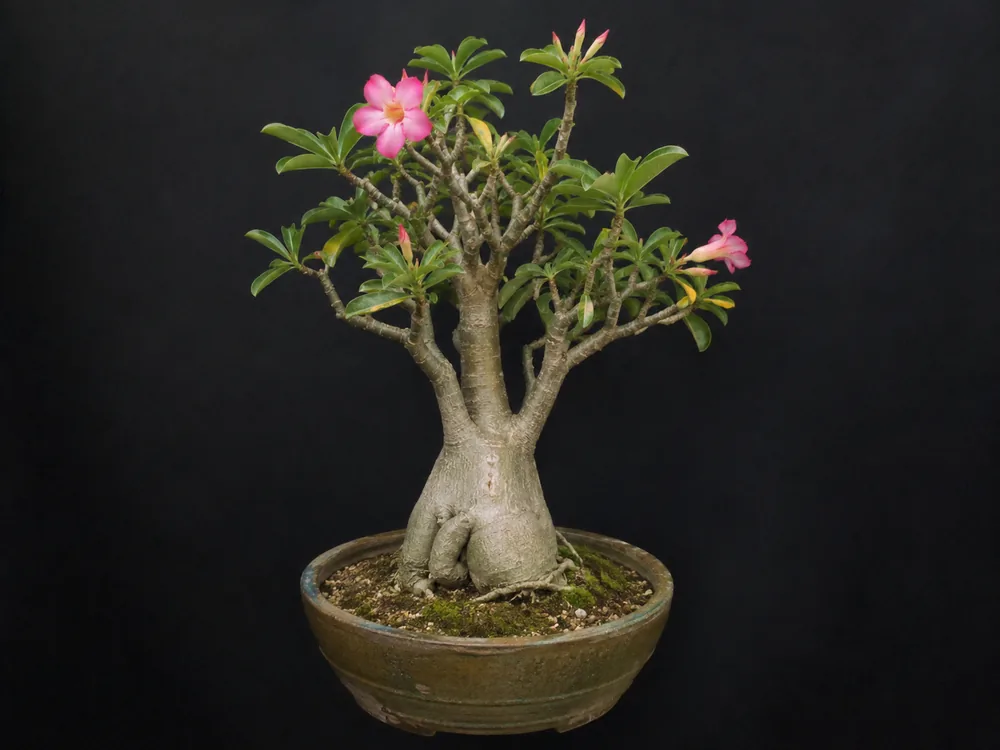
Desert Rose Bonsai Care
Adenium obesum
Zones 10b to 12, indoor or out. Grown for its dramatically swollen, sculptural caudex. Most are lost to overwatering.
Apocynaceae (dogbane family) · Succulent caudiciform shrub (deciduous in cool/dry spells)
Desert Rose quick reference
| USDA zones | 10b–12 (grow indoors / under glass in all cooler zones) |
|---|---|
| Indoor / outdoor | Indoor-capable — outdoors in summer warmth, indoors below ~50 °F |
| Light | Full sun, 6–8 hours — maximum light for flowers and a fat caudex |
| Water | Let the soil dry between waterings — a succulent that rots if kept wet |
| Soil | Very free-draining, gritty/cactus mix |
| Repot | Every 2–3 years, in warm weather |
| Frost | None — damaged below ~40 °F / 5 °C |
| Mature height (as bonsai) | Succulent to 3 m; kept 20-50 cm as bonsai |
| Growth rate | Slow |
| Season of interest | Pink summer flowers, swollen caudex |
| Leaf reduction | Limited - fleshy leaves |
| #1 cause of death | Root/caudex rot from overwatering or cold-wet soil |
Overview & Character
The Desert Rose is grown for its dramatically swollen, sculptural caudex (a bulbous, water-storing trunk-base) topped by glossy leaves and showy trumpet flowers in pink, red, white, and bicolors. It is technically a succulent rather than a true tree, but its naturally fat, gnarled base gives an instantly "old" bonsai look with very little time, making it a favorite for fast, characterful results.
It thrives on heat and sun and wants to be treated like a cactus: lots of light, sharp drainage, and a genuine dry-down between waterings. Its weaknesses are cold and wet — it has no frost tolerance and rots quickly in soggy soil. In all but frost-free climates it is grown as an indoor / patio bonsai, summered outdoors and brought in before nights turn cold.
Caution: the milky sap of Adenium is toxic if ingested; keep away from children and pets and wash hands after pruning.
Identification
Foliage: Spirally clustered, obovate (spoon-shaped) leaves at branch tips, glossy deep green, leathery, with a rounded or slightly notched tip and smooth margins. The plant often drops leaves in cool or dry rest periods.
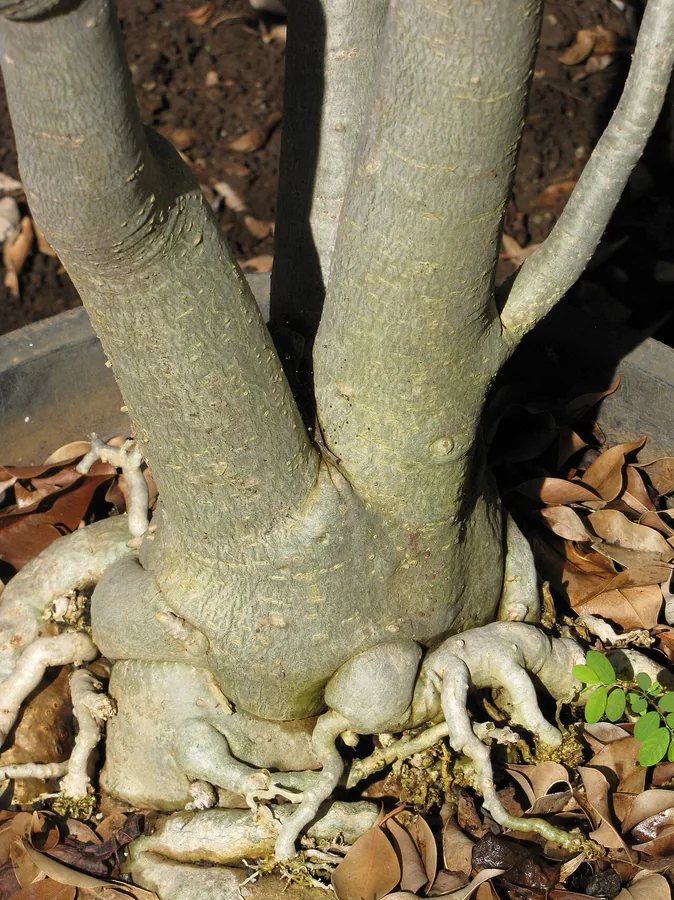
Bark & trunk: The signature feature — a smooth, pale grey-green to tan swollen caudex that bulges at the base and tapers into thick, fleshy, tapering branches. The whole plant has a soft, inflated, almost bottle-like form.
Growth habit / form: A slow, succulent shrub with a dominant fat base and few thick branches; lends itself to informal-upright and "baobab"-style fat-trunk bonsai.
Flowers / fruit: Showy five-petalled trumpet flowers ~5–6 cm across in pink, rose, crimson, and white, often with a darker throat; followed by paired, slender, horn-like seed pods that split to release silky-tufted seeds.
Look-alikes & how to tell them apart: The caudex plus trumpet flowers is distinctive; superficially the bloom resembles **oleander (Nerium) and plumeria**, both relatives, but neither develops the fat succulent caudex. The bottle-trunk habit is the quickest tell.
Climate & USDA Zone
Hardy outdoors only in USDA zones 10b–12 (frost-free, hot). Everywhere cooler it is grown as a container plant kept above ~50 °F / 10 °C, summered outside in full sun and overwintered indoors in bright warmth. It loves heat and tolerates drought; it cannot survive frost.
Light
As much direct sun as possible — 6–8 hours minimum. Full sun drives flowering and thickens the caudex. Indoors, give it the brightest south-facing window or supplement with grow lights; weak light produces lanky, soft, flowerless growth. In extreme desert heat (>95 °F) a little afternoon shade prevents leaf scorch, but in general more sun is better.
Watering
Water thoroughly, then let the soil dry out before watering again — treat it as a succulent.
- In active warm growth, water when the top inch of soil is dry (often roughly every 5–10 days), soaking until it drains.
- Reduce sharply in cool weather and during the dormant/leafless rest — nearly dry, just enough to keep the caudex from shrivelling.
- Never let it sit wet or cold-and-wet; standing moisture rots the caudex and roots fast.
- Excellent drainage is essential year-round.
Soil & Root Care
Soil: A very gritty, free-draining succulent/cactus mix — e.g. pumice/lava with a little akadama or quality cactus soil and coarse sand. Sharp drainage is non-negotiable.
Repotting:
- Frequency: every 2–3 years, always in warm weather when the plant is in active growth.
- Many growers lift the plant slightly at repotting to expose more of the swollen caudex/roots over time, enhancing the fat-base character.
- Let cut roots callus and keep the mix on the dry side after repotting to avoid rot; resume normal watering once recovered.
Feeding
Feed during the warm growing season with a balanced or slightly higher-phosphorus fertilizer (diluted) roughly every 2–4 weeks to support growth and flowering. Stop feeding in the cool/dormant rest period. Do not feed a stressed, freshly repotted, or leafless plant.
Pruning & Styling
- Pruning: Prune in warm weather; cuts bleed toxic latex, so let wounds dry and keep them dry to prevent rot. Pruning branch tips encourages branching and a fuller crown.
- Caudex development: the fat base thickens with age, sun, and good feeding; some growers raise the plant at each repot to display more caudex and surface roots.
- Wiring: the fleshy branches are brittle and mark easily — wire gently and briefly, or shape mainly by directional pruning.
- Suits informal-upright, fat-trunk/"baobab", and flowering styles.
Propagation & Cuttings
Ease: Easy from seed and cuttings (caudex only from seed). Best methods: seed (for fat caudex); cuttings.
Adenium obesum grows fast from fresh seed sown warm (28–35 °C) — germination is quick, and only seed-grown plants form the swollen bottle caudex that makes this species a bonsai favourite. Cuttings root easily in warm, dry-ish conditions with hormone but rarely develop a fat base (they root from the stem). Grafting is used to combine choice flowers on strong caudex stock. Keep everything warm and on the dry side to avoid rot; for bonsai caudex, always start from seed.
Pests
- Aphids and mealybugs (on new growth and flower buds)
- Spider mites (hot, dry indoor air)
- Scale insects
Treat with insecticidal soap, horticultural oil, or appropriate systemics; inspect leaf undersides and the caudex crevices regularly.
Disease, Fungus & Infection
- **Root and caudex rot (Phytophthora / Pythium and soft rots)** — the principal killer, caused by overwatering, poor drainage, or cold-wet soil. A soft, mushy, or discolored caudex signals rot; reduce watering, improve drainage, and cut away rotted tissue back to firm growth, letting it dry.
- Fungal leaf spot — in cool, damp, low-airflow conditions; cosmetic, improve airflow.
Prevention is almost entirely cultural: full sun, gritty fast-draining soil, dry-down between waterings, and warmth.
Most Common Causes of Death
1. Root / caudex rot from overwatering or cold-wet soil. The top killer; water like a succulent and keep it warm and sharply drained. 2. Frost / cold damage. No frost tolerance — protect below ~40 °F / 5 °C. 3. Too little light. Weak, soft, rot-prone growth and no flowers in low light. 4. Wet feet in winter dormancy. Keep nearly dry and warm during the cool rest. 5. Sudden hard pruning of a weak plant + wet wounds. Prune in warmth, keep cuts dry.
Seasonal Calendar
- Spring: As warmth returns, resume watering and feeding; repot if due; growth and flowering begin.
- Summer: Full sun outdoors; water on a wet/dry cycle; feed; peak bloom; prune to shape.
- Autumn: Taper water and feeding; bring indoors before nights drop below ~50 °F.
- Winter: Bright, warm rest; water sparingly (caudex firm, not shrivelled); no feeding; may drop leaves.
Close-up photo reference
Compare your tree against these to confirm the species and spot problems early.
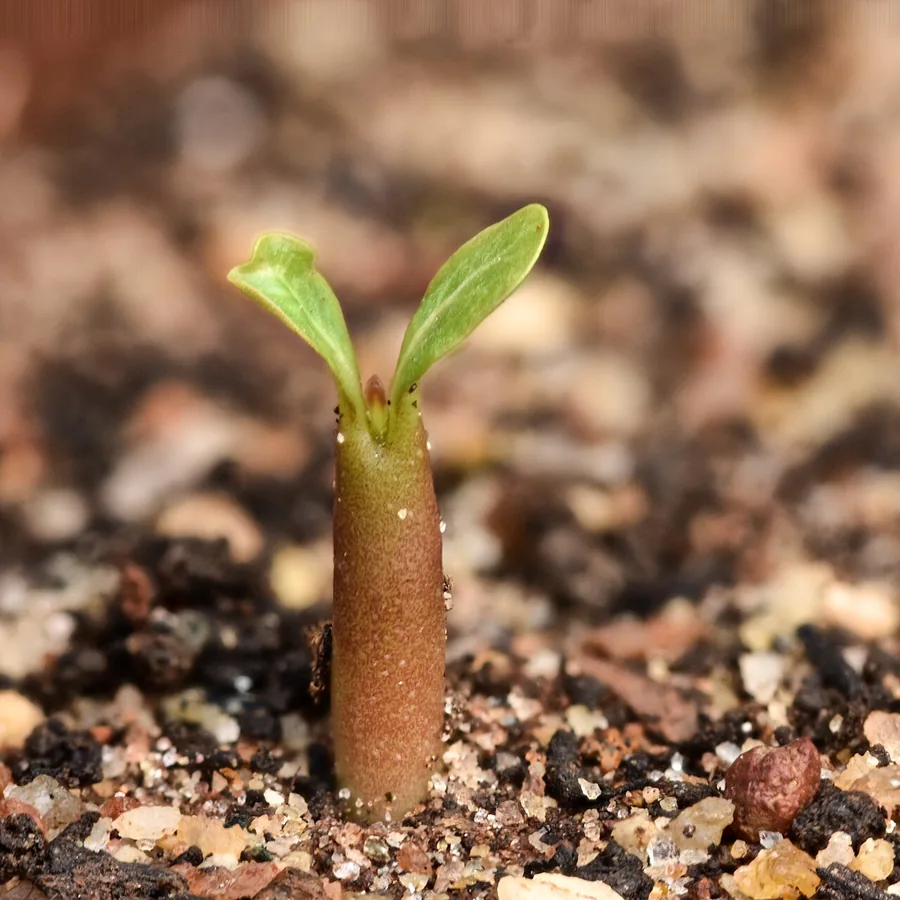
![This Photo was taken by Timothy A. Gonsalves. Feel free to use my photos, but please mention me as the author. I would much appreciate if you send me an email [email protected] or write on my talk page, for my information. Please contact me before commercial use. Please do not upload an edited image here without consulting me. I would like to make corrections only at my own source to ensure that the changes improve the image and are preserved.Otherwise you may upload an edited image with a new name. Please use one of the templates derivative or extract.](https://commons.wikimedia.org/wiki/File:Adenium_seedling_leaves_3day_Uthandi_Aug21_D72_20758-72_ZP.jpg)
.jpg)
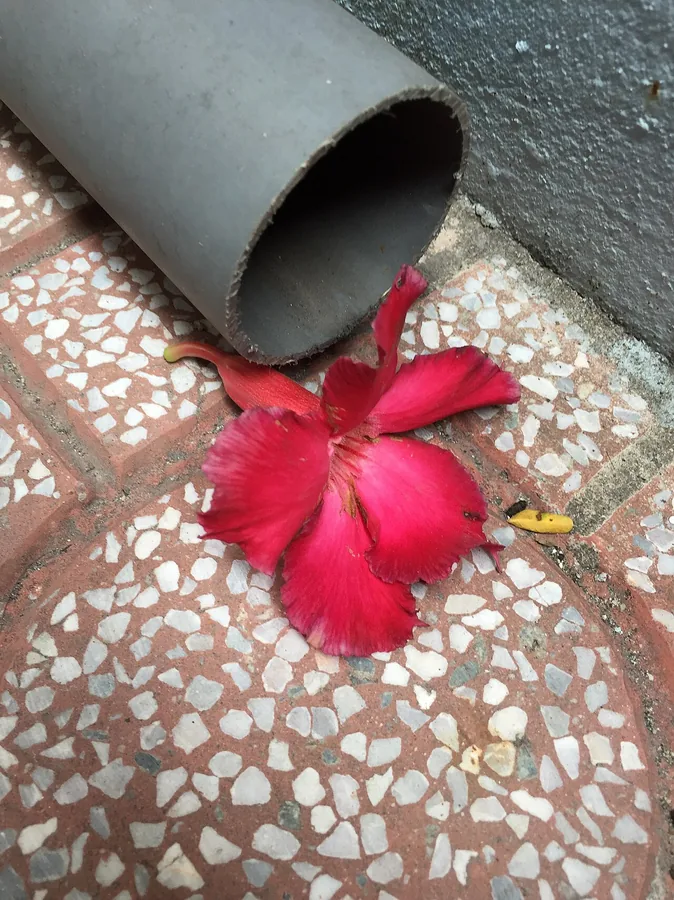

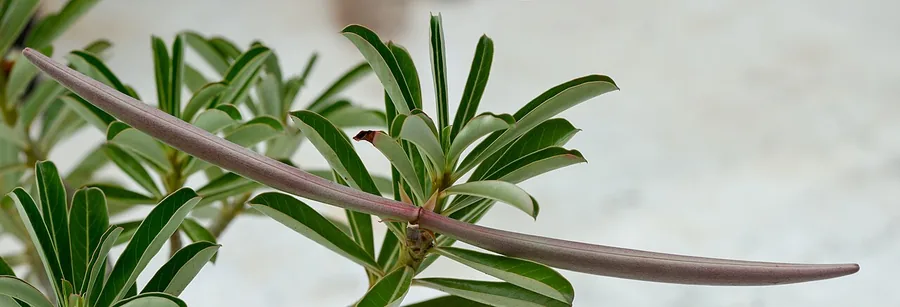
![This Photo was taken by Timothy A. Gonsalves. Feel free to use my photos, but please mention me as the author. I would much appreciate if you send me an email [email protected] or write on my talk page, for my information. Please contact me before commercial use. Please do not upload an edited image here without consulting me. I would like to make corrections only at my own source to ensure that the changes improve the image and are preserved.Otherwise you may upload an edited image with a new name. Please use one of the templates derivative or extract.](https://commons.wikimedia.org/wiki/File:Adenium_Fruit_15%2B16cm_Panorama_Chennai_Jun21_D72_20060%2B63_Pano.jpg)
Sources
Where to buy a Desert Rose bonsai
We don’t stock Desert Rose at the moment. These species need similar care and we have them now — they are the closest match in our catalogue.
- Vietnamese Blue Bell — similar care, in stock now
- Chinese Elm — similar care, in stock now
Browse all bonsai trees for sale or find a species matched to your climate and space.
- All species
- Shop bonsai trees, tools & supplies
- How to Water a Bonsai (Without Killing It)
- Bonsai Soil: What to Buy, What to Mix, and What It Costs
- Why Bonsai Die After Repotting: Diagnosing a Failed Repot
- Pruning vs. Pinching: Shaping Your Bonsai
- Overwintering Bonsai: Cold-Season Care
- Indoor Bonsai Light and Humidity: Making a Windowsill Actually Work
- Root Rot on bonsai
- Overwatering on bonsai
- Underwatering (Drought Stress) on bonsai
- Winter / Frost Damage on bonsai
- Leaf Scorch / Sunburn on bonsai
- Vietnamese Blue Bell bonsai care
- Chinese Elm bonsai care
- Chinese Privet bonsai care
- Chinese Wisteria bonsai care