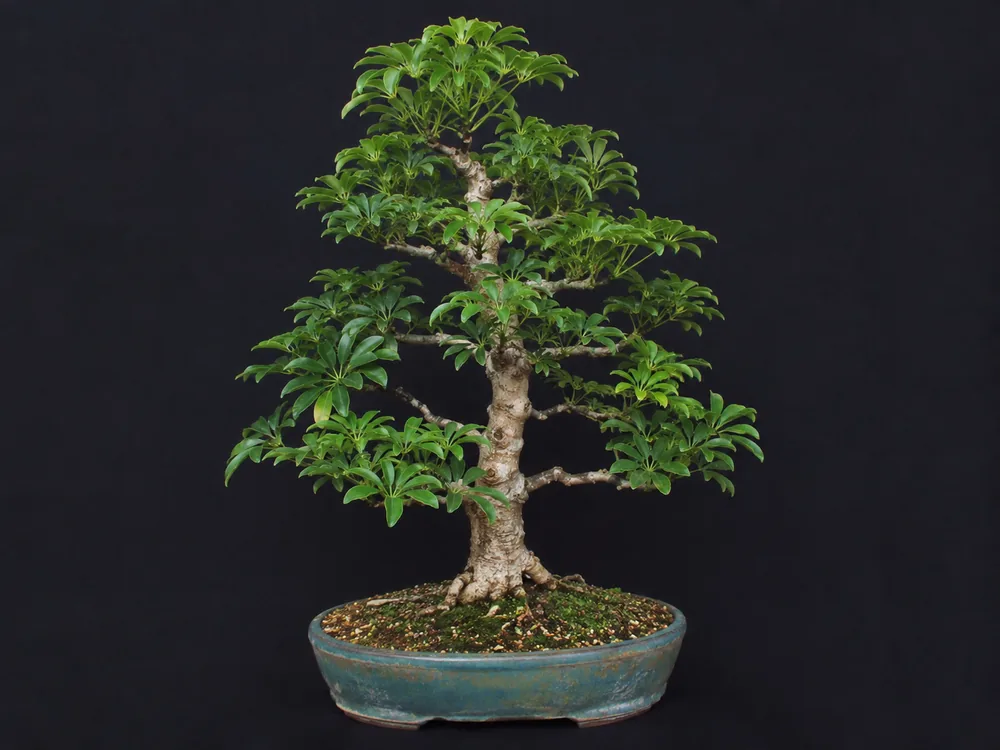
Dwarf Umbrella Tree (Dwarf Schefflera) Bonsai Care
Schefflera arboricola
15 Dwarf Umbrella Tree (Dwarf Schefflera) bonsai in stock, from $14.95 Shipped direct from our nursery partners, with a 48-hour live-arrival guarantee. See the trees
Zones 10 to 11, indoor. The single most forgiving tree in the indoor bonsai world. Most are lost to overwatering.
Araliaceae · Tropical/subtropical broadleaf evergreen — indoor bonsai in cold climates
Dwarf Umbrella Tree (Dwarf Schefflera) quick reference
| USDA zones | 10–11 outdoors year-round; treat as indoor elsewhere (tolerates brief 9b dips but no frost) |
|---|---|
| Indoor / outdoor | Indoor in any climate with frost; outdoors only in zones 10–11 or in summer warmth |
| Light | Very adaptable — bright indirect to direct light preferred, but tolerates low light better than almost any bonsai |
| Water | Moderate — let the top 1–2 inches dry between waterings. Leans dry rather than wet; overwatering is the killer. |
| Soil | Free-draining bonsai mix (e.g. akadama/pumice/lava, or a peat-free inorganic blend); never waterlogged |
| Repot | Every 2–3 years (young trees can go 1–2 years); roots are vigorous |
| Frost | None — damage begins below ~50°F (10°C); keep above 55°F (13°C) to be safe |
| Mature height (as bonsai) | Tree to 8 m; kept 25-60 cm as bonsai |
| Growth rate | Fast |
| Season of interest | Year-round evergreen, aerial roots |
| Leaf reduction | Good in bright light |
| #1 cause of death | Root rot from overwatering / poor drainage (compounded by cold, wet roots) |
Overview & Character
The Dwarf Schefflera is the single most forgiving tree in the indoor bonsai world. It thrives in conditions that would kill most species — low light, dry indoor air, irregular watering, and beginner mistakes — and bounces back from neglect with remarkable resilience. This toughness, combined with fast growth and a natural tendency to produce aerial roots, makes it the classic "first bonsai," especially for offices and dim rooms.
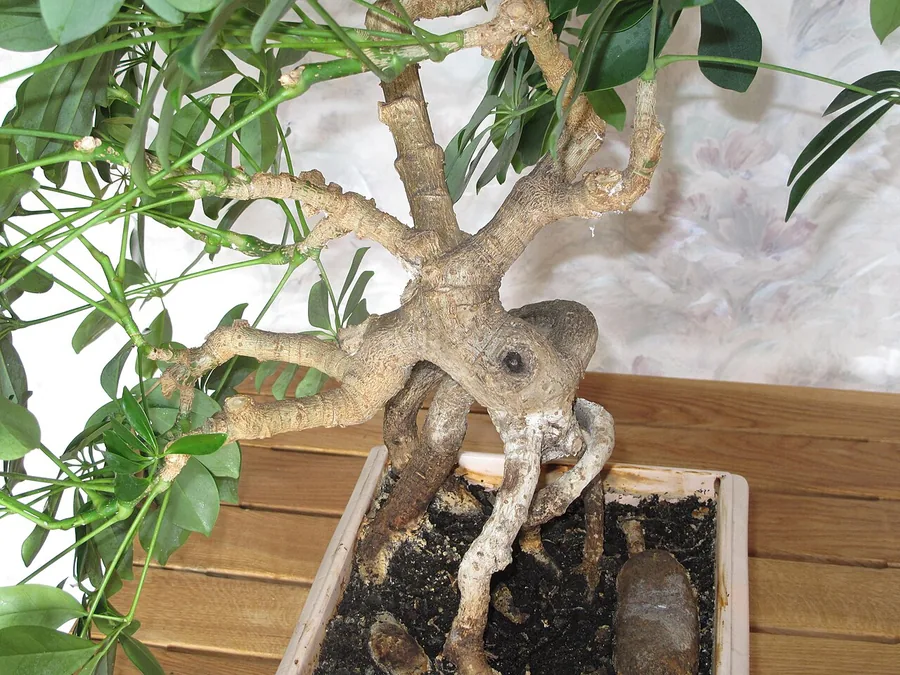
Its signature bonsai form is the banyan style: a multi-trunk, aerial-rooted canopy that mimics a tropical strangler fig draped over rock or a slab. In high humidity it sends down aerial roots that thicken into pillar-like supporting trunks, producing dramatic forest-on-a-rock plantings unlike anything else available indoors.
The trade-off: Schefflera wood is soft, brittle, and grows so fast that wiring rarely holds shape — branches thicken past the wire, scar easily, and often snap. It is therefore styled almost entirely by pruning (clip-and-grow), not by wiring. Accept that and it is a joy; fight it with wire and you will be frustrated.
Identification
FOLIAGE: Palmately compound leaves arranged like the ribs of an umbrella — typically 7–9 small, glossy, oval leaflets radiating from a single point at the end of a petiole. Leaflets are deep green, smooth-edged, and leathery; variegated cultivars (cream/yellow margins) exist. Leaves reduce well with pruning and good light.
BARK & TRUNK: Smooth, thin, greenish-grey to light brown bark, staying relatively smooth even with age (does not develop heavy plates). Trunks are soft and fleshy when young, firming with maturity. Often grown as multi-trunk clumps or banyan groups.
GROWTH HABIT/FORM: Upright, fast, and bushy with a strong apical drive; readily produces aerial roots in humid conditions that descend and fuse into the substrate. Naturally suits banyan, root-over-rock, clump, and informal upright styles.
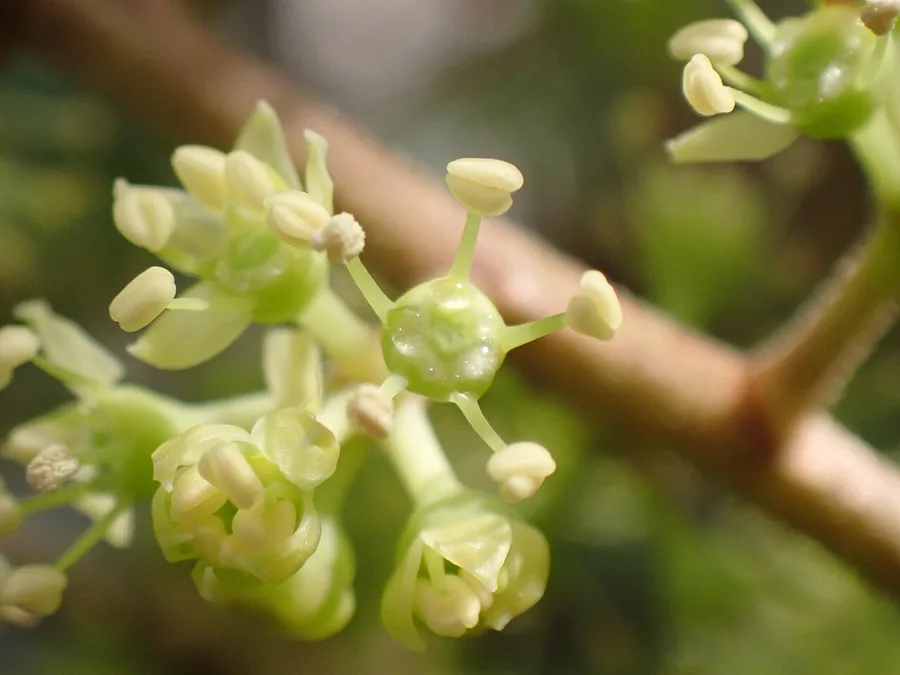
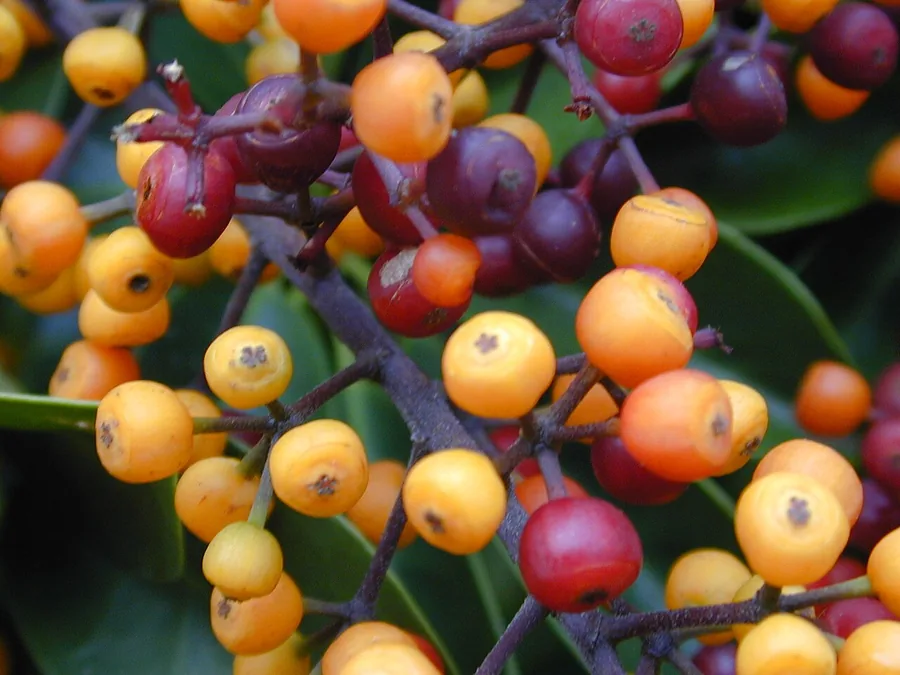
FLOWERS/FRUIT: Mature specimens (uncommon as small bonsai) produce small reddish flower spikes ("octopus" inflorescences) followed by orange-to-dark berries — rarely seen indoors.
Look-alikes & how to tell them apart: Distinguished from the larger common umbrella tree (Schefflera actinophylla) by its much smaller leaflets and bushier dwarf habit. The umbrella-spoke arrangement of multiple leaflets from one point separates it instantly from ficus species (single simple leaves) and from Money Tree (Pachira aquatica), which also has palmate leaves but with larger, fewer, lance-shaped leaflets and a thicker, often-braided trunk.
Climate & USDA Zone
Hardy outdoors only in USDA zones 10–11, where it can live outside all year. It tolerates brief dips toward zone 9b but suffers cold damage below about 50°F (10°C) and will not survive frost. In every cooler climate it is grown as an indoor bonsai, optionally summered outdoors once nights stay reliably above 55°F (13°C). Bring it back inside well before autumn cold arrives.
Light
One of its great strengths: it accepts a huge light range. It is happiest in bright indirect light or a few hours of direct sun (which keeps internodes short and leaves small), but it will genuinely survive and stay green in low-light spots where other bonsai decline — the reason it dominates office plantings. In dim conditions expect leggier growth and larger leaves; supplement with a grow light if you want compact ramification. Rotate the tree periodically for even growth.
Watering
Leans dry. Water thoroughly when the top 1–2 inches (2–5 cm) of soil feel dry, then let it drain freely — typically every 7–10 days in spring/summer and every 10–14 days in fall/winter, but always check the soil rather than following a calendar. Schefflera tolerates the occasional missed watering far better than it tolerates soggy roots. Do not let it sit in water or in constantly wet soil — root rot can set in within 7–10 days in poorly draining mix. Higher ambient humidity encourages the prized aerial roots; misting or a humidity tray helps but is not essential to survival.
Soil & Root Care
Use a free-draining bonsai substrate — an inorganic blend (akadama, pumice, lava rock) or a quality commercial bonsai mix. Avoid dense, water-retentive potting soil, which is the root cause of most Schefflera deaths. Roots are vigorous and fill a pot quickly. Repot every 2–3 years (annually for young, fast-growing stock), pruning back the root mass and refreshing the soil. Spring to early summer, during active growth, is the safest repotting window for a tropical.
Feeding
Feed regularly during the growing season — a balanced liquid fertilizer every 2 weeks, or a slow-release organic pellet, from spring through early autumn. Because it grows year-round indoors under good light, you can continue light feeding (roughly monthly) through winter; reduce or stop if growth visibly slows in a cool or dim location. Do not over-fertilize newly repotted trees.
Pruning & Styling
This species is styled by pruning, not wiring. Its brittle, fast-thickening wood does not hold wire well and scars or snaps easily — clip-and-grow is the proven method.
- Pruning: Cut back new shoots to 2–3 leaves once they have extended; the tree backbuds readily on old wood, so hard pruning is well tolerated and encourages ramification.
- Leaf reduction: Defoliation (removing leaves to force smaller regrowth) works on healthy specimens to reduce leaf size and build density.
- Aerial roots: To create the banyan look, raise humidity (a tall clear cover or tented bag) so the trunk sends down aerial roots; guide them into the soil where you want supporting columns. This is the species' standout artistic feature.
- Wiring: Generally avoid. If you must position a young, flexible shoot, do so briefly and watch closely for wire bite. Directional pruning is the better tool.
Propagation & Cuttings
Ease: Easy. Best methods: cuttings; air-layering.
Schefflera arboricola roots readily from stem and tip cuttings in warm, humid conditions with light hormone; even aerial-rooting stems establish easily. Air-layering is very reliable and, crucially, the way to build the banyan/aerial-root style this species is famous for in bonsai — layer a thick section and encourage roots down into the pot. Seed is seldom used. Keep all propagation warm (tropical). For bonsai, cuttings and layers develop fast, and the plant tolerates heavy cutting-back and root work.
Pests
Generally pest-resistant, but indoor, dry-air conditions can invite:
- Spider mites — fine webbing and stippled, dull leaves, especially in dry winter air; rinse foliage, raise humidity, treat with insecticidal soap or neem.
- Aphids — clustered on soft new growth; sticky honeydew.
- Scale insects — brown bumps on stems and leaf undersides; sticky residue.
- Mealybugs — white cottony masses in leaf axils.
Treat with neem oil or insecticidal soap every 7–10 days until clear, and isolate affected plants.
Disease, Fungus & Infection
The dominant problem is root rot from overwatering or poor drainage — soft, mushy, foul-smelling roots and sudden leaf drop. Treat by unpotting, cutting away all rotted roots, and repotting into fresh free-draining soil with corrected watering. Sooty mold may grow on the honeydew left by sap-sucking pests; control the pests and the mold clears. Sudden mass leaf drop is usually a stress response to overwatering, a cold draft, or a big move/light change rather than true disease — correct the cause and it typically re-leafs.
Most Common Causes of Death
1. Overwatering / root rot — the number one killer. Prevention: use free-draining soil, let the top 1–2 inches dry between waterings, and never let the pot sit in water. 2. Cold exposure / frost — fatal below ~50°F (10°C). Prevention: keep above 55°F (13°C); bring indoors before autumn cold and away from cold window glass and drafts. 3. Poor drainage substrate — dense potting soil holds water and rots roots even with "correct" watering. Prevention: repot into a proper inorganic bonsai mix. 4. Chronic underwatering / drought — tougher than most, but prolonged bone-dry soil still kills, with crisping leaf drop. Prevention: check soil regularly; don't let it fully desiccate. 5. Severe low light over the long term — survives dimness but slowly declines into weak, sparse growth that becomes vulnerable. Prevention: give bright indirect light or supplement with a grow light. 6. Pest infestation left unchecked — spider mites in dry indoor air can quietly defoliate a tree. Prevention: inspect regularly, raise humidity, treat early. 7. Cold drafts / heat-vent placement — sudden temperature swings trigger collapse. Prevention: keep away from doors, AC, and heating vents.
Seasonal Calendar
- Spring (Mar–May): Prime growth resumes. Repot now if due. Resume full feeding. Begin structural pruning. Move outdoors once nights stay above 55°F (13°C).
- Summer (Jun–Aug): Strongest growth — water more often, feed regularly, prune and pinch to build ramification. Raise humidity if developing aerial roots.
- Autumn (Sep–Nov): Bring indoors well before first cold nights. Reduce watering frequency. Taper feeding.
- Winter (Dec–Feb): Keep warm (above 55°F/13°C) and as bright as possible; supplement with a grow light. Water sparingly — only when the topsoil dries. Watch for spider mites in dry heated air.
Close-up photo reference
Compare your tree against these to confirm the species and spot problems early.


.jpg)
Sources
- Bonsai Empire — Hawaiian Umbrella (Schefflera arboricola) care guide
- Bonsai Mirai — Hawaiian Umbrella Bonsai Guide
- Bonsai Mary — Dwarf Umbrella Tree Bonsai (Schefflera arboricola)
- Tree Care Zone — Schefflera Bonsai Tree care tips
Buy a Dwarf Umbrella Tree (Dwarf Schefflera) bonsai
- Small Pre Hawaiian Umbrella Bonsai, 3 Years Old (Arboricola schefflera 'Luseanne') — $14.95
- Small Hawaiian Umbrella Bonsai, 3 Years Old (Arboricola schefflera 'Luseanne') — $28.95
- Hawaiian Umbrella Bonsai, Multi Trunk, 4 Years Old (Arboricola schefflera) — $29.95
- Small Golden Hawaiian Umbrella Bonsai, 5 Years Old (Arboricola schefflera 'Luseanne') — $34.95
- Small Hawaiian Umbrella Bonsai, Land and Water Pot, 6 Years Old (Arboricola schefflera 'Luseanne') — $45.95
- Medium Hawaiian Umbrella Bonsai, Land and Water Pot, 8 Years Old (Arboricola schefflera 'Luseanne') — $54.95
- Medium Hawaiian Umbrella Bonsai, 8 Years Old (Arboricola schefflera 'Luseanne') — $56.95
- Medium Hawaiian Umbrella Bonsai, Coiled Trunk, 8 Years Old (Arboricola schefflera 'Luseanne') — $59.95
See all 15 Dwarf Umbrella Tree (Dwarf Schefflera) bonsai trees for sale
- All species
- Shop bonsai trees, tools & supplies
- How to Water a Bonsai (Without Killing It)
- Bonsai Soil: What to Buy, What to Mix, and What It Costs
- Why Bonsai Die After Repotting: Diagnosing a Failed Repot
- Pruning vs. Pinching: Shaping Your Bonsai
- Overwintering Bonsai: Cold-Season Care
- Indoor Bonsai Light and Humidity: Making a Windowsill Actually Work
- Root Rot on bonsai
- Overwatering on bonsai
- Underwatering (Drought Stress) on bonsai
- Winter / Frost Damage on bonsai
- Insufficient Light (Etiolation) on bonsai
- Fukien Tea bonsai care
- Sea Grape bonsai care
- Weeping Fig bonsai care
- Bahama Berry bonsai care