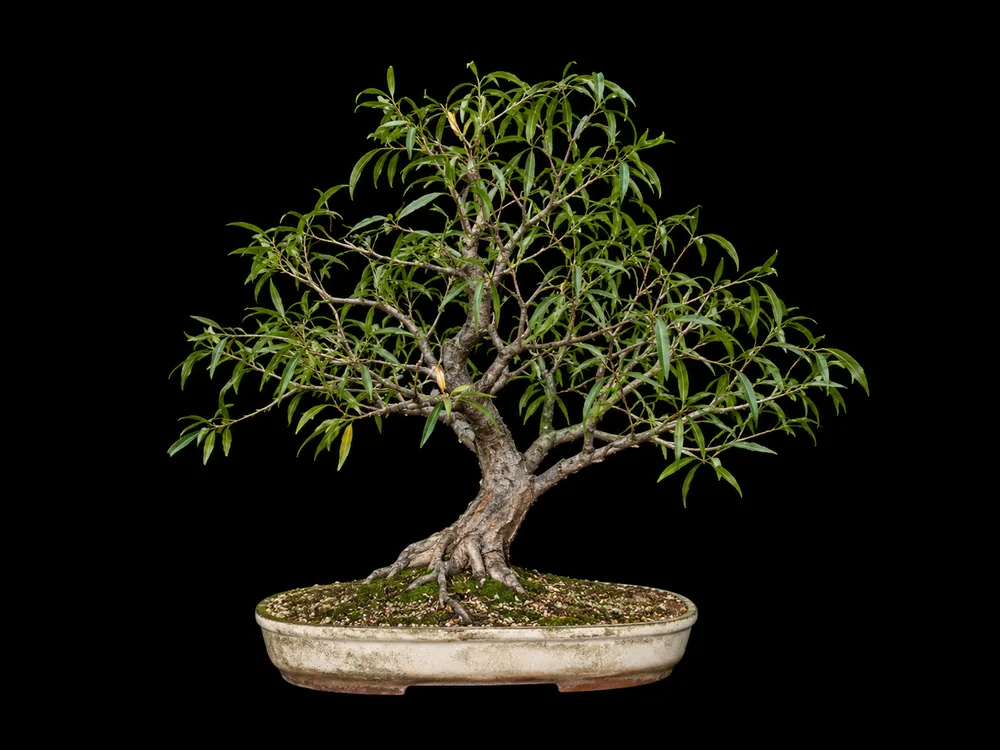
Willow Leaf Ficus Bonsai Care
Ficus salicaria
2 Willow Leaf Ficus bonsai in stock, from $34.95 Shipped direct from our nursery partners, with a 48-hour live-arrival guarantee. See the trees
Zones 10a to 12b, indoor. Among the most popular and most forgiving of all bonsai. Most are lost to overwatering.
Moraceae · Tropical broadleaf evergreen fig — excellent indoor bonsai in cold climates
Willow Leaf Ficus quick reference
| USDA zones | 10a–12b outdoors year-round; indoor bonsai in any cooler climate |
|---|---|
| Indoor / outdoor | Indoor in cold climates; outdoors in zones 10+ or summered outside in warmth |
| Light | Bright light — as much as possible; tolerates lower light better than many figs |
| Water | Moderate to moist — like most figs, water generously when the surface just dries; never let it bone-dry, but it also forgives occasional over/under-watering. |
| Soil | Free-draining bonsai mix; figs dislike constantly soggy roots |
| Repot | Every 2–3 years (young trees more often); very tolerant of root work |
| Frost | None — keep above ~50–55°F (10–13°C); no frost |
| Mature height (as bonsai) | Tree to 12m in nature; bonsai usually 25-60cm. |
| Growth rate | Fast (tropical, aerial roots). |
| Season of interest | Year-round cascading narrow leaves; aerial roots. |
| Leaf reduction | Good; slender leaves reduce well with trimming. |
| #1 cause of death | Overwatering / root rot (figs are sensitive to constantly wet soil) |
Overview & Character
The Willow Leaf Ficus is among the most popular and most forgiving of all bonsai, beloved for combining tropical-fig toughness with an unusually elegant, refined foliage. Its long, narrow, willow-like leaves and naturally graceful arching branches give it a delicacy that the heavier-leaved ficus species (like F. retusa) cannot match, while keeping all the legendary durability of the genus. It backbuds aggressively, ramifies into fine twiggy structure, heals wounds fast, and shrugs off mistakes — making it ideal for beginners yet refined enough for advanced artists.
Like all figs it exudes a milky white latex sap from any cut or wound (this seals wounds quickly but can irritate skin and stain). It also readily produces aerial roots in humid conditions, which can be developed into dramatic banyan and root-over-rock styles — a hallmark feature of the species in display-quality trees.
It is an indoor tree in any climate that frosts, and one of the few species that genuinely thrives long-term indoors given decent light. Its main vulnerability is the same as its relatives: it does not like to sit in cold, soggy soil.
Identification
FOLIAGE: Simple, alternate, long and narrow lance-shaped (willow-like) leaves, 2–4 inches long, glossy mid-to-deep green, with a tapering pointed tip — distinctly slender compared with the rounded leaves of most ficus. New growth often emerges with a reddish or bronze cast. Reduces well with pruning.
BARK & TRUNK: Smooth, pale grey bark, often with lighter mottling/lenticels; trunks fatten quickly and develop convincing age and movement. Old specimens form buttressing surface roots and fused aerial-root pillars.
GROWTH HABIT/FORM: Vigorous, upright-to-arching, fast-growing, readily backbudding even on old wood. Produces aerial roots in humidity. Suits formal/informal upright, banyan, root-over-rock, and group plantings.
FLOWERS/FRUIT: Like all figs, the flowers are enclosed in tiny figs (syconia) — small green-to-reddish fruit; rarely a feature on indoor bonsai.
Look-alikes & how to tell them apart: The narrow, willow-like leaf is the giveaway versus other common ficus bonsai (F. retusa, F. microcarpa, "Ginseng" ficus), which all have shorter, broader, oval/rounded leaves. The milky latex sap from any cut confirms it is a Ficus and separates it from look-alike narrow-leaved non-figs (e.g. true willows, oleander), none of which bleed white latex.
Climate & USDA Zone
Hardy outdoors only in USDA zones 10a–12b, where it can live outside all year. Everywhere colder it is grown as an indoor bonsai, optionally summered outside once nights stay reliably above about 55°F (13°C). It is frost-tender — keep it above 50–55°F (10–13°C) and protect from cold drafts and cold window glass. It also dislikes sudden environmental changes (a big shift in light, temperature, or humidity can trigger leaf drop), so move it gradually between indoor and outdoor positions.
Light
Give it as much bright light as you can. It is happiest in bright, sunny conditions (some direct sun keeps leaves small and internodes tight) but, like the genus generally, it tolerates moderate indoor light better than most bonsai — one reason it succeeds as a houseplant bonsai. In dim light expect larger leaves and leggier growth; supplement with a grow light for compact ramification. High humidity strongly encourages the aerial roots that make this species distinctive.
Watering
Leans moist but well-drained. Water generously whenever the soil surface just begins to dry — never let the root ball dry out completely, as figs respond to drought stress with leaf drop. At the same time, Ficus is sensitive to constantly wet, airless soil, so the pot must drain freely between waterings. In practice: keep it evenly moist, water thoroughly each time, and let the top layer dry slightly before the next watering. It is forgiving of the occasional over- or under-watering, which is part of its beginner-friendliness — but chronic overwatering in poor-draining soil is the leading cause of death. Room-temperature, soft water is ideal. Higher humidity (misting, trays) keeps foliage lush and promotes aerial roots.
Soil & Root Care
Use a free-draining bonsai substrate (inorganic mixes such as akadama/pumice/lava, or a quality commercial bonsai mix). Avoid dense, water-retentive potting soil. The Willow Leaf Ficus is very tolerant of root work — repot every 2–3 years (annually for young, fast-growing stock), pruning back roots hard and refreshing soil. Spring to early summer, in active growth and warmth, is the ideal repotting window. Strong, vigorous roots support its fast top growth, so don't be timid with routine root pruning on a healthy tree.
Feeding
Feed regularly during active growth — balanced liquid fertilizer roughly every 2 weeks, or a slow-release organic feed, from spring through autumn. Because it grows year-round indoors under good light, light feeding (about monthly) can continue through winter; reduce if growth slows in a cool or dim spot. Don't fertilize immediately after repotting; wait until new growth appears.
Pruning & Styling
Fast growth, eager backbudding, and rapid wound healing make this one of the most responsive species to shape.
- Pruning / clip-and-grow: Let shoots extend to 6–8 leaves, then cut back to 2–4 leaves; it backbuds readily, even on bare old wood, building dense, fine ramification. Expect milky latex to bleed from cuts — normal; it seals quickly.
- Defoliation: Healthy specimens tolerate partial or full defoliation to reduce leaf size and increase density.
- Aerial roots: Raise humidity (a clear cover or tented bag, or regular misting) to induce aerial roots; guide them down into the soil to develop banyan trunks and root-over-rock effects — the species' showcase feature.
- Wiring: Branches wire well while young and flexible; figs thicken fast, so check frequently for wire bite and remove wire before it cuts in. Larger limbs can be guy-wired.
- Sap caution: The latex can irritate skin and stain — work cleanly and wipe wounds.
Propagation & Cuttings
Ease: Very easy. Best methods: cuttings; air-layering.
Ficus salicaria (willow-leaf fig) roots from cuttings as easily as other figs — stem and trunk cuttings take fast in warmth, and air-layering is very reliable for instant trunk size and aerial roots. Seed is rarely used. Keep everything tropical-warm. For bonsai the narrow willow-like leaves reduce beautifully and it ramifies densely; cuttings and layers develop quickly, the plant fuses and back-buds strongly, and it tolerates heavy pruning — an excellent, forgiving indoor bonsai.
Pests
Tough but, in dry indoor air, can attract:
- Spider mites — fine webbing and stippled, dull leaves; worst in dry winter heat. Rinse foliage, raise humidity, treat with insecticidal soap/neem.
- Scale insects — brown bumps on stems and leaf undersides with sticky honeydew.
- Aphids — on soft new growth.
- Mealybugs — white cottony clusters in leaf axils.
Treat with neem oil or insecticidal soap, repeating every 7–10 days until clear; isolate affected plants.
Disease, Fungus & Infection
Genuinely disease-resistant; nearly all problems trace back to watering. The main threat is root rot and related fungal issues from overwatering or poor drainage — both prevented by free-draining soil and correct watering. Sooty mold may grow on honeydew left by sap-sucking pests; control the pests to clear it. Sudden leaf drop is usually a stress signal (a cold draft, a sharp drop in light or humidity, a move, or soggy roots) rather than true disease — identify and fix the cause, and a healthy fig typically re-leafs from its abundant dormant buds.
Most Common Causes of Death
1. Overwatering / root rot — the leading killer; figs dislike constantly soggy soil. Prevention: free-draining mix, let the surface dry slightly between waterings, never leave it standing in water. 2. Cold / frost exposure — fatal below ~50°F (10°C). Prevention: keep above 55°F (13°C); bring indoors before autumn cold; avoid cold drafts and window glass. 3. Letting the root ball dry out completely — drought stress causes heavy leaf drop and can kill. Prevention: keep evenly moist; check soil regularly. 4. Poor-draining/dense soil — holds water and rots roots even with careful watering. Prevention: repot into proper inorganic bonsai substrate. 5. Sudden environmental shock — abrupt change in light, temperature, or humidity triggers collapse/defoliation. Prevention: acclimate gradually when moving indoors/outdoors. 6. Prolonged low light — survives dimness but slowly weakens into sparse, vulnerable growth. Prevention: bright light or supplemental grow light. 7. Unchecked pests — spider mites in dry indoor air can defoliate a tree. Prevention: inspect regularly, raise humidity, treat early.
Seasonal Calendar
- Spring (Mar–May): Growth resumes strongly. Repot now if due. Resume full feeding. Begin pruning and structural work. Move outdoors once nights stay above 55°F (13°C), acclimating gradually.
- Summer (Jun–Aug): Peak growth — water generously, feed regularly, prune/pinch for ramification, and raise humidity to develop aerial roots. Best time for defoliation on healthy trees.
- Autumn (Sep–Nov): Bring indoors before cold nights, acclimating gradually to reduce leaf drop. Reduce watering frequency; taper feeding.
- Winter (Dec–Feb): Keep warm (above 55°F/13°C) and as bright as possible; supplement light. Water sparingly — only as the surface dries. Watch for spider mites in dry heated air.
Sources
- Bonsai Empire — Ficus Bonsai care guide
- Florgeous — How to Care for Willow Leaf Ficus Bonsai (Nerifolia/Salicifolia)
- NC State Extension — Ficus neriifolia (Willow Leaf Fig)
Buy a Willow Leaf Ficus bonsai
- All species
- Shop bonsai trees, tools & supplies
- How to Water a Bonsai (Without Killing It)
- Bonsai Soil: What to Buy, What to Mix, and What It Costs
- Why Bonsai Die After Repotting: Diagnosing a Failed Repot
- Pruning vs. Pinching: Shaping Your Bonsai
- Overwintering Bonsai: Cold-Season Care
- Indoor Bonsai Light and Humidity: Making a Windowsill Actually Work
- Root Rot on bonsai
- Overwatering on bonsai
- Underwatering (Drought Stress) on bonsai
- Winter / Frost Damage on bonsai
- Insufficient Light (Etiolation) on bonsai
- Ginseng Ficus bonsai care
- Weeping Fig bonsai care
- Ficus bonsai care
- Mistletoe Fig bonsai care