Mistletoe Fig Bonsai Care
Ficus deltoidea
Zones 10 to 11, indoor or out. The Mistletoe Fig earns its name from the fruit. Most are lost to overwatering.

Moraceae (mulberry and fig family) · Tropical evergreen flowering and fruiting shrub
Mistletoe Fig quick reference
| USDA zones | 10 to 11 |
|---|---|
| Indoor / outdoor | Indoor-capable; a genuine indoor tree, outdoors only in summer |
| Light | Bright, indirect to part direct sun |
| Water | Keep evenly moist; less thirsty than most figs, dislikes sogginess |
| Soil | Free-draining bonsai mix |
| Repot | Every 2 to 3 years in late spring; slower than other figs |
| Frost | None. Damage below about 50 F (10 C) |
| Mature height (as bonsai) | Shrub to 4 m; 15 to 45 cm as bonsai |
| Growth rate | Slow to moderate, slow for a ficus |
| Season of interest | Small yellow to dull red figs carried almost continuously |
| Leaf reduction | Moderate; leaves are naturally small already |
| #1 cause of death | Cold and draughts, then overwatering in low light |
Overview & Character
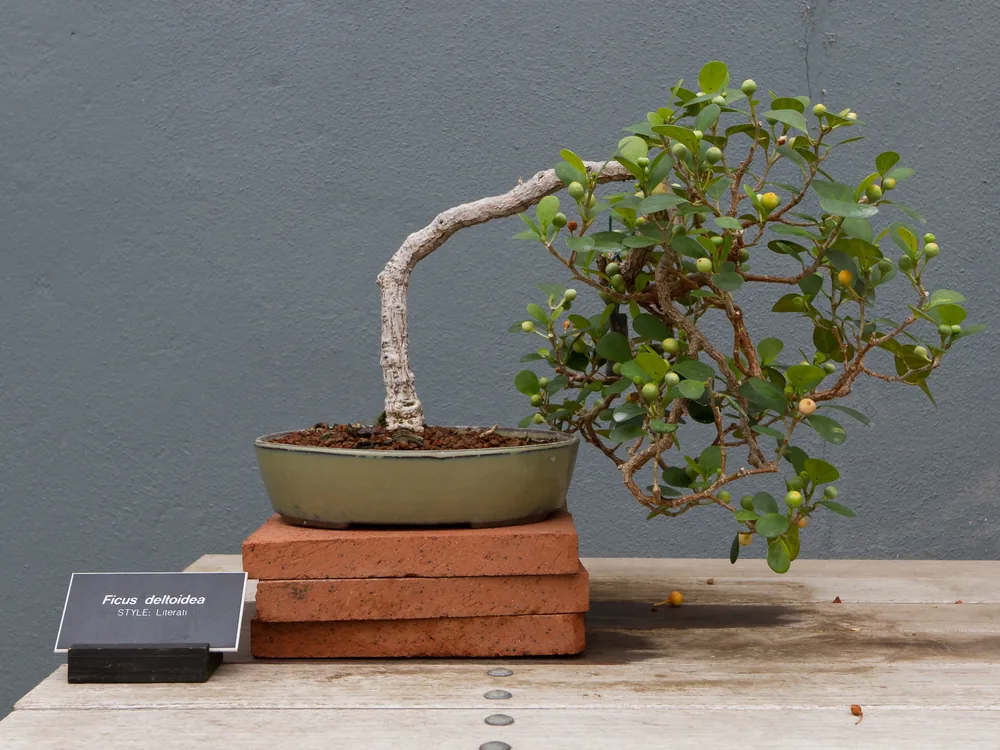
The Mistletoe Fig earns its name from the fruit. It carries small, round, pea-sized figs, yellow ripening to a dull orange-red, held in pairs in the leaf axils along the branches, and the effect is very like mistletoe berries scattered through the foliage. What makes this genuinely unusual is that it does this on very young, very small plants, and does it more or less continuously rather than in a single season. A tree fifteen centimetres tall can be in fruit, which almost nothing else in the indoor bonsai world will do.
Botanically it is Ficus deltoidea, a native of Malaysia, Indonesia and neighbouring parts of southeast Asia, where it frequently grows as an epiphyte in the crooks of larger trees before eventually reaching the ground. Almost the entire bonsai trade sells it under the older name Ficus diversifolia, which is a synonym; the two names refer to the same plant, and you will see both. In Malaysia it is well known as Mas Cotek and used in traditional herbal preparations.
Among figs it is the atypical one. Where Ficus retusa and Ficus benjamina are fast, coarse and almost aggressively vigorous, deltoidea is slow, small-leaved, restrained and comparatively delicate. It does not back-bud with the same enthusiasm, does not thicken quickly, and will not shrug off the heavy-handed treatment a retusa forgives. In exchange it holds a scale and a fineness that the vigorous figs lose, and it fruits.
Buy it for the fruit and the small leaves. Do not buy it expecting a fig's usual indestructibility.
Identification
Foliage: Alternate, thick, leathery leaves, typically 2 to 6 cm, and variable in shape on the same plant, which is what the old name diversifolia recorded. Most are obovate to deltoid, broadest near the tip and tapering to the stalk, with a rounded or slightly notched end rather than a point. Dark glossy green above.
The definitive field mark is on the underside: scattered fine reddish-brown or golden dots, which are glandular spots, along with a distinct network of raised veins. No other commonly sold fig shows this speckled underside, and it settles the identification immediately.
Bark & trunk: Smooth, pale grey to grey-brown, thickening slowly. Aerial roots form in high humidity but far less freely than on a retusa or a banyan fig.
Growth habit / form: Bushy, densely twiggy, often multi-stemmed, with a naturally somewhat irregular open branching. Suits informal upright, clump and root-over-rock styles at small sizes.
Flowers / fruit: As with all figs, the flowers are hidden inside the fruit body itself, so you never see a flower. The figs are round, roughly 5 to 12 mm, borne in pairs in the leaf axils, ripening from green through yellow to dull orange-red, and produced almost year round on a healthy plant. They are not palatable.
Look-alikes & how to tell them apart: Ginseng Ficus (F. microcarpa) has a swollen bulbous root mass and larger pointed leaves. Weeping Fig (F. benjamina) has thin, pointed, drooping leaves on pendulous shoots. Willow-Leaf Ficus (F. salicaria) has long narrow leaves. None of them fruits freely at small size indoors, and none has the speckled leaf underside.
Handling note: like all figs, cut stems bleed a white latex sap. It is a mild skin irritant, can stain, and is best washed off. Keep it away from eyes.
Climate & USDA Zone
Suited to USDA zones 10 to 11 outdoors, which for nearly everyone means it is an indoor tree. It is a true tropical with no dormancy requirement and no frost tolerance at all. Damage begins around 50 F (10 C), well above freezing.
It can spend the summer outdoors once night temperatures stay reliably above 60 F (15 C), and it benefits from the light and air movement, but it must be acclimatised over two weeks in each direction and brought back inside before autumn nights cool. Expect some leaf drop after each move; that is the standard fig response to a change of conditions and not a cause for alarm.
Humidity matters more for this species than for the tougher figs. Dry heated winter air causes leaf drop and invites spider mites. A humidity tray under the pot is more effective than misting.
Light
Bright light, indirect or gently filtered, with some direct sun welcome. As an epiphyte of the forest canopy it is adapted to bright dappled conditions rather than full unbroken exposure or deep shade.
Indoors, give it the brightest window available; a position near an east or south-facing window suits it well. Harsh unfiltered midday sun through glass can scorch the leaves, so a sheer curtain or a slight setback from the glass is worth having in summer. In poor light growth becomes leggy with widely spaced leaves, fruiting stops, and the plant slowly weakens.
Watering
Keep the soil evenly moist. It is less thirsty than the vigorous figs and considerably less tolerant of being waterlogged.
- Water when the surface has just begun to dry, then water thoroughly and let the excess drain away completely.
- Never leave the pot standing in a full saucer.
- Watering must drop substantially in winter, when light is low and growth has all but stopped. Overwatering a slow tree in a dim room is the classic way to rot its roots.
- A hard, complete dry-out causes leaf drop, and because the plant is slow, recovery takes a long time.
- It is sensitive to cold water on the roots. Use water at room temperature.
Soil & Root Care
Soil: A standard free-draining bonsai mix. Akadama with pumice and lava works well. Given its epiphytic origins it likes an open, airy root run and will not thank you for a dense water-holding compost.
Repotting:
- Frequency: every two to three years, which is longer than the two-year interval a vigorous fig wants, because this species fills a pot slowly.
- Timing: late spring or early summer, into warmth and lengthening days. Never repot in winter.
- Be moderate with the roots. Remove around a quarter, not the half a retusa will accept without complaint.
- Aftercare: warmth, humidity, shade from direct sun for two to three weeks, and restrained watering while the reduced roots re-establish.
Feeding
Feed lightly and regularly through the growing season. A balanced liquid fertiliser at half strength every two weeks, or solid organic fertiliser replaced every six weeks, matches its pace. Because it grows year round indoors, continue at roughly monthly intervals through winter rather than stopping entirely, unless the tree is in a genuinely dim cool spot and has stalled.
Heavy feeding will not accelerate a slow species. It produces soft oversized leaves and long internodes, which costs you exactly the fine scale you are growing this plant for.
Pruning & Styling
- Prune through the growing season. Allow a shoot to extend four to six leaves, then cut back to one or two.
- It back-buds, but less readily and less predictably than other figs, particularly on old bare wood. Do not strip a branch of all foliage assuming it will resprout; work more gradually than you would on a retusa.
- Cuts bleed latex freely. Misting the cut with water, or simply allowing it to seal, stops the flow. Wipe it off the bark before it dries and marks.
- Larger wounds heal slowly compared with vigorous figs, so keep structural cuts deliberate and seal them.
- Wiring: young shoots wire easily. Older wood is stiffer and the bark is thin and marks readily, so check wire every four to six weeks in the growing season.
- Defoliation is not advisable on this species. It is a standard technique on strong vigorous figs and this one lacks the reserves to recover well from it.
- Fruit is carried on the current season's growth in the leaf axils, so heavy continuous pruning of every extending shoot will reduce fruiting. If the figs are the point, let some shoots run.
Propagation & Cuttings
Ease: Moderate, harder than most figs. Best methods: semi-hardwood cuttings; air layering.
Cuttings root with bottom heat and high humidity, but less readily and more slowly than the vigorous figs, which strike almost by accident. Take semi-hardwood cuttings in late spring or summer, allow the cut end to stop bleeding latex before inserting it, and be patient.
Air layering is the more reliable route and the better one for producing a plant with a usable trunk, since it also solves this species' main limitation, which is how long it takes to thicken. Seed is impractical: figs are pollinated by species-specific fig wasps that are absent outside the plant's native range, so fruit produced in cultivation contains no viable seed.
Pests
- Scale insects, the most frequent problem on indoor figs
- Mealybugs, in leaf axils and at the root collar
- Spider mites, encouraged by dry heated indoor air, and the most damaging of the four
- Thrips, causing silvery stippling and leaf distortion
Sticky leaves or a black sooty film mean scale or mealybug producing honeydew above. Inspect the undersides of leaves weekly, since that is where all four begin. Horticultural oil and insecticidal soap are effective. Raising humidity is a genuine preventative against mites.
Disease, Fungus & Infection
Few true diseases. Nearly every problem is cultural:
- Leaf drop, the fig's universal response to cold, draughts, a move, a light change, or a dry-out. Identify the change before treating for anything.
- Root rot, from overwatering in low light, poor drainage or a full saucer. The most common way this species is actually killed.
- Anthracnose and leaf spot, in stagnant humid air. Improve airflow and remove affected leaves.
- Sooty mould, growing on pest honeydew rather than attacking the plant. Treat the insect.
Most Common Causes of Death
1. Cold and draughts. No frost tolerance and damage well above freezing. A cold windowsill behind a drawn curtain on a winter night is a real hazard. 2. Overwatering in low light. A slow tree in a dim room needs far less water than people give it, and rots. 3. Drying out completely. Recovery is slow because the plant is slow. 4. Treating it like a vigorous fig. Hard defoliation, aggressive root reduction and cutting back to bare wood are all tolerated by F. retusa and are not tolerated here. 5. Sudden changes. Moves, repotting and abrupt light shifts all cause leaf drop. Acclimatise gradually.
Seasonal Calendar
- Spring: Growth resumes as light returns. Repot in late spring if due. Resume full feeding. Begin the season's pruning.
- Summer: Strongest growth and heaviest fruiting. Prune extending shoots, leaving some to fruit. Optional move outdoors once nights are above 60 F (15 C). Water regularly.
- Autumn: Bring any outdoor tree in before nights cool, inspecting for pests first. Reduce feeding and watering as light drops. Expect some leaf drop after the move.
- Winter: Brightest available position. Water sparingly. Maintain humidity against dry heated air. Light monthly feed. Keep well away from cold glass, doors and heating vents.
Sources
- Wikipedia, Ficus deltoidea
- Plants of the World Online, Ficus deltoidea
- Bonsai Empire, Ficus bonsai care
Buy a Mistletoe Fig bonsai
- All species
- Shop bonsai trees, tools & supplies
- How to Water a Bonsai (Without Killing It)
- Bonsai Soil: What to Buy, What to Mix, and What It Costs
- Why Bonsai Die After Repotting: Diagnosing a Failed Repot
- Pruning vs. Pinching: Shaping Your Bonsai
- Overwintering Bonsai: Cold-Season Care
- Indoor Bonsai Light and Humidity: Making a Windowsill Actually Work
- Root Rot on bonsai
- Overwatering on bonsai
- Underwatering (Drought Stress) on bonsai
- Winter / Frost Damage on bonsai
- Leaf Scorch / Sunburn on bonsai
- Ginseng Ficus bonsai care
- Weeping Fig bonsai care
- Willow Leaf Ficus bonsai care
- Ficus bonsai care