Glossy Privet Bonsai Care
Ligustrum lucidum
Zones 8 to 10, indoor or out. The privet that actually becomes a tree. Most are lost to drying out.

Oleaceae (olive family) · Flowering evergreen broadleaf tree
Glossy Privet quick reference
| USDA zones | 8 to 10 (indoor-capable in cooler zones) |
|---|---|
| Indoor / outdoor | Indoor-capable, happiest outdoors; a bright window indoors |
| Light | Bright, direct sun for at least part of the day |
| Water | Thirsty, keep slightly moist; often daily in summer |
| Soil | Basic free-draining bonsai mix |
| Repot | Annually in spring while young, every 2 years once older |
| Frost | Hardy to about 10 F (-12 C) in the ground; protect a potted tree below 40 F (4 C) |
| Mature height (as bonsai) | Tree to 15 m in the wild; 25 to 80 cm as bonsai |
| Growth rate | Fast |
| Season of interest | Large creamy flower panicles in late summer, then blue-black berries; glossy year round |
| Leaf reduction | Good |
| #1 cause of death | Drying out, then root rot from standing water |
Overview & Character
Glossy Privet is the privet that actually becomes a tree. Where the other common privets stay shrubby, Ligustrum lucidum builds a real trunk with real girth, and it does it fast. That is exactly why it turns up so often as large, thick-trunked, tiered material: a specimen that would take decades in a slower species can be produced here in a fraction of the time.
It is tough, forgiving, and very hard to kill by pruning. It back-buds freely on old wood, tolerates being cut to a stump, and answers repeated cutting with finer twigs and smaller leaves. For anyone who wants to learn how a trunk and a branch structure are actually built, rather than only how to maintain one, it is close to ideal practice material.
The trade-off is appetite. It is thirsty, it is hungry, and it grows fast enough that a season of neglect will cost you the refinement you spent the previous season building. It rewards attention rather than tolerating absence.
One point of honesty about the name. Much of the US nursery trade, including many bonsai sellers, labels Ligustrum lucidum as "Chinese Privet". Botanically that name belongs to Ligustrum sinense, which is a different, smaller-leaved, semi-deciduous plant. We list this species under its correct common name and give the trade name here so you can match what you are reading elsewhere.
Identification
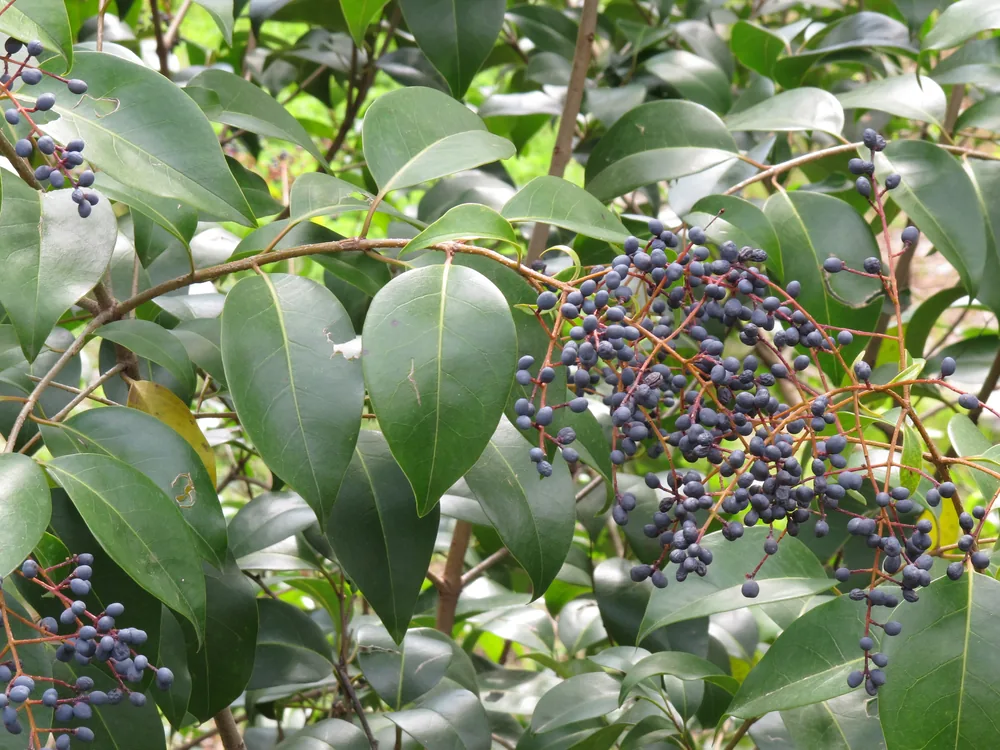
Foliage: Opposite, glossy, evergreen leaves, broadly oval and drawn to a distinct point, typically 8 to 15 cm long. Dark green and shining above, noticeably paler beneath. Held to the light the leaf shows a faintly translucent margin, which is a reliable field mark.
Bark & trunk: Smooth and pale grey-brown when young, developing fine pale lenticels and a soft mottled texture with age. Trunks fatten quickly, which is the main reason large specimens of this species are affordable.
Growth habit / form: Vigorous, upright, eventually a rounded-crowned tree. In a pot it suits informal upright, curved trunk and tiered branching styles, which is how most trained material is presented.
Flowers / fruit: Large, loose, creamy-white panicles in late summer, heavier and more conspicuous than on other privets, with a strong scent that not everyone enjoys. Followed by abundant blue-black berries that persist into winter.
Look-alikes & how to tell them apart: Japanese Privet (L. japonicum) has thicker, blunter, waxier leaves on a shrub that stays small. True Chinese Privet (L. sinense) has much smaller leaves, finely hairy twigs, and drops some of its foliage in a cold winter. Glossy Privet is the largest-leaved and the only one of the three that reliably makes a tree. Leaves and berries are toxic if eaten.
A note on where it is grown: L. lucidum seeds prolifically and is listed as an invasive weed in parts of the southern United States, Australia and New Zealand. As a container bonsai it presents no risk, but do not plant one out, and clear fallen berries rather than letting them wash into a garden bed.
Climate & USDA Zone
Reliably hardy in USDA zones 8 to 10, and established trees in the ground take brief dips to about 10 F (-12 C) without lasting harm. A tree in a bonsai pot has no such buffer: its roots sit in a few centimetres of soil above ambient air. Protect a potted specimen once temperatures fall below roughly 40 F (4 C), either in a cold frame, an unheated garage, or against a sheltered wall.
It grows best outdoors wherever the climate allows it. Indoors it does well in a genuinely bright position, and this is the usual arrangement for the trained specimens sold as indoor trees, but growth is looser and flowering less reliable than outside.
Light
A bright position with direct sun for at least part of the day. Strong light is what keeps internodes short, leaves small and growth compact. In poor light the tree does not die, it degrades: long floppy shoots, large thin leaves, and a loss of the ramification you have been building. If it lives indoors, give it the brightest window in the house and turn it regularly.
Watering
Glossy Privet is thirstier than most bonsai. Keep the soil slightly moist and water as soon as the top centimetre feels dry.
- In summer heat that often means daily, sometimes twice daily on a small pot.
- In winter, or indoors in low light, water considerably less, perhaps twice a week, but never let it go bone dry.
- It shows thirst honestly. Leaves go soft and dull before they drop, which gives you a warning window that many species do not.
- Free drainage with frequent watering is the balance. Standing water is the other way to kill it.
Soil & Root Care
Soil: A basic free-draining bonsai mix, akadama with pumice and lava in roughly equal parts, works well. It is not fussy and will accept most commercial mixes provided they drain.
Repotting:
- Frequency: annually in spring for young or heavily worked trees, dropping to every second year for large established specimens.
- Timing: as the buds begin to move, before the first flush hardens.
- It tolerates hard root work, and a third of the root mass can come off a healthy tree without drama.
- Aftercare: keep it moist and out of strong wind for two to three weeks. It re-establishes quickly.
Feeding
Feed generously. A solid organic fertiliser replaced every four weeks, or a balanced liquid feed weekly at half strength, suits its vigour and supports the repeated cutbacks that build ramification. Taper off through autumn and stop over winter for trees kept cold. Do not feed for a month after repotting.
Pruning & Styling
- Cut back hard two to three times a year. This species back-buds prolifically, including on bare old wood, and the more it is cut the finer the twigs and smaller the leaves become.
- It survives being reduced to a stump. That is how most thick-trunked material is developed: grow it out hard, cut it back to a stub, select new leaders, repeat.
- Allow shoots to extend to five or six pairs of leaves, then cut back to one or two pairs.
- Wiring: young shoots are flexible and wire easily. Branches thicken fast, so check wire every three to four weeks in summer. Wire bite on this species is quick and permanent.
- Large flower panicles drain energy. Remove them if you are building structure and keep them if you are enjoying the tree.
Propagation & Cuttings
Ease: Very easy. Best methods: cuttings of any kind; air layering; seed.
Ligustrum lucidum roots readily from softwood, semi-hardwood and hardwood cuttings, and thick branches removed during styling can be air layered into new trees rather than thrown away. Seed from the berries germinates freely, which is precisely why the species is invasive where it has escaped. For bonsai this matters twice over: material is cheap and plentiful, and a cutting struck today is usable stock within a few seasons.
Pests
- Scale insects, the most common problem, especially indoors
- Aphids on soft new growth
- Whitefly in warm still air
- Vine weevil, whose larvae eat roots unseen
- Spider mites in dry indoor conditions
Treat with horticultural oil or insecticidal soap, repeating at seven to ten day intervals to catch successive hatches. Improve airflow, which prevents more than it cures.
Disease, Fungus & Infection
Tough and largely trouble free. Nearly every problem traces back to culture rather than pathogens:
- Drying out, the single biggest cause of loss, from underestimating its thirst.
- Root rot, from a pot that does not drain or a saucer left full of water.
- Leaf spot and anthracnose, in damp, stagnant, crowded conditions. Thin the interior and improve airflow.
- Honey fungus, rare in containers but a genuine risk if the tree is ever planted out.
Prevention is bright light, frequent water through free-draining soil, moving air, and a look at the undersides of the leaves once a week.
Most Common Causes of Death
1. Drying out. Thirstier than nearly anything else you are likely to own. One missed watering in high summer can cost you a season. 2. Root rot from standing water. Water often, but never let the pot sit in a full tray. 3. Cold on a potted tree. Hardy in the ground, exposed in a pot. Protect below about 40 F (4 C). 4. Low light indoors. Slow decline rather than sudden death: leggy growth, big leaves, no flowers, and eventually a weak tree that pests find. 5. Vine weevil grubs in the root ball. Inspect at repotting and treat if you find creamy C-shaped larvae.
Leaves and berries are toxic if eaten. Keep fallen berries away from pets and small children.
Seasonal Calendar
- Spring: Repot as buds move. Resume feeding once growth is away. First hard cutback to build ramification. Increase watering as growth accelerates.
- Summer: Full light. Water daily or more. Feed steadily. Flower panicles open in late summer. Second cutback after the first flush hardens.
- Autumn: Berries colour. Taper feeding and reduce water as growth slows. A third light cutback if the tree is still pushing.
- Winter: Protect below about 40 F (4 C). Keep just moist, watering perhaps twice a week. No feed. Structural pruning on bare old wood is possible now if you want it.
Sources
- Bonsai Empire, Privet (Ligustrum) care
- Wikipedia, Ligustrum lucidum
- North Carolina Extension Gardener Plant Toolbox, Ligustrum lucidum
Buy a Glossy Privet bonsai
- Flowering Ligustrum Bonsai with Curved Trunk-Medium, 16 Years Old (Ligustrum lucidum) — $114.95
- Large Flowering Ligustrum Bonsai, Curved Trunk, 20 Years Old (Ligustrum lucidum) — $193.95
- Flowering Ligustrum Bonsai, Curved Trunk, 28 Years Old (Ligustrum lucidum) — $406.95
- Flowering Ligustrum Bonsai, Curved Trunk, 19 by 23 Inches (Ligustrum lucidum) — $437.95
- Flowering Ligustrum Bonsai, Curved Trunk, 17 by 25 Inches (Ligustrum lucidum) — $493.95
- Flowering Ligustrum Bonsai, Curved Trunk, 13 by 19 Inches (Ligustrum lucidum) — $493.95
- Flowering Ligustrum Bonsai, Curved Trunk, 15 by 20 Inches (Ligustrum lucidum) — $531.95
- All species
- Shop bonsai trees, tools & supplies
- How to Water a Bonsai (Without Killing It)
- Bonsai Soil: What to Buy, What to Mix, and What It Costs
- Why Bonsai Die After Repotting: Diagnosing a Failed Repot
- Pruning vs. Pinching: Shaping Your Bonsai
- Overwintering Bonsai: Cold-Season Care
- Indoor Bonsai Light and Humidity: Making a Windowsill Actually Work
- Root Rot on bonsai
- Underwatering (Drought Stress) on bonsai
- Winter / Frost Damage on bonsai
- Insufficient Light (Etiolation) on bonsai
- Spider Mites on bonsai
- Chinese Privet bonsai care
- Japanese Privet bonsai care
- Bahama Berry bonsai care
- Chinese Elm bonsai care