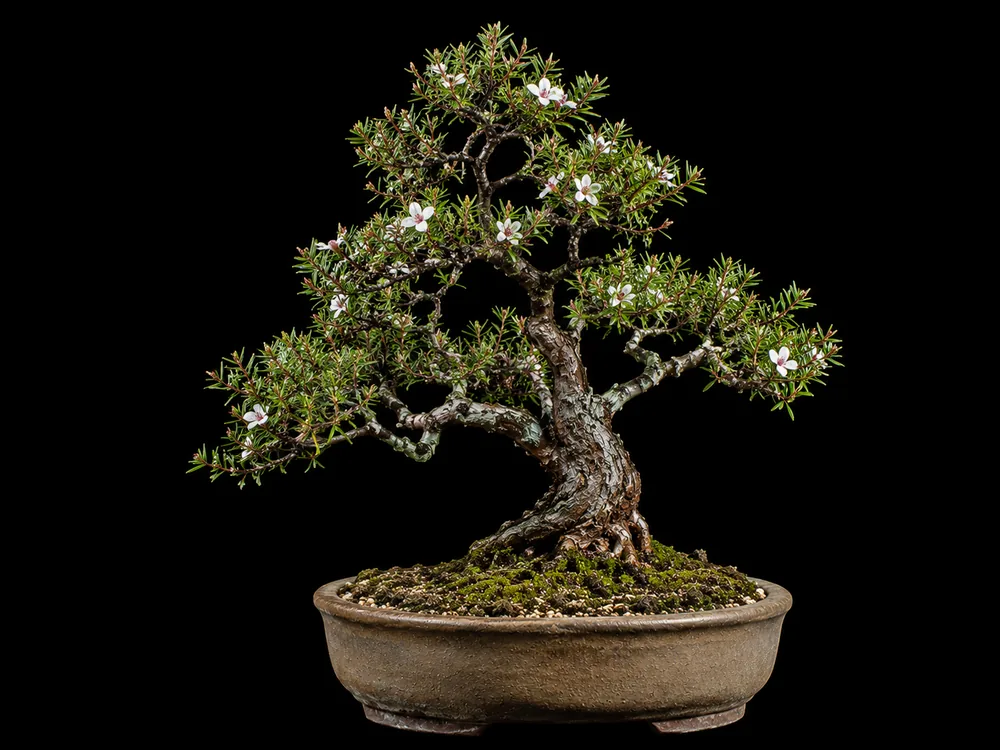
Tea Tree Bonsai Care
Leptospermum scoparium
Zones 9 to 10, outdoor. A fine-twigged evergreen from Australia and New Zealand, grown for tiny needle-like leaves. Most are lost to drying out.
Myrtaceae (myrtle family) · Evergreen broadleaf shrub
Tea Tree quick reference
| USDA zones | 9–10 (grow under glass in colder zones) |
|---|---|
| Indoor / outdoor | Outdoor in mild climates; bright cool glasshouse where frosty |
| Light | Full sun for compact growth and heavy flowering |
| Water | Keep consistently moist — never let it dry out |
| Soil | Free-draining, moisture-retentive, lime-free (acidic) mix |
| Repot | Every 2–3 years, in spring (or after flowering) |
| Frost | Low — protect below light frost; foliage burns in hard cold |
| Mature height (as bonsai) | Shrub to 4m in nature; bonsai usually 20-50cm. |
| Growth rate | Moderate. |
| Season of interest | Spring for small white or pink flowers; fine evergreen leaves. |
| Leaf reduction | Good; tiny leaves stay small with trimming. |
| #1 cause of death | Drying out the rootball (rapid, often fatal) |
Overview & Character
The Tea Tree is a fine-twigged evergreen from Australia and New Zealand, grown for tiny needle-like leaves, gracefully flaky bark, and a profuse spring display of small five-petalled flowers in white, pink, or red (single or double in cultivars). Its small foliage and naturally dense, wiry growth make it a beautiful flowering bonsai.
It has a reputation for being unforgiving about water: the fine root system dies quickly if the rootball ever dries out, and a dried-out tea tree often cannot be saved. Given steady moisture, full sun, and lime-free conditions it is otherwise vigorous and rewarding. In frosty climates it is kept in a bright, cool, frost-free glasshouse rather than indoors in a warm room.
Identification
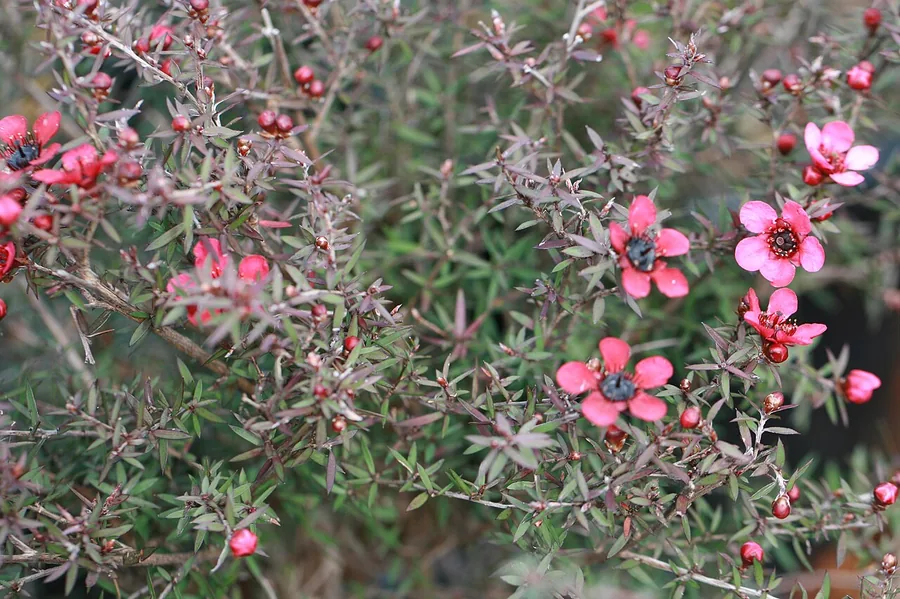
Foliage: Tiny, stiff, narrow lance- to needle-shaped leaves ~0.7–2 cm, aromatic when crushed (the "tea tree" scent), often with a sharp tip; new growth may be reddish or silky.
Bark & trunk: Attractive flaky, peeling grey-brown bark that shreds in thin strips with age, giving an aged, characterful trunk.
Growth habit / form: Dense, twiggy, wiry evergreen shrub with fine ramification; suits informal upright, windswept, and cascade styles.
Flowers / fruit: Masses of small (~1–2 cm) five-petalled flowers, white to pink to red (showy doubles in garden cultivars), borne along the stems in spring; followed by small woody seed capsules that persist on the wood.
Look-alikes & how to tell them apart: Resembles other fine-leaved myrtles and Coleonema (Confetti bush); distinguish by the aromatic stiff needle-like leaves, the persistent woody capsules, and the characteristic open five-petalled "tea tree" flower. Often confused in trade with Melaleuca (paperbark), a relative with bottlebrush flowers rather than open five-petalled blooms.
Climate & USDA Zone
Grows outdoors in mild, largely frost-free climates (USDA zones 9–10). It tolerates cool conditions but is damaged by hard frost, so in colder regions it overwinters in a bright, cool, frost-free glasshouse or porch. It needs lime-free (acidic) conditions and resents alkaline water/soil.
Light
Full sun is best — it produces compact growth, abundant flowers, and good color in strong light, and becomes leggy and shy-flowering in shade. In very hot inland climates light afternoon shade prevents stress, but in general give it as much sun as possible.
Watering
Keep the rootball consistently moist at all times — never let it dry out.
- The fine roots are intolerant of drought; a single thorough dry-out can kill the tree, often with no warning until foliage browns.
- Water thoroughly and check often, especially in sun and wind; in heat it may need watering more than once a day.
- Use lime-free (rain/soft) water where possible — it dislikes hard, alkaline water.
- Maintain good drainage so roots stay moist but not stagnant.
Soil & Root Care
Soil: A free-draining yet moisture-retentive, lime-free/acidic mix (e.g. akadama with pumice/lava, or an ericaceous bonsai mix). Avoid limestone grit and alkaline components.
Repotting:
- Frequency: every 2–3 years, in spring (or just after flowering); avoid heavy root work in cold.
- Root-prune conservatively — the fine roots resent rough handling; never bare-root.
- Aftercare: keep moist (never dry), shaded from harsh sun and wind while recovering.
Feeding
Feed monthly through the growing season with a balanced or acidic (ericaceous) fertilizer; many growers add slow-release granules each season and reduce feeding in winter. Avoid high-lime or alkaline feeds. Don't feed a stressed or freshly repotted plant.
Pruning & Styling
- Clip-and-grow: It responds well to trimming; make cuts leaving 4–5 leaf pairs on a shoot so there is foliage/buds below the cut, as old bare wood back-buds poorly.
- Trim after flowering to maintain shape and encourage dense twigging.
- Wiring: young shoots are flexible; wire carefully and protect the flaky bark; older branches stiffen and can be brittle.
- Suits informal upright, windswept, cascade, and literati styles.
Propagation & Cuttings
Ease: Moderate. Best methods: semi-hardwood cuttings; seed.
Leptospermum scoparium roots from semi-hardwood cuttings taken after a flush firms in late summer, with IBA under humidity at moderate rates — named flower forms are cloned this way. Seed is very fine: the woody capsules release it when dried, and it surface-sows warm without stratification, but seedlings vary. Keep on the acidic side and never let cuttings or plants dry out fully. For bonsai the tiny leaves and profuse flowers suit shohin; cuttings keep flower colour, and the plant back-buds on younger wood.
Pests
- Scale insects and mealybugs
- Aphids on new growth
- Spider mites (hot, dry conditions)
- Webbing caterpillars / leaf-tying larvae in some regions
Treat with horticultural oil or insecticidal soap; keep the plant vigorous and airy.
Disease, Fungus & Infection
Generally healthy in good culture; problems are largely cultural or fungal in damp stagnation:
- Root death from drying out — the dominant failure (a cultural problem, but effectively fatal root damage).
- Root rot — from waterlogging/poor drainage (less common than drought death for this species).
- Fungal leaf spot / dieback — in damp, crowded, low-airflow conditions; improve airflow and remove affected growth.
Prevention: never let it dry out, give full sun and airflow, and keep it lime-free.
Most Common Causes of Death
1. Drying out the rootball. By far the top killer — the fine roots die fast and the tree often cannot recover. Never let it dry. 2. Hard frost / cold damage. Protect from frost; overwinter cool but frost-free. 3. Lime / alkaline water or soil. Causes decline; keep lime-free. 4. Hard pruning into bare old wood. Back-buds poorly; always leave foliage below cuts. 5. Root rot from waterlogging. Keep moist but well-drained, never stagnant.
Seasonal Calendar
- Spring: Main flowering; repot if due (or just after bloom); resume feeding; full sun.
- Summer: Full sun; water heavily and never let it dry; feed; light trim after flowering.
- Autumn: Taper feeding/water slightly; move to frost-free shelter before cold.
- Winter: Bright, cool, frost-free rest; keep moist (not dry); minimal feeding.
Close-up photo reference
Compare your tree against these to confirm the species and spot problems early.

Sources
Where to buy a Tea Tree bonsai
We don’t stock Tea Tree at the moment. These species need similar care and we have them now — they are the closest match in our catalogue.
- Buttonwood — similar care, in stock now
- Satsuki Azalea — similar care, in stock now
- Barbados Cherry — similar care, in stock now
Browse all bonsai trees for sale or find a species matched to your climate and space.
- All species
- Shop bonsai trees, tools & supplies
- How to Water a Bonsai (Without Killing It)
- Bonsai Soil: What to Buy, What to Mix, and What It Costs
- Why Bonsai Die After Repotting: Diagnosing a Failed Repot
- Pruning vs. Pinching: Shaping Your Bonsai
- Overwintering Bonsai: Cold-Season Care
- Indoor Bonsai Light and Humidity: Making a Windowsill Actually Work
- Root Rot on bonsai
- Underwatering (Drought Stress) on bonsai
- Winter / Frost Damage on bonsai
- Insufficient Light (Etiolation) on bonsai
- Spider Mites on bonsai
- Buttonwood bonsai care
- Satsuki Azalea bonsai care
- Bahama Berry bonsai care
- Barbados Cherry bonsai care