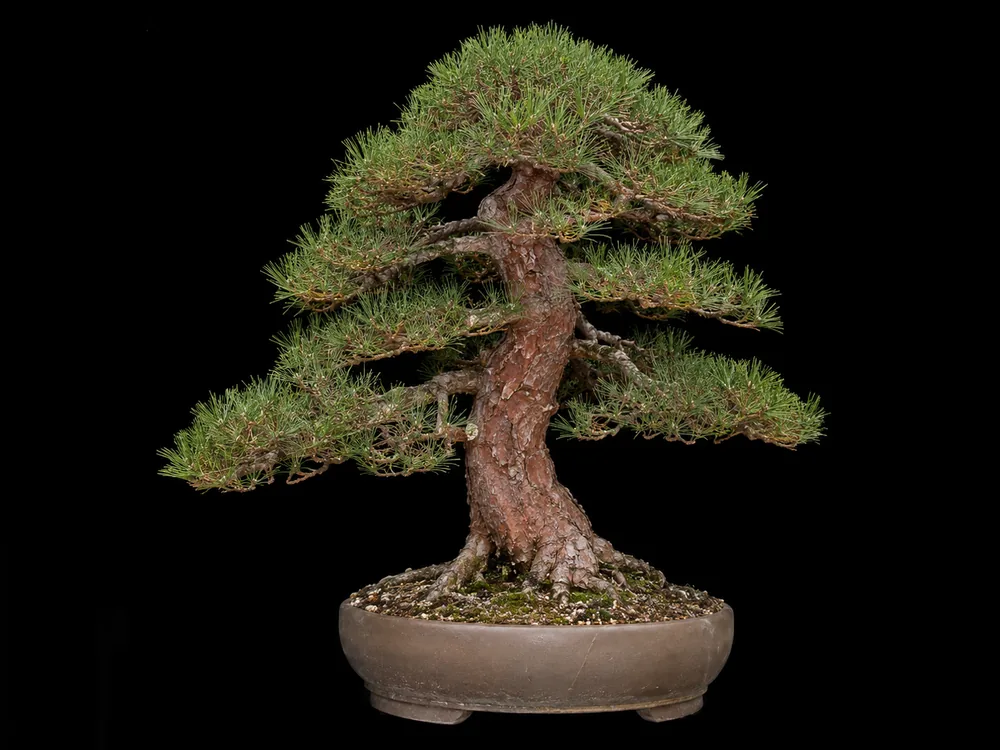
Japanese Red Pine Bonsai Care
Pinus densiflora
Zones 4 to 7. One of the pillar species of Japanese bonsai, traditionally regarded as the refined. Most are lost to overwatering.
Pinaceae · Evergreen coniferous tree; two-needle (diploxylon), double-flush pine
Japanese Red Pine quick reference
| USDA zones | 4–7 (some sources to 8); notably cold-tolerant for a multi-flush pine |
|---|---|
| Indoor / outdoor | Strictly outdoor, year-round; needs full sun and winter cold |
| Light | Full sun all day — non-negotiable for tight, healthy growth |
| Water | On the dry side — a foothill pine; let it approach dryness between thorough waterings. Do not overwater. |
| Soil | Very free-draining, inorganic, lean mix (pumice/akadama/lava) |
| Repot | Every 3–5 years (young more often, mature less) |
| Frost | Excellent; hardy and used in cooler climates |
| Mature height (as bonsai) | Tree to 35 m; 30-70 cm as bonsai |
| Growth rate | Moderate |
| Season of interest | Year-round slender needles, reddish flaking bark |
| Leaf reduction | Good via decandling |
| #1 cause of death | Root rot/overwatering and decline from mistimed or excessive decandling |
Overview & Character
The Japanese red pine is one of the pillar species of Japanese bonsai, traditionally regarded as the **refined, "feminine" counterpart to the bold, "masculine" Japanese black pine (Pinus thunbergii)**. Where black pine is heavy, dark and powerful, red pine is airy, delicate and graceful: thinner, softer needles, more slender shoots, and that beautiful reddish-orange flaking bark on the upper trunk. It is prized for elegant, literati (bunjin) and feminine informal upright styles.
Crucially, the red pine is a double-flush pine — like black pine, it can produce two flushes of growth in a single season, and therefore can be decandled to balance vigor, reduce needle length and build ramification. But because it is a more delicate, foothill species, decandling is done less aggressively and slightly earlier than on black pine, and weak trees should not be decandled at all. Treat it as a black pine's gentler cousin: same toolkit, a lighter hand.
Identification
FOLIAGE: Needles in bundles of two, soft, slender and somewhat twisted, bright to bluish-green, generally finer and softer than the stiff dark needles of black pine. Needle length reduces well with bonsai techniques.
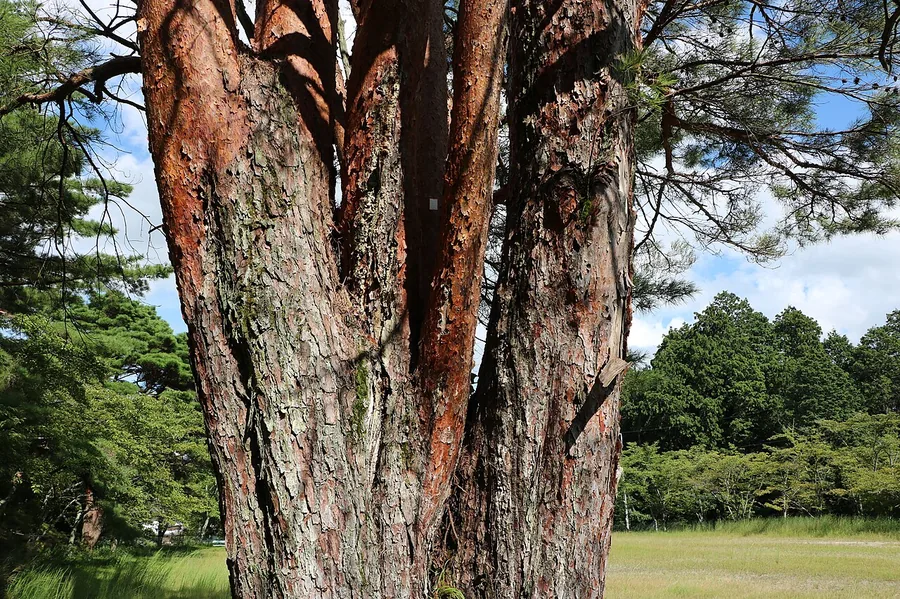
BARK & TRUNK: The signature feature — bark on the upper trunk and branches is distinctly reddish-orange, thin and flaking in plates; lower trunk darkens and becomes platey with age. The warm red bark is the easiest field mark.
GROWTH HABIT/FORM: Slender, graceful, often irregular and picturesque in the wild; more open and refined than black pine. Strongly apically dominant.
FLOWERS/FRUIT/CONES: Small egg-shaped to conical cones, about 3–5 cm, maturing brown over two seasons. Male catkins cluster at the base of new candles in spring.
Look-alikes & how to tell them apart: The key comparison is **Japanese black pine (Pinus thunbergii): black pine has stiff, sharp, dark-green needles, grayish-black fissured bark, and large grayish-white winter buds, whereas red pine has softer, finer needles, reddish-orange flaking bark, and reddish-brown, more pointed, resinous winter buds. Against Scots pine (Pinus sylvestris) — also red-barked and two-needled — red pine's needles are typically softer and less blue-green, and its bark color extends lower and more orange; Scots pine needles are shorter, stiffer and more strongly twisted. The combination of two soft needles + reddish-orange upper bark + slender refined habit** identifies the red pine.
Climate & USDA Zone
Hardy through roughly USDA zones 4–7 (some references extend to zone 8). Among the double-flush pines it is unusually cold-tolerant — it grows in the higher elevations of the Japanese Alps and is the multi-flush pine of choice for cooler climates, still managing two flushes even where the growing season is shorter. It must live outdoors year-round, in full sun, with a genuine winter dormancy.
Light
Full sun, all day, every day. Red pine demands maximum light to keep needles short, internodes tight and the tree vigorous enough to handle decandling. Shade produces long needles, weak interior growth and loss of lower/inner branches. This is not a tree to compromise on light.
Watering
Red pine wants to be on the dry side. As a foothill species it has only moderate water needs (less than black pine) and is tolerant of dryness — it prefers to dry out noticeably between thorough soakings. Water deeply when the soil has approached dryness, then wait. Overwatering and constantly damp soil are far more dangerous than occasional dryness and are a leading cause of decline. In a lean, free-draining mix this self-corrects; in a water-retentive mix it kills.
Soil & Root Care
Use a very free-draining, inorganic, lean mix — pumice-heavy with akadama and lava is typical; pines also benefit from mycorrhizal fungi in the soil (the white threads in the rootball are good — preserve them). Repot every 3–5 years in early spring before the candles extend; young trees more often, mature trees less. Pines resent heavy root disturbance, so reduce roots conservatively and never bare-root. Keep the mycorrhizae; don't wash them all away.
Feeding
Feed generously in spring before decandling to build the strength the technique requires, then withhold fertilizer through summer after decandling so the second flush emerges with shorter needles and tighter growth. Resume feeding once the second flush hardens off — typically from about mid-September — to restore energy for winter. Solid organic fertilizer cakes work well. Strong autumn feeding fuels next year's candles.
Pruning & Styling
Red pine uses the full double-flush toolkit — with restraint:
- Decandling (the signature technique): On healthy, vigorous trees, remove the spring candles in late spring/early summer — for red pine, slightly earlier than black pine, around early to mid-June — to force a smaller, more refined second flush with shorter needles and more buds. Decandle less aggressively than black pine; weak trees and weak areas should not be decandled, or you will lose them.
- Candle thinning/balancing: Adjust strong vs. weak candles to even out vigor — leave more length on weak areas, reduce strong ones, because red pine is strongly apically dominant and the top will run away.
- Needle plucking/thinning: In autumn, pull old needles and thin dense areas to balance energy, let light into the interior, and encourage back-budding.
- Structural pruning: Done in autumn/winter when the tree is least active.
- Wiring: Best in autumn to winter; branches are flexible when young. Watch for wire bite on the thin red bark.
Because it is daintier than black pine, err toward gentler, better-timed work rather than heavy intervention.
Propagation & Cuttings
Ease: Easy from seed; graft for selections. Best method: seed.
Pinus densiflora is grown from seed like black pine — soak, brief cold-moist stratification, spring sowing in gritty mix; germination is good. Cuttings don't root; cultivars ('Tanyosho' and dwarfs) are grafted. Red pine has finer, softer needles and a more delicate character than black pine and is slightly less vigorous, so decandle more gently. For bonsai, seedlings grown lean with mycorrhizae, or grafted forms, are the route; it back-buds fairly well when healthy.
Pests
- Pine needle scale and other scales — white specks on needles; treat with oil/systemic.
- Aphids and adelgids (woolly sap-suckers) on shoots and bark.
- Spider mites in hot, dry weather — dull, speckled needles.
- Pine sawfly larvae — chew needles, can defoliate quickly; pick off or treat.
- Pine shoot moth / pine bark beetles — bore into candles and bark; remove affected shoots.
Disease, Fungus & Infection
- Root rot (Phytophthora) from overwet soil — the main disease risk; prevent with a dry-side regime and sharp drainage.
- Needle cast / needle blight fungi — banded yellowing and premature needle drop, worse in stagnant, humid air; improve airflow, remove fallen needles.
- Diplodia (Sphaeropsis) tip blight — kills new candles and shoots, especially on stressed trees; prune out and disinfect tools.
- Pine wilt nematode (vectored by longhorn beetles) is a serious risk to red pine in affected regions — sudden browning and death; source clean stock and control beetle vectors.
Most Common Causes of Death
1. Overwatering / root rot. Red pine wants dry-side soil; constant moisture rots roots. Prevention: lean, free-draining mix; let it approach dryness between waterings. 2. Decandling a weak tree, or decandling too hard/too late. Removing candles from a tree without the energy to push a second flush can kill it or a branch. Prevention: only decandle healthy trees, feed well beforehand, go lighter and slightly earlier than black pine, skip weak areas. 3. Insufficient light. Shade weakens the whole tree and loses interior branches. Prevention: full sun all day. 4. Loss of mycorrhizae / over-aggressive repotting. Bare-rooting and washing away the fungi sets pines back severely. Prevention: repot conservatively, preserve mycorrhizae, never bare-root. 5. Pine wilt nematode / borer attack. Can kill rapidly. Prevention: clean stock, control beetle vectors, remove and destroy affected wood. 6. Kept indoors / no winter dormancy. Prevention: outdoors year-round with winter cold. 7. Letting the rootball dry out completely. "Dry-side" is not "bone-dry" — total dry-out kills fine roots and mycorrhizae. Prevention: water thoroughly when dry; don't neglect it in heat.
Seasonal Calendar
- Spring: Repot before candles extend (early spring). Feed heavily to build strength. Let candles extend; thin/balance candles by vigor.
- Early summer: Decandle healthy trees ~early–mid June (slightly earlier and lighter than black pine). Withhold fertilizer afterward. Provide steady water (dry-side) as the second flush forms.
- Late summer / autumn: Resume feeding once the second flush hardens (~mid-September). Pluck old needles and thin to balance energy and admit light. Begin structural pruning and wiring.
- Winter: Full dormancy outdoors in full sun. Excellent cold tolerance; protect pots from severe freeze. Water sparingly. Continue wiring on dormant wood.
Close-up photo reference
Compare your tree against these to confirm the species and spot problems early.

Sources
- Bonsai Mirai — Japanese Red Pine guide
- Bjorn Bjorholm / Eisei-en — Japanese Pine care guide
- Bonsai Tonight — Which pines can I decandle?
- Bonsai Empire — Pine (Pinus) care
Where to buy a Japanese Red Pine bonsai
We don’t stock Japanese Red Pine at the moment. These species need similar care and we have them now — they are the closest match in our catalogue.
- Japanese Black Pine — similar care, in stock now
- Japanese White Pine — similar care, in stock now
Browse all bonsai trees for sale or find a species matched to your climate and space.
- All species
- Shop bonsai trees, tools & supplies
- How to Water a Bonsai (Without Killing It)
- Bonsai Soil: What to Buy, What to Mix, and What It Costs
- Why Bonsai Die After Repotting: Diagnosing a Failed Repot
- Pruning vs. Pinching: Shaping Your Bonsai
- Overwintering Bonsai: Cold-Season Care
- Indoor Bonsai Light and Humidity: Making a Windowsill Actually Work
- Root Rot on bonsai
- Overwatering on bonsai
- Underwatering (Drought Stress) on bonsai
- Winter / Frost Damage on bonsai
- Insufficient Light (Etiolation) on bonsai
- Bristlecone Pine bonsai care
- Eastern White Pine bonsai care
- Japanese Black Pine bonsai care
- Japanese White Pine bonsai care