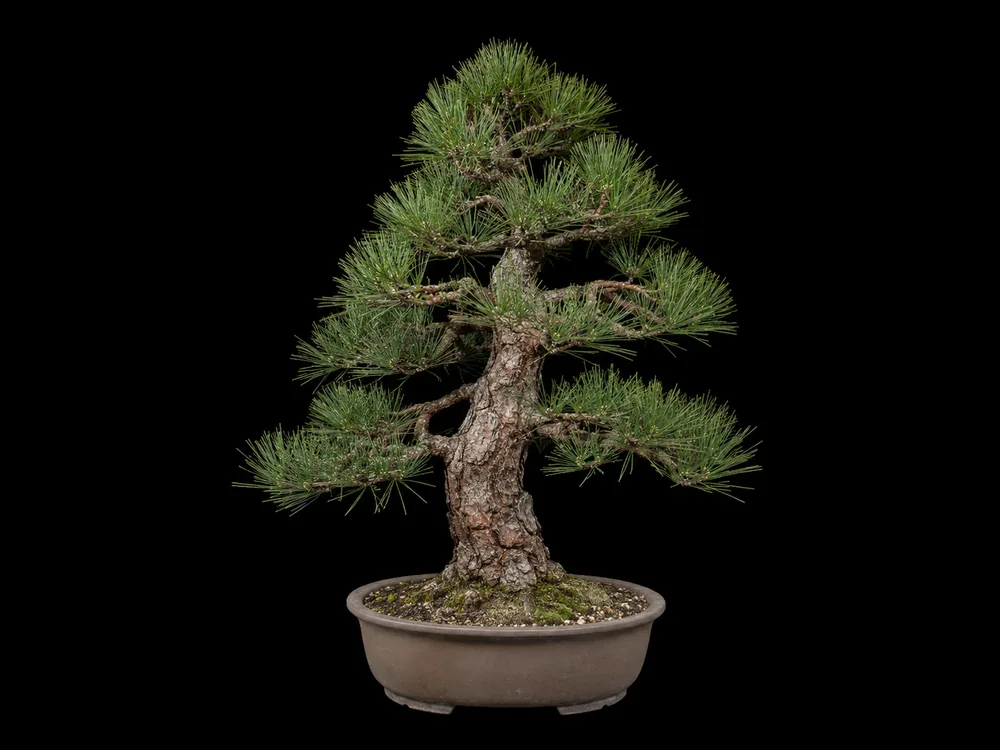
Ponderosa Pine Bonsai Care
Pinus ponderosa
Zones 3 to 7. One of the great native pines of the western United States and one of the most coveted bonsai subjects. Most are lost to overwatering.
Pinaceae (the pine family) · Evergreen, single-flush coniferous tree; outdoor bonsai, very popular as collected (yamadori) material
Ponderosa Pine quick reference
| USDA zones | 3–7 (some references extend to 8); needs cold winter dormancy |
|---|---|
| Indoor / outdoor | Strictly outdoor — never an indoor tree |
| Light | Full sun, all day; the more direct light, the shorter the needles |
| Water | Dry-side. Let the soil approach dryness between waterings; resents constantly wet roots |
| Soil | Free-draining, gritty, inorganic mix (e.g. pumice-heavy / akadama-pumice-lava); high oxygen, low water retention |
| Repot | Infrequently — every 4–7+ years for established/collected trees; only when actively recovering and rooted |
| Frost | Excellent; cold-hardy. Protect only the pot/roots in hard freezes and shield fresh collections |
| Mature height (as bonsai) | 30-70m wild; 30-70cm as bonsai |
| Growth rate | Slow; collected yamadori favorite |
| Season of interest | Year-round; long needles, deep plated bark |
| Leaf reduction | Long needles reduce modestly; needle-pluck |
| #1 cause of death | Overwatering / root rot (and disturbing roots too aggressively too soon on collected trees) |
Overview & Character
The Ponderosa Pine is one of the great native pines of the western United States and one of the most coveted bonsai subjects in North America. Its appeal comes almost entirely from collected (yamadori) trees — ancient, slow-grown specimens pulled from high-desert and mountain sites where centuries of drought, wind, and lean soil have produced thick, plated bark, deadwood, and movement that no nursery tree can match.
It is a single-flush pine, meaning it pushes one set of candles per year. This makes it behave very differently from the Japanese black pine (a multi-flush pine). You do not decandle a Ponderosa. Instead you refine it through candle selection, balancing, and needle work. It is dry-loving, sun-loving, and patient — a tree for growers who respect that working with old collected pines is a multi-year conversation, not a single season's project.
Identification
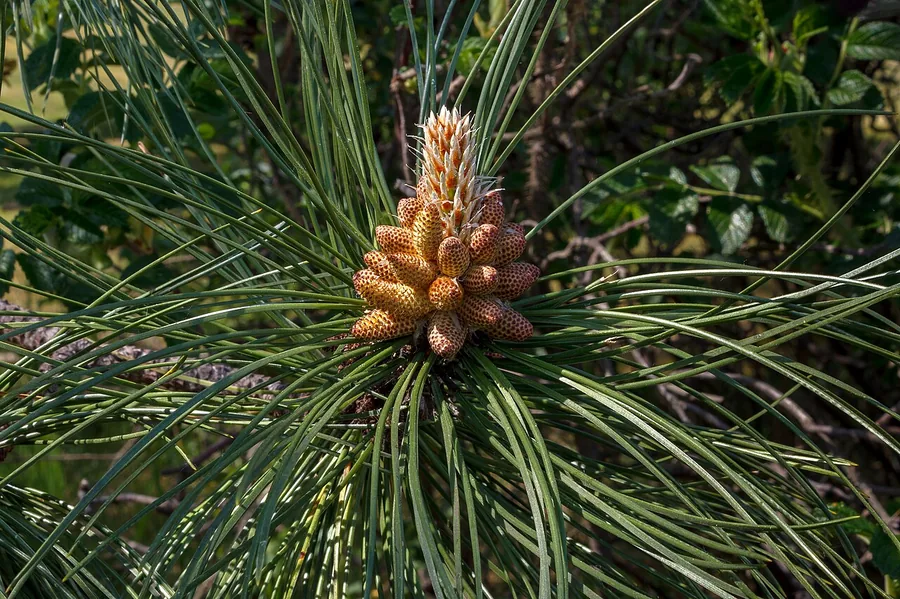
Foliage: Long needles, typically borne in bundles (fascicles) of 2 to 3 (most often 3), commonly 5–10 inches (12–25 cm) long in the wild — among the longest of the common bonsai pines. In bonsai cultivation, strong sun and disciplined watering shorten them considerably. Needles are stiff, dark to yellow-green, and tufted at branch tips. Crushed foliage and bark of older trees give off a distinctive butterscotch/vanilla scent.
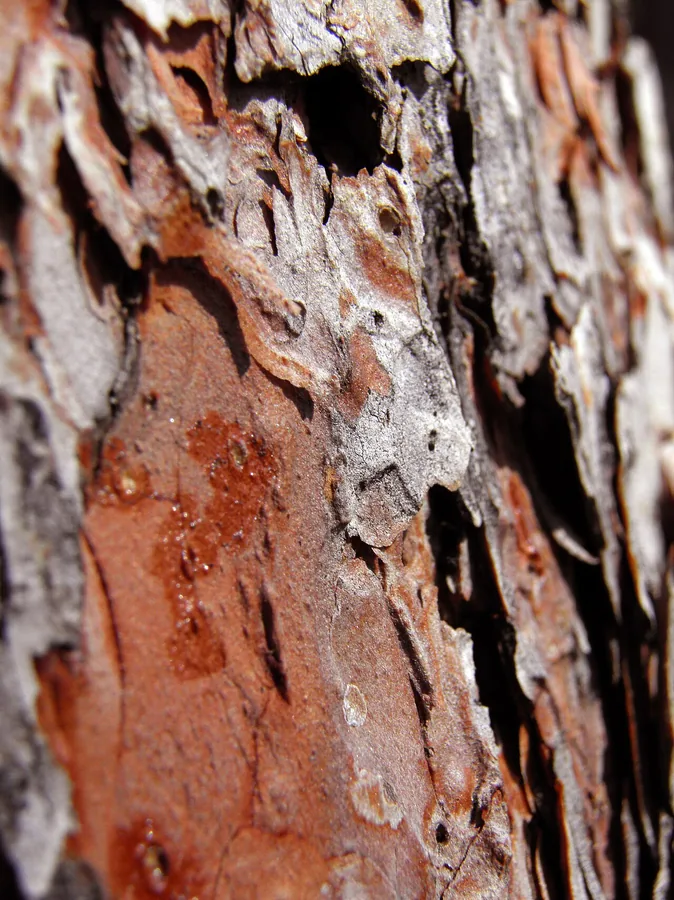
Bark & trunk: The signature feature. Mature bark forms large, irregular, flat plates separated by deep black fissures, ranging from cinnamon-orange to yellow-brown ("yellowbelly" pines). Young/immature bark is dark gray-brown and furrowed ("blackjack" stage). Trunks on collected trees are often massive, fluted, and carry natural deadwood (shari/jin).
Growth habit / form: Strongly upright in nature, but collected specimens show dramatic, weathered, windswept and literati-friendly forms. Open, irregular branch structure with foliage carried in tufts at the tips.
Cones: Egg-shaped to oval, 3–6 inches (8–15 cm) long, reddish-brown, with a small outward-pointing prickle on each scale (a useful field ID — the prickle "pokes" you, unlike Jeffrey Pine's inward prickle).
Look-alikes & how to tell them apart: Most easily confused with **Jeffrey Pine (Pinus jeffreyi), which has bluer-gray needles, more rounded cone scales with inward-curving** prickles (Ponderosa's curve outward and prick the hand — "gentle Jeffrey, prickly Ponderosa"), and a more pronounced vanilla/pineapple bark scent. Also distinguished from black/red pines by its single-flush growth and much longer needles, and from lodgepole/shore pine (Pinus contorta) by its 2–3 long needles versus contorta's 2 short ones.
Climate & USDA Zone
Ponderosa Pine is fully hardy across roughly USDA zones 3–7. It is a cold-climate, continental-mountain species that requires a genuine winter dormancy with sustained cold (below about 45°F / 7°C) to stay healthy. It thrives on warm, sunny days and cool nights, and tolerates low humidity well — it is, after all, a high-desert and montane tree. Keep it outdoors year-round.
Light
Full, direct sun for the entire day. Ponderosa is a sun-demanding species and never does well in shade. Maximum light keeps internodes tight, needles shorter, and the tree vigorous. Insufficient light produces weak, leggy, overlong-needled growth and invites fungal problems. In extreme heat, the foliage is fine in full sun, but the dark pot can cook the roots — shade or insulate the container, not the canopy.
Watering
Dry-side. This is the single most important rule. Ponderosa Pine is adapted to arid soils and is highly sensitive to wet feet. Allow the top inch or so of soil to dry and the pot to feel light before watering again, then water thoroughly until it runs from the drainage holes. In summer this may mean watering every 2–3 days; in cooler weather, weekly or less.
The roots need oxygen as much as water. Constantly saturated soil suffocates the roots and causes the rot that kills more Ponderosas than anything else. When in doubt, wait — this species forgives a little drought far more readily than a little excess. Pair this watering discipline with a coarse, free-draining inorganic soil so the mix never holds standing water.
Soil & Root Care
Use a highly free-draining, predominantly inorganic substrate — for example a pumice-heavy mix, or akadama / pumice / lava in roughly equal parts, leaning grittier (more pumice/lava) for collected and recovering trees. The goal is abundant air in the root zone and no water-logging.
Ponderosa, like most pines, depends on mycorrhizal fungi in its roots (often visible as white webbing). Preserve it: never bare-root a Ponderosa, work the roots gently and gradually over several repots, and avoid washing all the old soil away. Repot infrequently — established trees every 4–7 years or more, only when the tree is strong and the pot is full of healthy roots. Newly collected trees must be left undisturbed in a coarse, draining medium (pure pumice is common) for one to several years to recover before any root work. Repot in early spring as buds begin to swell.
Feeding
Feed to build and maintain vigor, but moderately — the aim with an old refined pine is controlled, balanced strength rather than explosive growth. Begin feeding in spring once growth is active and continue through the growing season, easing off in the hottest part of summer if needed and feeding again into autumn to harden the tree for winter. A balanced organic fertilizer works well; many growers favor heavier autumn feeding on pines to thicken next year's buds. Recovering collected trees should not be fertilized hard until they are clearly re-established and pushing strong growth.
Pruning & Styling
Do NOT decandle this pine. Decandling (cutting off the spring candles entirely to force a second flush) is a Japanese black pine technique for multi-flush pines and will weaken or kill branches on a single-flush species like Ponderosa.
Instead, manage Ponderosa through:
- Candle selection: In spring, candles emerge as thick, prominent shoots. Reduce vigor differences across the tree by selecting how many candles to keep per area — remove excess candles from strong tips, keep candles on weaker areas. This balances energy across the tree.
- Candle reduction (partial): Once the white papery sheaths at the needle bases begin to shed (typically early-to-mid June in the Northern Hemisphere), you may shorten candles to an even length across the tree. Always leave some of this year's new needles on each shoot — removing an entire candle can cause that branch to die back.
- Needle work / plucking: Reduce old needles on strong areas in autumn to balance vigor, push light into the interior, and improve appearance. Leave more needles on weak shoots.
- Structural pruning: Remove unwanted branches in late summer to early autumn so the tree recovers before winter; seal larger cuts.
- Wiring & styling: Wire in late autumn through winter when the tree is dormant and sap pressure is low; collected Ponderosas take wire and bends well but old wood is stiff, so use guy wires and patience for large movements. Deadwood (jin/shari) suits the species superbly.
Work conservatively. Old collected pines respond slowly; doing too much in one year is a common path to decline.
Propagation & Cuttings
Ease: Slow from seed; mostly collected. Best methods: seed; collection.
Pinus ponderosa is grown from seed — cold-moist stratify ~1–2 months and sow in spring in lean, gritty mix; germination is fair but seedlings are slow, with a long juvenile grass stage. Cuttings don't root; selections are grafted. The dramatic bonsai are mostly collected from the western mountains as old, thick-barked yamadori. For bonsai, collected trees give instant age and long needles that shorten with candle work; seedlings demand great patience and mycorrhizal soil.
Pests
Pines, including Ponderosa, can be troubled by aphids, pine needle scale, spider mites, sawfly larvae, borers/bark beetles, caterpillars, mealybugs, and weevils. Spider mites are more likely on stressed, dusty, or poorly ventilated trees in hot weather. Inspect needle bundles and bark regularly. Treat aphids/scale/mites promptly with appropriate horticultural oil or insecticide; borers and bark beetles are most attracted to already-weakened trees, so vigor and good culture are the best defense. Good airflow and full sun greatly reduce pest pressure.
Disease, Fungus & Infection
The most significant disease threats are fungal: root rot (from overwatering — by far the most dangerous), needle cast (needles yellow, spot, and drop, often from poor airflow or excess moisture), **tip/shoot blight (Diplodia) which kills new candles and shoot tips, and various rusts**. Pines can decline alarmingly fast once disease takes visible hold, so prevention beats cure: dry-side watering, free-draining soil, full sun, open airflow, and removing fallen needles and debris. Treat fungal outbreaks with an appropriate fungicide and immediately correct the cultural cause (usually too much water or too little air).
Most Common Causes of Death
1. Overwatering & root rot. The number-one killer. Prevention: water dry-side, use coarse inorganic soil, and let the pot get light before rewatering. 2. Aggressive/too-soon root work on collected trees. Disturbing the roots of a freshly collected yamadori before it has recovered kills it. Prevention: leave new collections undisturbed in pure pumice for 1–3+ years; never bare-root; reduce roots gradually. 3. Decandling like a black pine. Removing whole candles on this single-flush pine causes branch dieback and decline. Prevention: never decandle — use candle selection and partial reduction, always leaving new needles. 4. Insufficient light. Shade produces weak, fungus-prone, leggy growth that slowly fades. Prevention: full sun all day, year-round. 5. Doing too much in one season. Repotting + heavy pruning + wiring at once overwhelms an old pine. Prevention: stagger major work across years; let the tree show strength first. 6. Lack of winter dormancy / improper overwintering. Kept warm year-round, or roots frozen solid in a small pot, the tree fails. Prevention: allow real dormancy outdoors; protect only the root mass in extreme cold. 7. Fungal disease (tip blight, needle cast) left untreated. Spreads fast and can kill. Prevention: airflow, dry foliage, sanitation, prompt fungicide.
Seasonal Calendar
- Early Spring (Mar–Apr): Best repotting window as buds swell — only for strong, well-rooted trees. Begin watering more as growth resumes. Start light feeding.
- Late Spring (May–Jun): Candles emerge and extend. Perform candle selection; as needle sheaths shed (early–mid June), do partial candle reduction, leaving new needles. Watch for aphids.
- Summer (Jul–Aug): Peak growth, then hardening. Watch watering carefully in heat (still dry-side); protect pot from baking. Monitor for spider mites. Ease feeding in extreme heat.
- Autumn (Sep–Nov): Structural pruning and needle plucking to balance vigor; resume/increase feeding to harden the tree and build buds. Begin wiring as the tree goes dormant.
- Winter (Dec–Feb): Dormant — ideal for wiring and heavy bends. Water sparingly. Provide full winter cold but protect roots from deep, prolonged freezes; shelter freshly collected trees.
Close-up photo reference
Compare your tree against these to confirm the species and spot problems early.


Sources
- Ponderosa Pine Bonsai Guide — Bonsai Mirai
- Care and Maintenance Guide for Native US Pine Bonsai (Pinus) — Eisei-en / Bjorn Bjorholm
- Working with Collected Ponderosa Pines for Bonsai — Bonsaify
- Care Guide for Pine Bonsai Species (Pinus) — Bonsai Empire
Where to buy a Ponderosa Pine bonsai
We don’t stock Ponderosa Pine at the moment. These species need similar care and we have them now — they are the closest match in our catalogue.
- Japanese Black Pine — similar care, in stock now
- Japanese White Pine — similar care, in stock now
Browse all bonsai trees for sale or find a species matched to your climate and space.
- All species
- Shop bonsai trees, tools & supplies
- How to Water a Bonsai (Without Killing It)
- Bonsai Soil: What to Buy, What to Mix, and What It Costs
- Why Bonsai Die After Repotting: Diagnosing a Failed Repot
- Pruning vs. Pinching: Shaping Your Bonsai
- Overwintering Bonsai: Cold-Season Care
- Indoor Bonsai Light and Humidity: Making a Windowsill Actually Work
- Root Rot on bonsai
- Overwatering on bonsai
- Winter / Frost Damage on bonsai
- Insufficient Light (Etiolation) on bonsai
- Spider Mites on bonsai
- Bristlecone Pine bonsai care
- Eastern White Pine bonsai care
- Japanese Black Pine bonsai care
- Japanese White Pine bonsai care