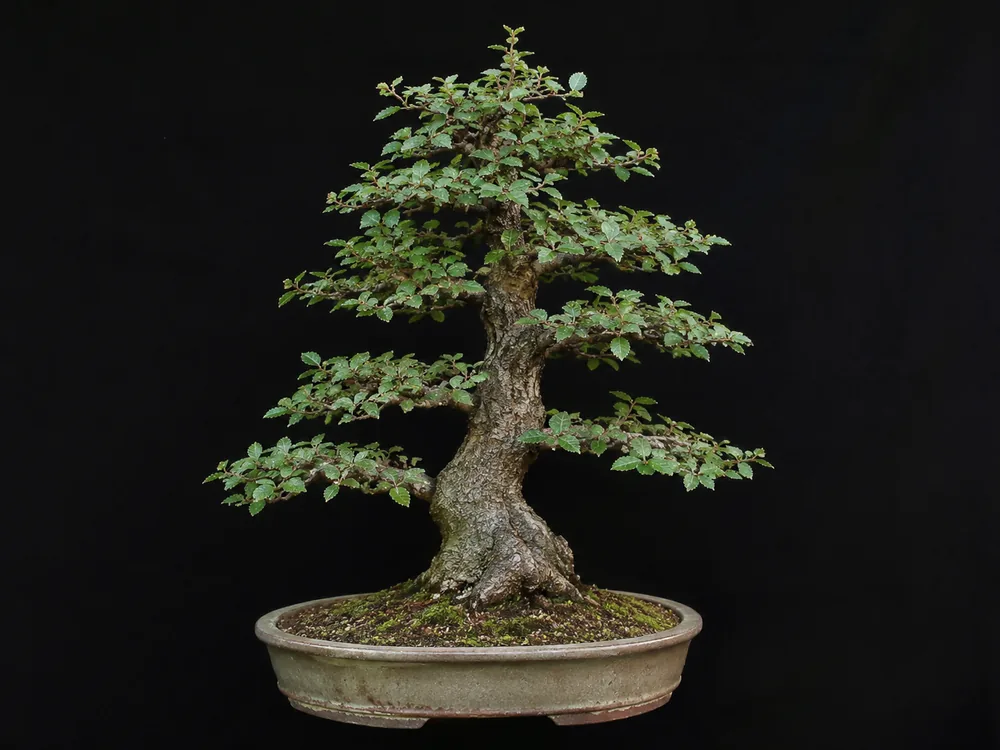
Cedar Elm Bonsai Care
Ulmus crassifolia
Outdoor. A tough, adaptable North American elm native to the south-central United States, Texas, Oklahoma, Louisiana. Most are lost to drying out.
Ulmaceae (Elm family) · Deciduous broadleaf tree; outdoor bonsai for warm and temperate climates
Cedar Elm quick reference
| USDA zones | Roughly 6–9 (very heat-tolerant; one of the best elms for hot southern regions) |
|---|---|
| Indoor / outdoor | Outdoor — needs full sun and a real dormancy period |
| Light | Full sun; tolerates intense heat better than most bonsai species |
| Water | Moist — keep it on the wet side. Likes ample water; tolerates heavier, water-retentive soil and does not want to dry out |
| Soil | Tolerant of a wide range; naturally prefers alkaline clay. Use a free-draining mix that still holds moisture (e.g. akadama/pumice/lava with added organic component) |
| Repot | Young trees every 1–2 years; older specimens every 2–3 years, late winter to early spring |
| Frost | Hardy and cold-tolerant once established, but protect potted roots below about 28°F (-2°C) |
| Mature height (as bonsai) | Tree to 25 m; kept 25-60 cm as bonsai |
| Growth rate | Moderate |
| Season of interest | Yellow autumn colour, corky bark |
| Leaf reduction | Excellent - small leaves reduce readily |
| #1 cause of death | Winter root-freeze of the unprotected pot, and (in cultivation) summer drought stress from letting the pot dry out |
Overview & Character
Cedar Elm is a tough, adaptable North American elm native to the south-central United States — Texas, Oklahoma, Louisiana, Arkansas and into northern Mexico. Despite the name it is not a cedar; the name refers to the cedar-dotted limestone country where it grows. It is one of the finest bonsai subjects for hot, dry, high-UV climates where more delicate elms and maples struggle.
The species is prized for its very small, rough-textured leaves that reduce beautifully in a pot, its prolific back-budding after pruning, and its unusual habit of flowering and fruiting in late summer and autumn rather than spring — a quirk shared with very few other elms. It develops fine ramification quickly and forgives heavy work, making it a forgiving yet refined bonsai.
Identification
Foliage: Small, stiff, oval leaves with a distinctly rough, sandpapery upper surface and doubly serrated margins. Leaves are noticeably smaller than American or Chinese elm. Good yellow to gold autumn color before leaf drop.
Bark & trunk: Mature bark is gray-brown, rough, fissured and flaky. Young twigs frequently develop corky wings or ridges along the branches — a strong diagnostic feature. Trunks taper well and take on an aged, rugged look relatively early.
Growth habit / form: Naturally a rounded crown with somewhat drooping, arching branches. Branches back-bud freely, including at the site of cuts, which makes building a dense, twiggy silhouette straightforward.
Flowers / fruit: Inconspicuous greenish flowers appear in late summer to autumn (unlike spring-flowering elms), followed by small flat winged samaras. Not grown for ornamental bloom.
Look-alikes & how to tell them apart: Cedar Elm is easily confused with Chinese Elm (Ulmus parvifolia), Winged Elm (Ulmus alata) and American Elm (Ulmus americana). Tell them apart by leaf and timing: Cedar Elm has the smallest, roughest, sandpaper-textured leaves, often shows corky winged twigs, and flowers/fruits in autumn — Chinese Elm has smoother, glossier leaves and flowers in late summer-to-autumn too but is far less rough; American Elm has much larger, smoother leaves and spring flowers; Winged Elm has prominent corky wings but larger, smoother leaves and spring bloom.
Climate & USDA Zone
Cedar Elm thrives in USDA zones 6–9 and is exceptionally tolerant of heat, sun and drought once established in the ground — qualities that carry over to bonsai. It is fully deciduous and needs a genuine cool dormancy in winter. In its hardiness range it can overwinter outdoors with root protection; in colder zones it must be sheltered in an unheated garage, cold frame or mulched bench through the coldest spells. Do not bring it indoors as a houseplant — it requires the seasonal cold cue.
Light
Give it as much sun as you can — full, all-day sun is ideal and produces the smallest leaves and tightest growth. Cedar Elm handles blazing southern summers better than almost any other deciduous bonsai. Insufficient light causes leggy growth and larger leaves.
Watering
This is a moisture-loving tree — keep it on the wet side. Cedar Elm likes full, moderate-to-generous water and will tolerate (and arguably prefers) a heavier, more water-retentive soil than most bonsai species, reflecting its native alkaline clay soils. Water thoroughly whenever the surface begins to dry; in hot weather this may mean once or twice daily. Do not let the rootball dry out during the growing season. The main watering risk is under-watering in summer heat, not over-watering — though the pot must still drain freely so roots are never standing in stagnant water.
Soil & Root Care
Cedar Elm is unfussy about soil and grows naturally across a wide range, with a preference for alkaline clay. For bonsai use a free-draining inorganic mix (akadama, pumice, lava) but lean toward better water retention than you would for a pine — adding a portion of organic matter or extra akadama suits it well. It is not sensitive to alkalinity, so hard tap water is fine.
Roots are vigorous and the tree shrugs off root-pruning, recovering quickly. Repot young trees every 1–2 years and older specimens every 2–3 years, in late winter to early spring just as buds begin to move. Bare-root and reduce the rootmass confidently — Cedar Elm tolerates aggressive root work better than most species.
Feeding
Feed heavily during the growing season to support its naturally vigorous growth. Use a balanced fertilizer from spring through autumn; organic cakes or a balanced liquid feed both work well. Ease off as the tree slows and approaches dormancy. Because the tree is acid-indifferent, you do not need acidifying feeds. Strong feeding supports rapid back-budding and ramification.
Pruning & Styling
Cedar Elm is a back-budding powerhouse — it readily sprouts new buds at the site of pruned limbs, so a removed branch is relatively easy to replace. Let new shoots extend to several nodes, then cut back to 1–2 leaves to build ramification. Pinch and trim through the growing season to maintain the silhouette. Major structural pruning is best done in late winter/early spring before bud break, or in early summer when the tree recovers fast.
Wiring takes well on young, flexible shoots; older branches lignify and become stiffer, so wire while supple. The species suits informal upright, broom, and naturalistic styles that show off its rounded crown and arching branches. Because Cedar Elm flowers and fruits on the season's later growth and is not grown for bloom, you can prune freely without worrying about sacrificing flowers.
Propagation & Cuttings
Ease: Easy. Best methods: seed; cuttings; root cuttings.
Cedar elm is an easy elm: it seeds prolifically in autumn (unusually, it flowers and fruits in late summer/fall), and fresh seed sown at once germinates quickly with little dormancy. Softwood and semi-hardwood cuttings in the growing season root well with IBA under humidity, and root cuttings from suckers are reliable in spring. For bonsai this vigour means fast development, easy replacement branches, and the corky-winged, small-leaved character builds quickly on cutting- or seed-grown stock.
Pests
Cedar Elm is generally tough but can occasionally host:
- Aphids — clustering on soft new growth; rinse off or treat with insecticidal soap.
- Spider mites — common in hot, dry conditions; watch for stippling and fine webbing, increase humidity and treat with miticide if needed.
- Scale (including cottony/cushiony scale) — treat with horticultural oil.
- Elm leaf beetle — usually minor, chewing leaf damage; hand-pick or spot-treat.
- Leaf-gall wasps — small reddish-purple galls may appear on leaves in late spring to early summer; cosmetic and generally harmless.
Disease, Fungus & Infection
Cedar Elm is more resistant to Dutch elm disease than many elms but is not immune. The most common cultivation issue is powdery mildew in late summer, especially when foliage stays wet and air movement is poor. Prevent it by watering at the soil rather than over the leaves, spacing trees for airflow, and giving full sun; control with a fungicide if it appears. Root rot is uncommon given the tree's moisture tolerance but can occur in a non-draining pot left waterlogged.
Most Common Causes of Death
1. Winter root-freeze of the unprotected pot. Though the tree is cold-hardy, exposed roots in a shallow pot freeze far more readily than roots in the ground. Prevention: overwinter in a cold frame, unheated garage, or heel the pot into the ground with mulch when temperatures drop below ~28°F (-2°C). 2. Summer drought stress / letting the pot dry out. This moisture-lover desiccates if the rootball goes dry in heat. Prevention: check daily in summer, water thoroughly before the soil fully dries, and use a moisture-retentive mix. 3. Keeping it indoors year-round. Cedar Elm needs winter dormancy and full outdoor sun; indoor culture causes slow decline. Prevention: grow it outdoors all year, sheltering only the roots in deep cold. 4. Waterlogging in a non-draining pot. Although it tolerates moisture, standing stagnant water suffocates roots and invites rot. Prevention: ensure free drainage even in a heavier mix. 5. Over-aggressive work stacked too close together. Repotting, heavy branch removal and defoliation all at once can overwhelm even a tough tree. Prevention: space major operations across seasons. 6. Insufficient light. Deep shade weakens the tree, enlarges leaves and invites mildew. Prevention: full sun.
Seasonal Calendar
- Late winter (Feb–Mar): Repot just before bud break; structural pruning; begin moving out of winter protection as hard frost passes.
- Spring (Apr–May): Strong growth begins; start feeding; let shoots extend then cut back; wire flexible new growth. Watch for leaf galls and aphids.
- Summer (Jun–Aug): Peak growth and heat — water heavily, often twice daily; continue trim-and-grow ramification; watch for spider mites and late-summer mildew. Flowering/fruiting may begin in late summer.
- Autumn (Sep–Nov): Fruiting and yellow fall color; reduce feeding as growth slows; let the tree harden off; leaves drop.
- Winter (Dec–Jan): Dormant. Provide root protection from hard freezes; water sparingly but never let roots desiccate; no fertilizer.
Sources
- Ulmus crassifolia — Bonsai BCI
- Making A Small Cedar Elm Bonsai — Bonsai South
- Texas Cedar Elm — Bonsai Nut discussion
Where to buy a Cedar Elm bonsai
We don’t stock Cedar Elm at the moment. These species need similar care and we have them now — they are the closest match in our catalogue.
- Chinese Elm — similar care, in stock now
Browse all bonsai trees for sale or find a species matched to your climate and space.
- All species
- Shop bonsai trees, tools & supplies
- How to Water a Bonsai (Without Killing It)
- Bonsai Soil: What to Buy, What to Mix, and What It Costs
- Why Bonsai Die After Repotting: Diagnosing a Failed Repot
- Pruning vs. Pinching: Shaping Your Bonsai
- Overwintering Bonsai: Cold-Season Care
- Indoor Bonsai Light and Humidity: Making a Windowsill Actually Work
- Root Rot on bonsai
- Overwatering on bonsai
- Underwatering (Drought Stress) on bonsai
- Winter / Frost Damage on bonsai
- Insufficient Light (Etiolation) on bonsai
- American Elm bonsai care
- Chinese Elm bonsai care
- Siberian Elm bonsai care
- Winged Elm bonsai care