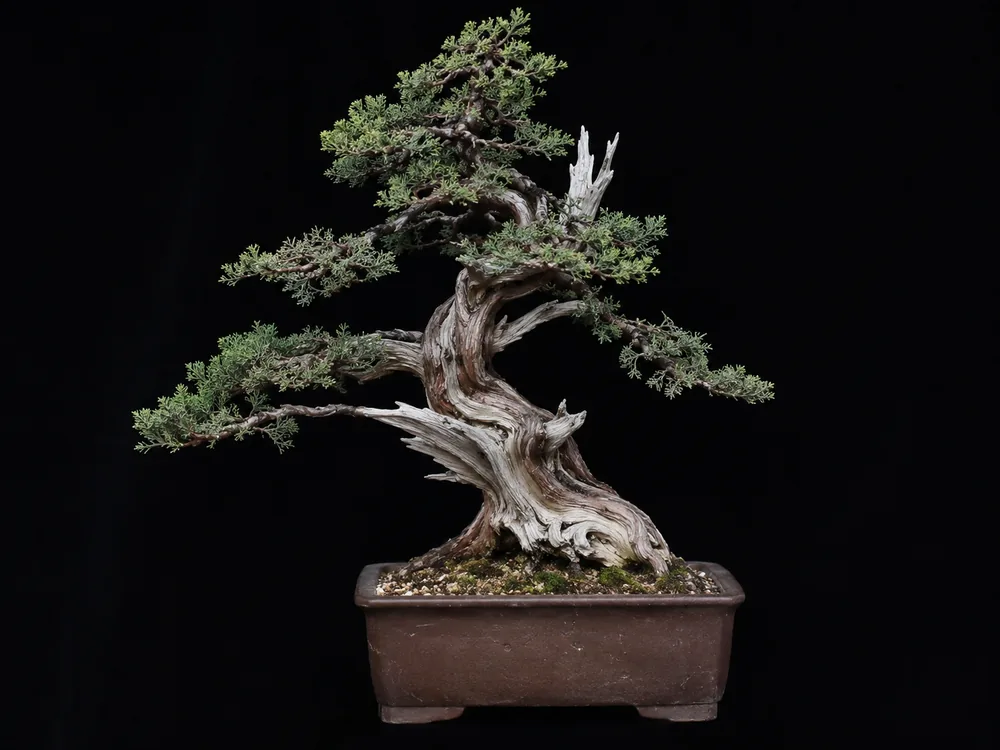
California Juniper Bonsai Care
Juniperus californica
One of the most dramatic and sought-after native bonsai subjects in the American West. Most are lost to overwatering.
Cupressaceae (the cypress family) · Evergreen, scale-foliage coniferous shrub/small tree; outdoor bonsai, prized as collected (yamadori) material for its deadwood
California Juniper quick reference
| USDA zones | Roughly 8–10 (warm, arid native range; not deeply cold-hardy) |
|---|---|
| Indoor / outdoor | Strictly outdoor — never an indoor tree |
| Light | Full sun, all day; demands maximum light |
| Water | Moderate / dry-tolerant but NOT bone-dry. Drought-tough in the ground, yet in a pot it must not dry out completely |
| Soil | Very free-draining, gritty, inorganic mix (pumice / lava / akadama); high oxygen |
| Repot | Infrequently — every 4–7+ years for established trees; leave fresh collections to recover for years |
| Frost | Limited; protect from hard freezes — a warm-climate desert species |
| Mature height (as bonsai) | Shrub-tree to 8 m; 25-60 cm as bonsai |
| Growth rate | Slow |
| Season of interest | Year-round evergreen, striking deadwood |
| Leaf reduction | Good - scale foliage tightens with pinching |
| #1 cause of death | Overwatering / root problems, and root-disturbing collected trees too soon (plus letting a potted tree go completely dry) |
Overview & Character
The California Juniper is one of the most dramatic and sought-after native bonsai subjects in the American West. It is treasured above all as collected (yamadori) material: ancient desert shrubs from the Mojave and surrounding arid country, where extreme drought has sculpted thick, chunky, weathered deadwood wrapped around thin live veins, topped with a contrasting mass of emerald-green foliage. Few species offer such powerful natural shari and jin.
Like all junipers it carries scale-like foliage and is a strictly outdoor tree that lives on sunshine. It is genuinely drought-hardy, but the most important — and most counterintuitive — care lesson is that a juniper in a bonsai pot cannot be treated like one in the desert ground: it has a small, confined root volume and must not be allowed to dry out completely. Equally critical, like all junipers it will not back-bud on bare old wood, so it must never be cut back past green foliage.
Identification
Foliage: Scale-like (adult) foliage, tiny, tightly overlapping, gray-green to emerald, hugging the shoots in the characteristic juniper pattern (not needle-like in the mature plant). Foliage is aromatic when crushed. Juvenile/stressed growth can show sharper, awl-like leaves.
Bark & trunk: Thin, fibrous, gray-brown to reddish bark that shreds in strips. The hallmark of collected specimens is the massive, bleached, fluted deadwood (shari) with one or more narrow live veins of bark feeding the canopy — a survival adaptation to desiccation.
Growth habit / form: A low, gnarled, often multi-trunked desert shrub or small tree, naturally contorted and asymmetrical with dramatic movement, deadwood, and sparse, clustered foliage — inherently bonsai-like.
Cones: Berry-like seed cones (juniper "berries"), fleshy, bluish to reddish-brown with a waxy bloom, about 0.3–0.6 inches (8–15 mm), usually containing one or two seeds.
Look-alikes & how to tell them apart: Easily confused with other western junipers. **Utah Juniper (Juniperus osteosperma) overlaps in range and look but tends to be more tree-like with a single dominant trunk and slightly different cone/seed counts. Western Juniper (J. occidentalis) is generally larger, found at higher elevation, with grayer foliage and gland-dotted scales. Rocky Mountain Juniper (J. scopulorum)** is hardier, more upright/columnar, and from colder interior ranges. As a group, junipers are distinguished from true cedars and cypresses by their berry-like (not woody) cones and shredding fibrous bark. When buying "California Juniper," confirm provenance — much collected material is regionally mixed.
Climate & USDA Zone
California Juniper is a warm, arid-climate species, hardy roughly across USDA zones 8–10. It is not a deeply cold-hardy juniper — its desert origins mean it should be protected from hard, prolonged freezes. It loves heat, intense sun, low humidity, and dry air, and tolerates poor soils. Keep it outdoors all year, but in colder regions provide winter shelter (cold frame, unheated greenhouse, or protected bench) once temperatures threaten a hard freeze, while still giving it a cool dormant rest.
Light
Full, direct sun all day, every day. This is non-negotiable. California Juniper is a desert sun-worshipper; insufficient light is one of the most common causes of decline in juniper bonsai, producing weak, leggy, sparse foliage and inviting pests and fungus. Maximum sun keeps the foliage tight, dense, and emerald, and the tree vigorous. Pair strong sun with good airflow.
Watering
Moderate — drought-tolerant but never bone-dry, and never soggy. This is the key nuance. In its native desert the tree survives extreme drought, but in a bonsai container with a small, fast-draining root volume the rules change: you must not let the soil go completely dry through the whole pot, or fine roots die back. At the same time, junipers in pots also fail from constant wetness and poor drainage.
The practical target is slightly moist soil: in the heat of the growing season a California Juniper may need watering once or even twice a day, but always in a free-draining mix so excess water runs straight through and air returns to the roots. Let the surface begin to dry between waterings, then water thoroughly — don't keep it swampy, and don't let it desiccate. Misting the foliage in dry heat is appreciated. In cool weather, reduce frequency sharply.
Soil & Root Care
Use a very free-draining, predominantly inorganic substrate — pumice and lava heavy, with some akadama, leaning grittier for collected and recovering trees. The mix must hold a little moisture while draining instantly and staying full of air.
Junipers depend on healthy fine roots and associated fungi — never bare-root a California Juniper, work roots gently and gradually, and keep some old soil. Repot infrequently: established trees every 4–7 years or more, in spring, only when strong and well-rooted. Collected desert junipers are extremely slow to re-establish — leave a freshly collected tree completely undisturbed in coarse, draining medium (often pure pumice) for two to several years until it is vigorously growing before doing any root work. Repotting too soon is a classic way to lose an irreplaceable yamadori.
Feeding
Feed regularly through the growing season to maintain a dense, healthy foliage mass, using a balanced fertilizer (organic pellets and/or liquid feed). Begin in spring as growth becomes active, continue through summer and into autumn, then taper off before winter rest. Do not fertilize a freshly collected or recovering tree until it is clearly re-established and pushing strong new growth — feeding a weak, poorly rooted juniper does harm, not good.
Pruning & Styling
The cardinal rule for all junipers, including California Juniper: never cut a branch back beyond its green foliage. Junipers do not reliably back-bud on bare old wood — if you cut a branch back to a leafless section, that branch will usually die rather than re-sprout. Always leave green growth on any branch you intend to keep.
Guidance:
- Let it grow, then refine: In early spring allow new shoots to extend freely; don't pinch emerging growth, because elongation helps move growth hormones and build strength throughout the tree.
- Pinch/thin, don't shear: Once growth has run, refine the silhouette by pinching or snipping back to a point where green foliage remains, and thin out congested/inner growth to admit light and air. Avoid blunt overall shearing, which weakens junipers and browns the cut tips.
- Structural pruning: Remove unwanted whole branches at the trunk when restyling, but never reduce a kept branch past its foliage.
- Wiring & deadwood: Wire in the cooler part of the year. California Juniper excels at deadwood work — live veins can be split away from deadwood (jin/shari), but the wood is brittle and must be handled carefully. Power tools are commonly used; preserve deadwood with lime sulfur.
Propagation & Cuttings
Ease: Cuttings possible; seed very slow; mostly collected. Best methods: collection; cuttings.
Junipers root from cuttings, and California juniper is no exception — semi-hardwood cuttings taken in late autumn to winter with a heel, dipped in IBA and kept cool and humid, root over several months at moderate rates. Seed is extremely slow and dormant (needs long, complex stratification) and rarely used. In practice the famous California juniper bonsai are collected yamadori from the high desert, valued for massive deadwood and live veins. For bonsai, cuttings are useful for shohin, but collected old material defines the species.
Pests
The major pest of juniper bonsai, especially in hot, dry climates, is spider mites — perfectly suited to California Juniper's preferred conditions. The first sign is foliage losing its rich green, fading to pale or mottled green, then browning; fine webbing may appear. Inspect often (tap foliage over white paper to spot moving dots). Also watch for juniper scale, aphids, mealybugs, juniper webworm, and bagworm. Treat mites with appropriate miticide and improve airflow and occasional foliage rinsing; treat scale/mealybugs/aphids with horticultural oil. Good ventilation and full sun reduce pressure — but note dusty, stagnant, indoor-like conditions invite mites.
Disease, Fungus & Infection
Junipers can suffer root rot from overwatering or poor drainage (a leading cause of unexplained decline), **tip blight / Phomopsis and Kabatina blights (browning, dieback of shoot tips), and juniper rusts (e.g. cedar-apple rust and relatives, producing galls or orange gelatinous masses, needing an alternate host such as apple/hawthorn nearby). A frequent silent killer is interior browning from lack of light and air circulation. Prevent disease with full sun, strong airflow, free-draining soil, balanced watering, and removal of dead interior foliage and debris. Treat blights and rusts with an appropriate fungicide and prune out affected tips back to healthy green growth (never into bare wood). Note that a juniper often looks fine for weeks after its roots have failed** — green foliage can mask a tree that is already dead, so root health is paramount.
Most Common Causes of Death
1. Overwatering / poor drainage / root rot. A confined, soggy root mass rots. Prevention: very free-draining inorganic soil, water to "slightly moist," never swampy, ensure water runs through freely. 2. Letting a potted tree go completely dry. Desert-tough in the ground, but a small pot's fine roots die if fully desiccated. Prevention: keep slightly moist; water 1–2x daily in summer heat; never assume "it's a desert plant, it can dry out." 3. Root work on collected trees too soon. Repotting an unrecovered yamadori kills it. Prevention: leave new collections undisturbed in pure pumice for 2+ years until vigorously growing; never bare-root. 4. Cutting branches back past green foliage. Junipers don't back-bud on bare old wood — the branch dies. Prevention: always leave green growth on any branch you keep; refine by pinching to foliage. 5. Insufficient light and air circulation. Causes weak, sparse, browning, pest-ridden growth. Prevention: full sun all day and open, airy placement. 6. Spider mite infestation. Thrives in the heat the tree loves and can defoliate it. Prevention: inspect regularly, rinse foliage, ensure airflow, treat promptly. 7. Lack of dormancy / hard freeze damage. It needs a cool rest but is not cold-hardy. Prevention: allow a cool dormant period but shelter from hard, prolonged freezes.
Seasonal Calendar
- Early Spring (Mar–Apr): Repotting window for strong, well-rooted established trees as growth resumes (only well-recovered trees). Begin feeding; let new shoots grow freely. Increase watering as it warms.
- Late Spring (May–Jun): Vigorous growth. Begin refining/pinching back to green foliage and thinning congestion. Watch closely for spider mites as heat rises.
- Summer (Jul–Aug): Peak heat — water 1–2x daily in a free-draining mix; mist in dry heat; never let it fully dry. Maintain feeding. Vigilant mite monitoring.
- Autumn (Sep–Nov): Continue light refinement; feed to harden the tree, then taper. Begin wiring and deadwood work as the tree cools down. Reduce watering as growth slows.
- Winter (Dec–Feb): Cool dormant rest. Reduce watering (keep barely moist). Protect from hard, prolonged freezes — cold frame or sheltered bench. Good season for deadwood carving and wiring while dormant.
Sources
- California Juniper Bonsai Guide — Bonsai Mirai
- Care and Maintenance Guide for Native US Juniper Bonsai (Juniperus) — Eisei-en / Bjorn Bjorholm
- Guide to Juniper Bonsai Tree Care — Bonsaify
- Care Guide for the Juniper Bonsai Tree (Juniperus) — Bonsai Empire
Where to buy a California Juniper bonsai
We don’t stock California Juniper at the moment. These species need similar care and we have them now — they are the closest match in our catalogue.
- Chinese Juniper — similar care, in stock now
- Nana Juniper (Japanese Garden Juniper) — similar care, in stock now
Browse all bonsai trees for sale or find a species matched to your climate and space.
- All species
- Shop bonsai trees, tools & supplies
- How to Water a Bonsai (Without Killing It)
- Bonsai Soil: What to Buy, What to Mix, and What It Costs
- Why Bonsai Die After Repotting: Diagnosing a Failed Repot
- Pruning vs. Pinching: Shaping Your Bonsai
- Overwintering Bonsai: Cold-Season Care
- Indoor Bonsai Light and Humidity: Making a Windowsill Actually Work
- Root Rot on bonsai
- Overwatering on bonsai
- Underwatering (Drought Stress) on bonsai
- Winter / Frost Damage on bonsai
- Insufficient Light (Etiolation) on bonsai
- Chinese Juniper bonsai care
- Eastern Red Cedar bonsai care
- Nana Juniper (Japanese Garden Juniper) bonsai care
- Needle Juniper bonsai care