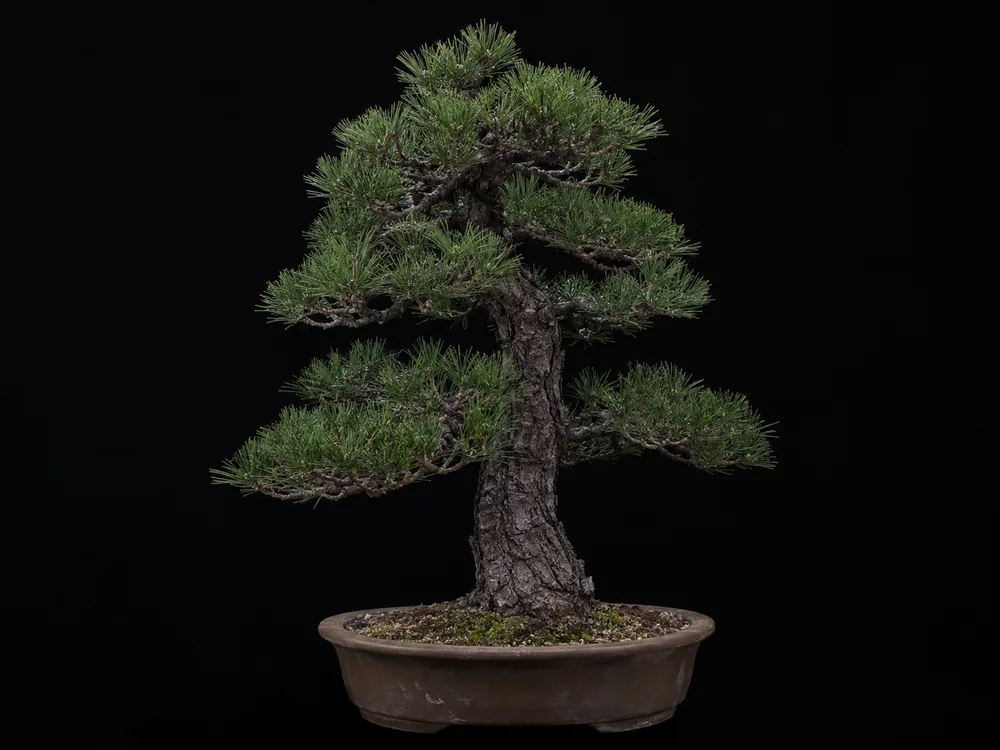
Japanese Black Pine Bonsai Care
Pinus thunbergii
1 Japanese Black Pine bonsai in stock, from $185.00 Shipped direct from our nursery partners, with a 48-hour live-arrival guarantee. See the trees
Zones 5 to 9, outdoor only. The "king" of classical bonsai, a vigorous, masculine, sun-loving conifer. Most are lost to overwatering.
Pinaceae · Evergreen conifer
Japanese Black Pine quick reference
| USDA zones | 5–9 |
|---|---|
| Indoor / outdoor | Outdoor only |
| Light | Maximum full sun — more is always better |
| Water | Let soil dry out between waterings — dislikes constant wetness |
| Soil | Very free-draining, gritty inorganic mix |
| Repot | Every 2–4 years (young more often) |
| Frost | Hardy; protect potted roots in severe freezes |
| Mature height (as bonsai) | Tree to 25 m; 30-80 cm as bonsai |
| Growth rate | Moderate |
| Season of interest | Year-round dark green needles, fissured bark |
| Leaf reduction | Good via decandling |
| #1 cause of death | Root rot from overwatering/poor drainage; weakness from mis-timed decandling |
Overview & Character
The Japanese Black Pine is the "king" of classical bonsai — a vigorous, masculine, sun-loving conifer with thick, fissured, dark bark, strong trunks, and stiff, dark-green needles in pairs. It is the species most associated with powerful, formal bonsai and with the advanced refinement technique of decandling, which is used to control vigor, balance energy, and produce short needles and dense ramification.
It is exceptionally tough and long-lived but demands the right culture: full sun, a soil that dries between waterings, and correctly timed seasonal work. It is a double-flush pine, meaning healthy trees can be decandled to force a second, finer flush of growth each year. JBP is a tree for the patient — it rewards disciplined, season-appropriate care.
This is an outdoor tree; it cannot live indoors.
Identification
Foliage: Stiff, sharp, dark green needles in bundles (fascicles) of two, fairly long and thick (commonly ~7–12 cm in unrefined trees; kept much shorter on refined bonsai through decandling). Needles are rigid and somewhat twisted, and notably more robust/coarse than most two-needle pines.
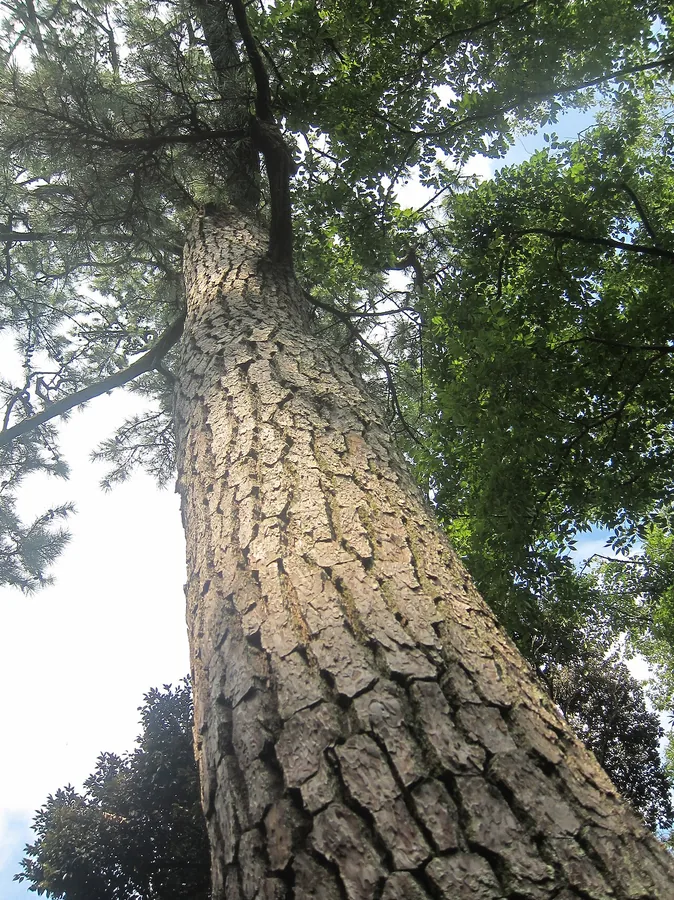
Bark & trunk: The classic tell — thick, deeply fissured, plated dark grey-black bark that develops corky character relatively young, giving the species its name and masculine look. Trunks are strong and often muscular.
Buds: A key ID feature — prominent, silvery-white, cylindrical winter buds covered in fringed white scales (contrasting with the reddish buds of Japanese Red Pine).
Growth habit / form: Vigorous, upright, double-flush conifer with a powerful, irregular natural form; the dominant species for formal/informal upright and powerful classical styles.
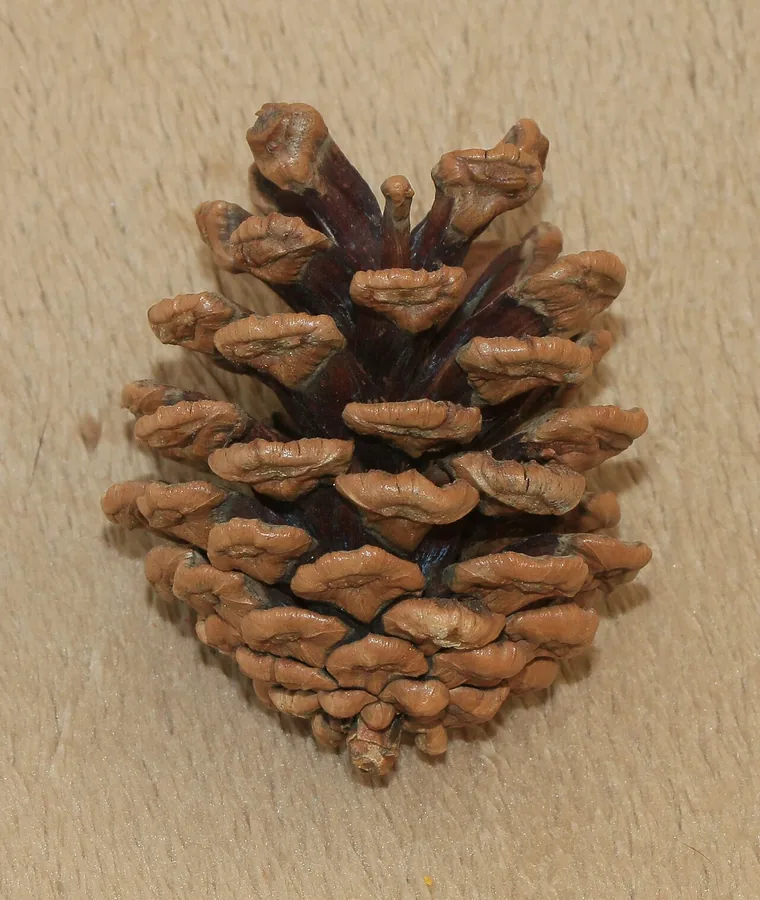
Cones: Ovoid-conic woody seed cones ~4–7 cm, borne in clusters, ripening grey-brown over two seasons.
Look-alikes & how to tell them apart: Most often confused with **Japanese Red Pine (Pinus densiflora) — both have paired needles, but distinguish by bark and buds: Black Pine has dark grey-black, deeply fissured bark and white buds, whereas Red Pine has flaky orange-red upper-trunk bark and reddish-brown** buds (Black Pine needles are also stiffer and coarser).
Climate & USDA Zone
Hardy in USDA zones 5–9. It needs full sun and a genuine winter dormancy. Tolerates heat, wind, coastal salt, and poor soils extremely well. Grow outdoors year-round; protect potted roots in severe winter freezes (the tree is hardy but exposed pot roots are more vulnerable than roots in the ground).
Light
As much direct sun as possible — full sun all day is ideal. Sun is what keeps a black pine healthy, compact, and able to support back-budding and decandling. Insufficient light produces weak, leggy growth, long needles, and a tree too weak to decandle. Never shade a black pine to "protect" it (except briefly after major work).
Watering
Let the soil dry out (nearly) between waterings. Black pines do not like to be kept constantly wet — poor drainage and persistent moisture cause root rot.
- Allow the soil to dry out substantially, then water thoroughly until it runs freely from the drainage holes, saturating the whole root ball.
- Don't, however, leave the roots bone-dry for long stretches — that slows growth; the goal is a wet/dry cycle, not chronic drought or chronic sogginess.
- JBP is relatively drought-tolerant compared with most species.
- Watering also interacts with technique: in refinement, slightly leaner watering helps keep needles short, while developing trees are watered more freely for vigor.
- Excellent drainage is non-negotiable.
Soil & Root Care
Soil: A very free-draining, gritty, predominantly inorganic mix — akadama / pumice / lava (often leaning heavier on pumice/lava for sharp drainage). Pines partner with mycorrhizal fungi (a beneficial white webbing in the soil); preserve it at repotting, as it aids pine health.
Repotting:
- Frequency: young/developing trees every 2 years; mature/refined trees every 3–4 (or more) years.
- Timing: early spring, as buds begin to swell/extend, before the candles open.
- Remove up to ~1/3 of the roots; do not bare-root — keep core roots and some existing soil/mycorrhizae intact.
- Aftercare: shelter from harsh sun/wind for a few weeks, keep appropriately watered (not soggy), and resume normal feeding once recovered.
Feeding
Black pines are heavy feeders, and fertilizer timing is a key technique:
- Developing trees: feed heavily throughout the growing season to build vigor and girth.
- Refined trees (being decandled): feed strongly in spring up to about one month before decandling, then stop fertilizing roughly a month before decandling (late spring/early summer) so the first flush hardens and the second flush stays compact; resume feeding after the summer candles have emerged and through autumn.
- Heavy autumn feeding builds reserves for winter and the next year's strength. Don't feed freshly repotted or dormant trees.
Pruning & Styling
Decandling (the signature JBP technique):
- On healthy, established trees, in early summer (around June to early July), completely cut off the spring candles (new shoots) back to their base / last year's needles.
- This forces a second, shorter flush of summer growth with smaller needles and creates branching at each cut — building fine ramification and balancing strength across the tree.
- Only decandle vigorous, healthy trees. Weak trees, recently repotted trees, or trees in development should not be decandled — it can severely weaken or kill an under-strength pine.
- Timing is regional: decandle earlier in short-season/cold climates, later in long-season/warm climates, so the second flush has time to mature before fall.
Needle plucking / thinning: in autumn, old needles and excess needles are plucked to balance strength (more needles left on weak areas, fewer on strong areas) and to let light into interior buds.
Pruning: structural pruning of branches is best in autumn (lower sap flow reduces excessive resin bleed).
Wiring: best applied in late autumn to winter while the tree is less active; pine branches set well but watch for wire bite, as bark scars. Protect bark on older trees.
Propagation & Cuttings
Ease: Easy from seed; graft for selections. Best method: seed.
Pinus thunbergii is grown from seed — soak and give a short cold-moist stratification (2–4 weeks), then sow in spring in lean, gritty mix; germination is good and seedlings are vigorous for a pine. Cuttings don't root; named forms are side-veneer grafted. Black pine is the classic bonsai pine because it back-buds strongly and responds to candle-cutting (decandling) to balance vigour and reduce needles. For bonsai, seedlings grown hard with mycorrhizae, or grafted cultivars, are the route.
Pests
- Aphids (on new shoots/candles)
- Scale insects
- Pine needle scale
- Spider mites (hot, dry conditions; needle stippling/bronzing)
- Pine sawfly larvae / caterpillars (chew needles)
- Bark beetles / borers (attack stressed or weakened trees)
Treat with horticultural oil, insecticidal soap, or appropriate systemics; keeping the tree vigorous is the best defense against borers/beetles.
Disease, Fungus & Infection
JBP is strong but can suffer in wet, stagnant, poorly drained conditions:
- **Root rot (Phytophthora / Pythium)** — from overwatering/poor drainage; the principal disease risk.
- **Needle cast / needle blight fungi (e.g., Dothistroma, Lophodermium)** — fungal needle browning and premature needle drop, worse in prolonged wet, humid, low-airflow conditions. Improve airflow, avoid wetting foliage in the evening, remove affected needles, apply copper or other appropriate fungicide if persistent.
- Diplodia (Sphaeropsis) tip blight — kills new shoots/candles, especially on stressed trees in wet springs; prune out affected tips, sanitize, fungicide if needed.
- General rule: pine diseases tend to appear when the soil stays wet (prolonged rain or overwatering) or when airflow is poor and foliage stays damp.
Prevention: full sun, sharp drainage, strong airflow, correct watering, and tool sanitation.
Most Common Causes of Death
1. Root rot from overwatering / poor drainage. The top killer; use a gritty free-draining mix, water on a wet/dry cycle, never standing water. 2. Decandling or hard-pruning a weak tree. Only decandle vigorous, established, healthy trees — never one recently repotted or in development. 3. Doing too much at once. Don't stack repotting, heavy root work, decandling, and heavy pruning in one season. 4. Insufficient sun. Shade weakens pines, stretches growth, and prevents refinement. 5. Chronic drought / borers; indoor keeping; unprotected winter roots. Keep vigor up to resist beetles/borers; grow outdoors with dormancy; shelter roots in severe freezes.
Seasonal Calendar
- Early spring: Repot if due (before candles open); begin feeding.
- Late spring: Candles extend; for refined trees stop fertilizing ~1 month before decandling; wire.
- Early summer: Decandle healthy established trees (~June–early July); protect the second flush.
- Autumn/Winter: Heavy autumn feeding; needle plucking; structural pruning; wire in winter; protect roots from severe freezes.
Close-up photo reference
Compare your tree against these to confirm the species and spot problems early.

_-_cone_-_S._Rae.jpg)
Sources
Buy a Japanese Black Pine bonsai
- All species
- Shop bonsai trees, tools & supplies
- How to Water a Bonsai (Without Killing It)
- Bonsai Soil: What to Buy, What to Mix, and What It Costs
- Why Bonsai Die After Repotting: Diagnosing a Failed Repot
- Pruning vs. Pinching: Shaping Your Bonsai
- Overwintering Bonsai: Cold-Season Care
- Indoor Bonsai Light and Humidity: Making a Windowsill Actually Work
- Root Rot on bonsai
- Overwatering on bonsai
- Underwatering (Drought Stress) on bonsai
- Winter / Frost Damage on bonsai
- Insufficient Light (Etiolation) on bonsai
- Eastern White Pine bonsai care
- Japanese White Pine bonsai care
- Ponderosa Pine bonsai care
- Bristlecone Pine bonsai care