Heavenly Bamboo Bonsai Care
Nandina domestica
1 Heavenly Bamboo bonsai in stock, from $54.95 Shipped direct from our nursery partners, with a 48-hour live-arrival guarantee. See the trees
Zones 6 to 9, outdoor. Not a bamboo. Most are lost to pests.
Berberidaceae (barberry family) · Hardy evergreen to semi-evergreen shrub with cane-like stems and fine compound foliage
Heavenly Bamboo quick reference
| USDA zones | 6–9 for the species; 'Firepower' commonly listed 6a–9b |
|---|---|
| Indoor / outdoor | Outdoor. A hardy landscape shrub, not a houseplant |
| Light | Full sun to deep shade — the red winter colour is far better in full sun |
| Water | Let it dry slightly between waterings. Genuinely heat- and drought-tolerant |
| Soil | Adaptable, any reasonable pH, provided it drains |
| Repot | Not documented for bonsai; every 2–3 years in spring is general practice |
| Frost | To roughly −10°F at the cold end of zone 6. Protect the pot |
| Mature height (as bonsai) | 6–8 ft for the species; 'Firepower' is a dwarf at 2–2.5 ft. 15–40 cm as bonsai |
| Growth rate | Slow to moderate for 'Firepower' |
| Season of interest | Red-tinged new growth in spring, white flower panicles, and red-to-purple foliage through autumn and winter |
| Leaf reduction | Not documented; the compound leaflets are naturally fine |
| #1 cause of death | Nothing species-specific — it has no serious pests or diseases. Failures are ordinary container mistakes |
Overview & Character
Nandina is not a bamboo. It is a member of the barberry family that happens to have cane-like stems and layered, feathery, compound foliage, and the resemblance stops there.
'Firepower' is the dwarf cultivar most often sold for container work, and it is a good match for bonsai: naturally compact at 2–2.5 ft, densely mounding, with fine tripinnate leaves that turn genuinely striking shades of red and purple through autumn and winter — best of all in full sun. Against the general run of species in this catalogue it is unusually forgiving: heat-tolerant, drought-tolerant, shade-tolerant, and with no serious pest or disease problems documented by extension services.
An honest oddity worth knowing. Clemson Extension notes that dwarf Nandina selections including 'Firepower' are commonly infected with a non-lethal virus that causes the leaf cupping, crinkling and twisting that gives them their characteristic texture — and which may also be responsible for their dwarf habit and slow growth. It does not harm the plant. But the compact, crinkled look you bought is partly viral, and that seems worth saying out loud.
Identification
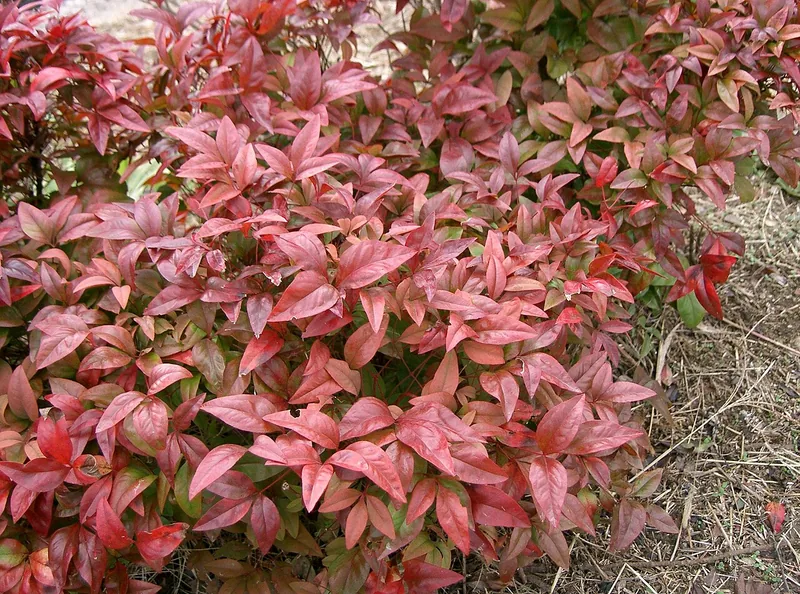
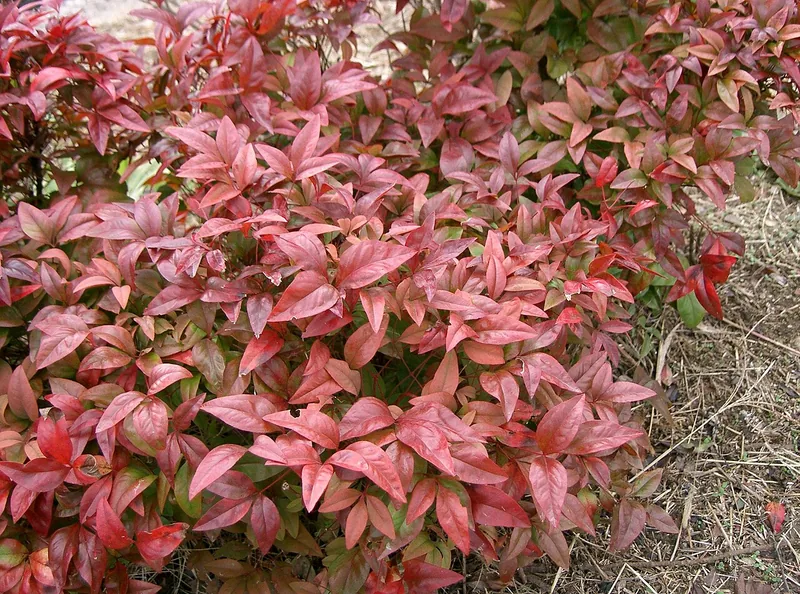
Foliage: Overlapping layers of fine-textured, bi- to tripinnately compound leaves up to 30–60 cm long, giving an umbrella-like tiered form. Leaflets are oval to lance-shaped. New growth emerges red-tinged; autumn and winter foliage turns red to reddish-purple, most intensely in full sun. On 'Firepower' the leaves are noticeably cupped and crinkled.
Stems: Erect, unbranched, cane-like — the source of the bamboo comparison. The species spreads by underground rhizomes; 'Firepower' is far more restrained.
Flowers & fruit: Showy white flower panicles 15–30 cm, April to June, followed in the species by bright red berries persisting through winter. 'Firepower' is a low- or non-fruiting selection, which matters (see below).
Look-alikes: True bamboos, superficially only — they are grasses with hollow jointed culms and simple strap leaves. Nothing else in a bonsai collection resembles Nandina closely.
Climate & USDA Zone
Zones 6–9 for the species, with 'Firepower' commonly listed 6a–9b. It survives to roughly −10°F at the cold end, with dieback increasing below that; zone 5 plantings need frost cloth, mulch or a sheltered wall.
As always with a pot: root hardiness in a shallow container is well below the ground figure. Protect the pot even though the top growth is comparatively tough.
Light
Full sun to deep shade — one of the most adaptable species here. But the autumn and winter foliage colour, which is the main reason to grow 'Firepower', develops properly only in full sun. In deep shade you get a green plant.
Watering
Let it dry slightly between waterings. Documented as heat- and drought-tolerant, which makes it noticeably more forgiving than Pieris or beech. In a bonsai pot it should still not be allowed to dry out repeatedly — moderate, even watering with tolerance for the occasional dry spell is the right pattern.
Soil & Root Care
Adaptable. It does not need the acid conditions Pieris demands and tolerates a range of soil types and pH. Good drainage is still preferable.
Honest gap: no Nandina bonsai repotting interval is documented. Every two to three years in spring, before growth begins, is the sensible general practice.
Feeding
Moderate feeding through the growing season with a balanced fertiliser. It is not a hungry plant and overfeeding will cost you the intensity of the winter colour by pushing soft green growth.
Pruning & Styling
Nandina's structure is cane-like: stems rise unbranched from the base rather than ramifying into fine twigs. Styling therefore works with cane placement and the tiered foliage layers rather than classical branch development. Old canes can be cut to the base to renew the clump and encourage new shoots.
Honest gap: there is no dedicated Nandina bonsai literature that we could find. Treat pruning-as-bonsai technique here as an area to experiment in rather than a documented method.
Propagation & Cuttings
Ease: Moderate. Best methods: division of the clump; stem cuttings.
As a named cultivar, 'Firepower' must be propagated vegetatively to stay true. Specific bonsai propagation data is not documented.
Pests
Clemson Extension states plainly that Nandina has no serious insect problems. This is a genuinely low-maintenance plant.
Disease, Fungus & Infection
Likewise, no serious disease problems documented. The non-lethal virus present in dwarf cultivars (see Overview) is asymptomatic beyond the leaf texture it causes.
Most Common Causes of Death
There is no dramatic species-specific killer here, and we are not going to invent one. Extension sources describe it as free of serious pests and diseases. Realistically, a Nandina bonsai dies from ordinary container failures:
1. Root-bound neglect in a pot left unrepotted for years. 2. Poor drainage in a mix that has broken down. 3. Repeated complete dry-out — it is drought-tolerant, not immortal. 4. Unprotected roots in a hard freeze, particularly at the cold edge of its range.
For a beginner, this is one of the more forgiving species on the site.
Seasonal Calendar
- Spring: Repot if due before growth starts; red-tinged new growth; flower panicles from April.
- Summer: Full sun for winter colour; moderate watering; light feeding.
- Autumn: Foliage colours up. Reduce feeding.
- Winter: The main display season for 'Firepower' — red and purple foliage. Protect the pot from hard freezes.
Toxicity, Safety & Handling
The berries contain cyanogenic glycosides. Research documented by the North Carolina Botanical Garden and the UNC Herbarium links Nandina fruit to bird deaths — cedar waxwings in particular, which gorge on berries in flocks and can consume a lethal dose.
For people, the National Capital Poison Center describes low toxicity from small ingestions, but the berries should not be eaten and should be kept from pets and children.
'Firepower' is a low- or non-fruiting selection, which makes it a meaningfully lower-risk choice than the fruiting wild type — Clemson Extension recommends exactly these non-fruiting cultivars as the responsible alternative. If your plant does set fruit, remove it.
Close-up photo reference
Compare your tree against these to confirm the species and spot problems early.

Sources
- Nandina — Clemson Cooperative Extension HGIC 1071
- Nandina Fruits Can Be Toxic to Birds — North Carolina Botanical Garden, UNC-Chapel Hill
- Nandina domestica or "Heavenly Bamboo" — National Capital Poison Center
Buy a Heavenly Bamboo bonsai
- All species
- Shop bonsai trees, tools & supplies
- How to Water a Bonsai (Without Killing It)
- Bonsai Soil: What to Buy, What to Mix, and What It Costs
- Why Bonsai Die After Repotting: Diagnosing a Failed Repot
- Pruning vs. Pinching: Shaping Your Bonsai
- Overwintering Bonsai: Cold-Season Care
- Indoor Bonsai Light and Humidity: Making a Windowsill Actually Work
- Underwatering (Drought Stress) on bonsai
- Winter / Frost Damage on bonsai
- Fungal Canker & Dieback on bonsai
- Overwatering on bonsai
- Root Rot on bonsai
- Boxwood bonsai care
- Cork Oak bonsai care
- Cotoneaster bonsai care
- Japanese Mock Orange bonsai care