Eastern Redbud Bonsai Care
Cercis canadensis
Zones 4 to 9, outdoor. A small understory tree of eastern North America. Most are lost to repotting shock.
Fabaceae (legume/pea family) · Deciduous flowering broadleaf tree
Eastern Redbud quick reference
| USDA zones | 4 to 9 |
|---|---|
| Indoor / outdoor | Outdoor: a temperate deciduous tree that needs a real winter dormancy |
| Light | Full sun to part shade: sun for best flowering; light afternoon shade in hot climates |
| Water | Evenly moist: likes regular water, not drought-tolerant in a pot; never waterlogged |
| Soil | Well-draining bonsai mix; tolerates a range of pH |
| Repot | Every 2 to 3 years in early spring before bud break |
| Frost | High: cold-hardy to roughly −30 °C / −20 °F in the ground; protect the pot from hard freeze |
| Mature height | Tree to 9 m; kept 30-70 cm as bonsai |
| Growth rate | Moderate |
| Season of interest | Pink spring blossom, yellow autumn color |
| Leaf reduction | Limited - large heart-shaped leaves |
| #1 cause of death | Root disturbance / heavy root pruning: redbuds have coarse, sensitive roots and resent aggressive work |
Overview & Character
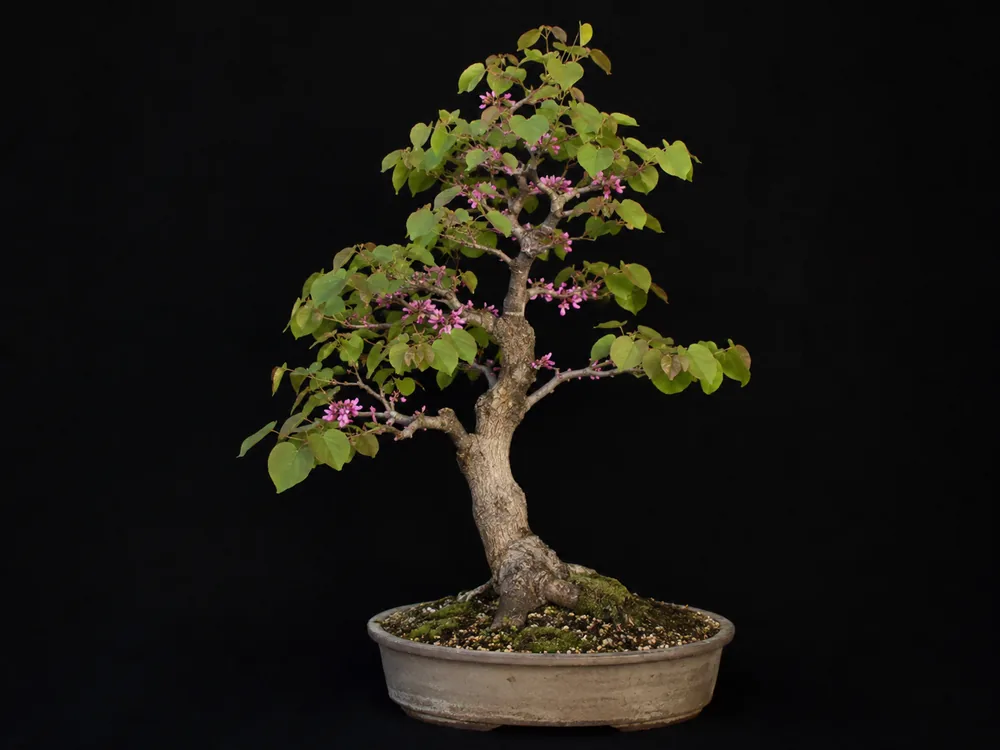
Eastern redbud is a small understory tree of eastern North America, famous for the burst of rosy-pink to magenta flowers that clothe its bare branches, and even the trunk (cauliflory), in early spring before the leaves emerge. As a bonsai it is grown above all for that spring flower show, followed by handsome heart-shaped leaves that can turn yellow in autumn, and by a naturally picturesque, twisting, often multi-trunked form. A well-developed redbud in full bloom is one of the most striking flowering bonsai in the temperate palette.
The care keys: treat it as a true outdoor deciduous tree that needs to go fully dormant in winter, give it plenty of sun to fuel flowering, keep it consistently watered in its pot, and, critically, work its roots cautiously. Redbuds are legumes with coarse, somewhat brittle root systems and long taproots in youth; they do not enjoy heavy or frequent root pruning, and impatience at repotting is the classic way to lose one. Handle the roots gently and it is a rewarding, hardy, long-lived subject.
Identification
Foliage: Alternate, simple, heart-shaped (cordate) leaves 7 to 12 cm across, emerging reddish-bronze and maturing to smooth green; often clear yellow in autumn. Reduce well with pruning and light-management.
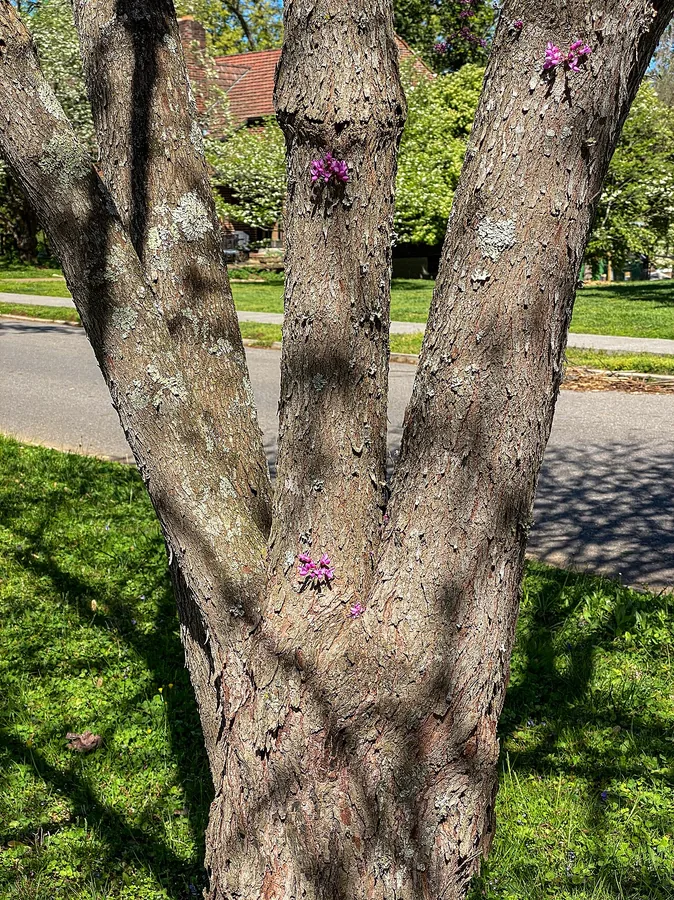
Bark & trunk: Young bark smooth and gray-brown, developing into dark, scaly, ridged bark with reddish inner tones on older trunks, attractive, aged character on mature bonsai.
Growth habit / form: Small tree to 6 to 9 m in nature with a broad, rounded, often irregular crown; frequently leans or divides low, giving natural informal, twisting, and multi-trunk forms.
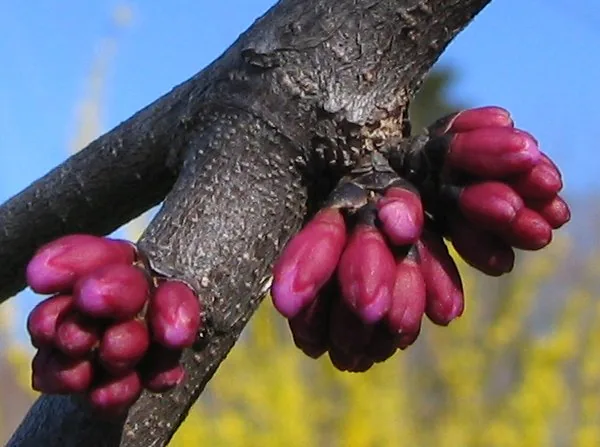
Flowers / fruit: Clusters of small pea-like rosy-pink to magenta flowers borne directly on branches and trunk in early spring before leaf-out; followed by flat, brown, bean-like seed pods (legumes) that can persist into winter.
Look-alikes & how to tell them apart: Easily confused with the European Cercis siliquastrum (Judas tree), which has slightly larger, more rounded (notched-tip) leaves and even showier trunk-borne bloom. The reliable tell is leaf tip: C. canadensis has a distinctly pointed (acuminate) heart-shaped leaf, whereas C. siliquastrum leaves are rounded or notched at the tip. Range and cold-hardiness differ too; C. canadensis is far hardier.
Climate & USDA Zone
Eastern redbud is fully cold-hardy across USDA zones 4 to 9, tolerating ground temperatures down to roughly −30 to −34 °C (−20 to −30 °F). It requires a genuine winter dormancy with cold, so it must live outdoors year-round; it is not an indoor tree. The vulnerability in bonsai culture is the exposed rootball: pot roots are far less hardy than the trunk, so in hard-freeze regions protect the pot over winter (heel it into the ground, mulch it, or move it to a cold frame or unheated shed) to keep roots from freezing solid, while still giving the tree its needed chill. In hot southern summers, light afternoon shade prevents leaf scorch.
Light
Give redbud full sun to light part shade; plenty of sun is what drives strong flower-bud set for the spring display. In cooler climates, full sun is ideal. In hot-summer regions, dappled or afternoon shade protects the thin heart-shaped leaves from scorch and reduces watering stress. Too much shade means weak growth and poor bloom.
Watering
Keep the soil evenly moist through the growing season; redbud is not drought-tolerant in a pot and dislikes drying out, but equally must never sit waterlogged.
- Water thoroughly whenever the surface begins to dry; in summer heat this may be daily.
- Do not let the rootball fully dry: drought stress causes leaf scorch, wilting, and dieback.
- Ensure sharp drainage; standing water rots the coarse roots.
- Reduce watering in autumn and give only enough over dormancy to keep roots from drying out completely.
Soil & Root Care
Soil: A well-draining bonsai mix such as akadama with pumice and lava (roughly 2:1:1), or a quality inorganic mix with some organic component. Redbud tolerates a fairly wide pH range and is not fussy about substrate as long as drainage is good.
Repotting:
- Repot every 2 to 3 years, less often as the tree matures.
- Time it for early spring, just before or as buds swell, while dormant; this is when it recovers best.
- Root-prune conservatively: redbuds have coarse, somewhat brittle roots and resent heavy work; remove only a modest portion, tease out old soil gently, and never bare-root a mature specimen.
- Aftercare: keep sheltered from wind and hard sun for a few weeks, protect from late frost, water carefully, and delay feeding until new growth appears.
Feeding
Feed from spring leaf-out through summer. Because redbud is a nitrogen-fixing legume, it does not need heavy nitrogen; a balanced fertilizer every 2 to 4 weeks, or a slow-release organic feed, supports growth well. To favor flowering, ease off nitrogen in late summer and allow the tree to set buds; a slightly higher-phosphorus feed in late summer/autumn can support next spring's bloom. Stop feeding once the tree goes dormant.
Pruning & Styling
- Suitable styles include informal upright (moyogi), slanting, clump and multi-trunk forms that echo its naturally leaning, divided habit; its cauliflorous bloom suits broad, characterful trunks.
- Prune structurally in late winter/early spring, but note that flowers form on old wood; heavy dormant pruning removes bloom, so prune the main structure right after flowering if you want to preserve the spring show.
- Pinch and trim new shoots through the growing season to build ramification and reduce leaf size; redbud back-buds reasonably on older wood.
- Wire young, flexible branches; older wood is stiff and brittle and snaps easily, so bend cautiously and use guy wires for larger limbs.
- Seal larger cuts, as redbud can be prone to dieback and canker at wounds.
Propagation & Cuttings
Ease: Moderate. Best methods: seed; collected (cuttings hard).
Cercis canadensis is grown mainly from seed, which has a double dormancy: scarify the hard coat (nick or hot-water soak) then cold-moist stratify ~2 months before spring sowing. Cuttings root poorly and are rarely successful; named forms are budded or grafted. Redbud resents root disturbance, so sow where it can grow on or pot early. For bonsai, seedlings or young collected trees are the route; the early pink flowers on bare wood are the reward, appearing once trunks mature.
Pests
- Treehoppers (e.g. buffalo treehopper): lay eggs in twigs, causing scarring and dieback; prune out affected twigs and treat with insecticidal soap.
- Leafhoppers: feed on foliage causing stippling and distortion; control with insecticidal soap.
- Scale insects: appear as bumps on stems; treat with horticultural oil, especially a dormant-oil application.
- Caterpillars / leaf rollers: chew and roll leaves; hand-pick or treat with Bacillus thuringiensis (Bt).
- Spider mites: in hot, dry conditions, causing stippling; rinse foliage and treat with miticidal soap.
Treatment line: for sap-suckers use insecticidal soap or horticultural oil on both leaf surfaces every 7 to 10 days; for chewing pests hand-pick or apply Bt.
Disease, Fungus & Infection
- Canker (Botryosphaeria): the most serious real disease of redbud; causes sunken lesions and branch dieback, entering through wounds and stressed tissue. Prune out cankered wood well below the lesion and seal cuts; keep the tree vigorous.
- Verticillium wilt: soil-borne fungus causing sudden wilting and branch death; there is no cure; remove affected wood and avoid stressing the tree.
- Leaf spot / anthracnose fungi: dark blotches in wet, humid conditions; remove affected leaves and improve airflow.
- Root rot (Phytophthora): from waterlogged soil; prevented by sharp drainage and careful watering.
Prevention: keep the tree healthy and unstressed, avoid unnecessary wounds, prune cleanly and seal cuts, ensure good drainage and air movement, and remove diseased wood promptly.
Most Common Causes of Death
1. Aggressive / frequent root pruning: the number-one killer in bonsai culture; redbud's coarse, brittle roots resent heavy work and can fail to recover. Root-prune sparingly and only in early spring. 2. Frozen rootball in winter: the pot roots are far less hardy than the trunk and can be killed by a hard freeze. Protect the pot (mulch, cold frame, or heel into the ground) while still allowing dormancy. 3. Drought / letting the pot dry out: redbud is not drought-tolerant in a container; drying triggers scorch and dieback. Keep evenly moist. 4. Canker / Verticillium taking hold in a stressed tree: disease exploits wounds and stress. Keep it vigorous, avoid injury, and cut out infected wood early. 5. Waterlogging / root rot: soggy soil rots the roots. Use free-draining substrate and never let the pot stand in water.
Seasonal Calendar
- Spring: Flowering on bare wood, then leaf-out; repot in early spring before bud break if due, prune structurally just after bloom, resume feeding as leaves expand.
- Summer: Full growth: keep evenly watered (daily in heat), feed moderately, pinch shoots for ramification; provide afternoon shade in hot climates and watch for mites and treehoppers.
- Autumn: Leaves may color yellow and drop; reduce watering and feeding, allow the tree to harden off, and begin arranging winter root protection.
- Winter: Fully dormant outdoors: protect the pot/roots from hard freeze while ensuring the tree gets its needed chill; water only enough to keep roots from drying out.
Close-up photo reference
Compare your tree against these to confirm the species and spot problems early.
_Bark_and_Blooms_-_Knoxville,_Tennessee_-_April_10,_2020.jpg)

Sources
- Wikipedia: *Cercis canadensis*
- Missouri Botanical Garden: *Cercis canadensis*
- The Morton Arboretum: Eastern redbud
Growing a Eastern Redbud bonsai
We don’t currently stock Eastern Redbud trees. If you already have one — or you are sourcing one elsewhere — these are the supplies its care depends on:
- Bonsai Decorative Crushed Shale Top of Soil Dressing — $4.95
- Bonsai Zen Garden Grooming Rake — $8.95
- Metal Impression Tags Package of 4 — $2.95
Browse all bonsai trees, tools and soil or find a species we stock that suits your conditions.
- All species
- Shop bonsai trees, tools & supplies
- How to Water a Bonsai (Without Killing It)
- Bonsai Soil: What to Buy, What to Mix, and What It Costs
- Why Bonsai Die After Repotting: Diagnosing a Failed Repot
- Pruning vs. Pinching: Shaping Your Bonsai
- Overwintering Bonsai: Cold-Season Care
- Indoor Bonsai Light and Humidity: Making a Windowsill Actually Work
- Root Rot on bonsai
- Underwatering (Drought Stress) on bonsai
- Winter / Frost Damage on bonsai
- Leaf Scorch / Sunburn on bonsai
- Spider Mites on bonsai
- Amur Maple bonsai care
- Beautyberry bonsai care
- Common Hackberry bonsai care
- European Spindle bonsai care