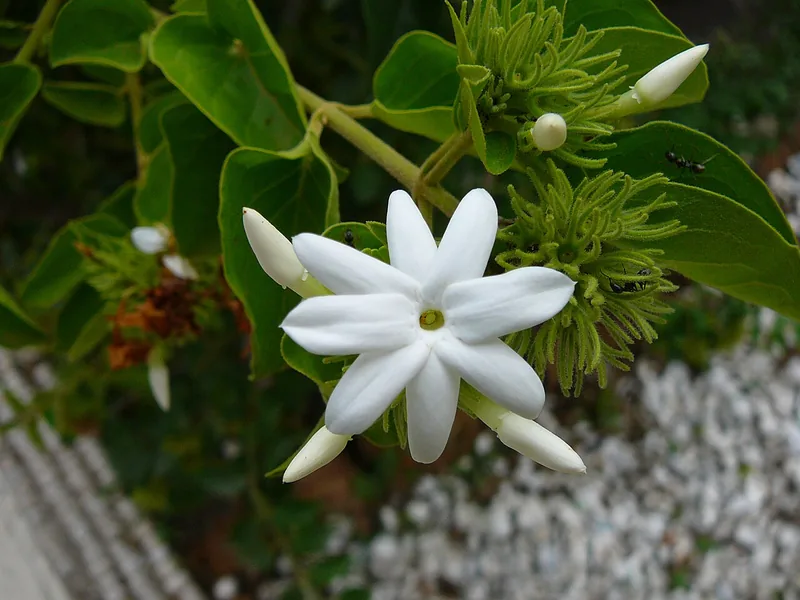
Downy Jasmine Bonsai Care
Jasminum multiflorum
1 Downy Jasmine bonsai in stock, from $48.95 Shipped direct from our nursery partners, with a 48-hour live-arrival guarantee. See the trees
Zones 9 to 11, outdoor. The workhorse of the tropical jasmines: fast, dense, floriferous. Most are lost to cold damage.
Oleaceae (olive family) · Tropical evergreen flowering shrub or scrambler; tender, vigorous
Downy Jasmine quick reference
| USDA zones | 9–11 outdoors year-round; indoors or greenhouse everywhere else |
|---|---|
| Indoor / outdoor | Outdoors through the warm season; indoors before nights approach 50°F |
| Light | Full sun to semi-shade — more shade-tolerant than Arabian Jasmine |
| Water | Evenly moist. Water thoroughly, but the roots must never sit waterlogged |
| Soil | Adaptable, provided it drains freely |
| Repot | Not documented for this species; general practice is every 1–2 years while young, spring |
| Frost | None. Leaf drop and dieback below about 50°F (10°C) |
| Mature height (as bonsai) | Vigorous scrambler; specific wild dimensions not well documented |
| Growth rate | Fast — noticeably more vigorous than Arabian Jasmine |
| Season of interest | Masses of white star-shaped flowers; little to no fragrance |
| Leaf reduction | Not documented |
| #1 cause of death | Cold exposure — leaf drop and dieback below 10°C, then collapse |
Overview & Character
Downy Jasmine is the workhorse of the tropical jasmines: fast, dense, floriferous, and more tolerant of shade than its perfumed cousin. It flowers heavily and repeatedly, covering itself in small white stars, and it fills out a bonsai silhouette quickly.
What it does not do is smell. That is worth saying twice because it is the most common disappointment with this species — it looks like jasmine and it flowers like jasmine and it has almost no scent.
Its speed cuts both ways. You get a filled-out tree quickly, and you get a leggy mess quickly if you stop pruning.
Identification
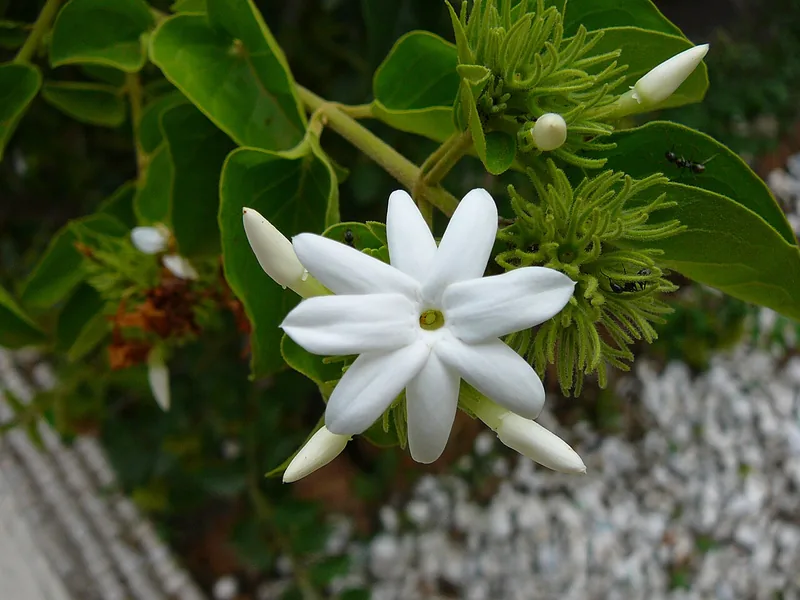
Foliage: Ovate to heart-shaped leaves, 3–8 cm, covered in soft hairs that give the whole plant a grey-green, faintly silvery, downy cast. Older leaves lose some hairiness except along the veins. The hairiness is the definitive identification against J. sambac, which is glossy and hairless. The sepals are noticeably hairy too.
Growth habit: Vigorous, dense, scrambling; fills space quickly and cascades if unsupported.
Flowers: White, star-shaped, in clusters. Abundant. Essentially unscented.
Look-alikes:
- J. sambac — glossy hairless leaves, powerfully fragrant flowers.
- J. nudiflorum — deciduous, yellow, hardy, winter-flowering.
- Trachelospermum jasminoides — the true "star jasmine", a different family entirely.
Climate & USDA Zone
Zones 9–11 for reliable outdoor growing. It may survive in a sheltered 8b microclimate, but freeze damage is a genuine risk.
One caution on sources: you may encounter claims online that this species is hardy to zone 5 and tolerates −12°C. Those figures appear in AI-generated aggregator content and contradict every horticultural source we could find. Do not rely on them. Treat this as a tender tropical, zones 9–11.
Light
Full sun to semi-shade. It is more shade-tolerant than Arabian Jasmine, which makes it a slightly easier indoor subject over winter, though flowering is always heaviest in strong light.
Watering
Evenly moist. Water thoroughly so the whole rootball is wetted, and let the excess drain away completely. It is adaptable about soil type as long as the roots are never waterlogged. A fast grower in summer will need checking daily; reduce noticeably in winter.
Soil & Root Care
Adaptable, provided it drains. A standard free-draining bonsai mix is fine.
Honest gap: we could not find a documented repotting frequency for this species. Given its documented vigour, every one to two years while the tree is developing, in spring, is the sensible general practice — adjust to how fast it fills its pot.
Feeding
Feed regularly through the warm growing season — a fast grower that flowers heavily uses a lot. A balanced fertiliser every two to four weeks. Stop over winter.
Pruning & Styling
It grows in flushes: a wave of flowers, then vigorous new extension, then some shedding of inner leaves. Prune to shape after a flowering flush finishes, and avoid heavy cutting immediately before a bloom cycle.
Because it is vigorous, expect to trim often. Left alone it runs to long lax shoots and the interior thins out.
Honest gap: the precise optimal pruning calendar for this species is inferred from the genus pattern rather than documented for J. multiflorum specifically. Watch how your plant flushes and work with it.
Propagation & Cuttings
Ease: Easy. Best method: semi-hardwood cuttings.
Consistent with the genus, semi-hardwood cuttings root readily in warm humid conditions. We could not find explicit confirmation for this species specifically, but there is no reason to expect it differs from its relatives.
Pests
Not separately documented for this species. The genus set — aphids, spider mites, whiteflies, mealybugs, scale — is what to watch for, especially in dry indoor air in winter.
Disease, Fungus & Infection
Not separately documented for this species. Fungal problems under poor drainage and stagnant air are the predictable risk, consistent with the genus.
Most Common Causes of Death
1. Cold. The best-documented failure mode: leaf drop and dieback below about 50°F, then collapse. Almost always because it was treated like a hardy jasmine. 2. Waterlogged roots. The secondary risk, and the one that finishes off plants weakened by a cold winter. 3. Neglected pruning. Not fatal, but a vigorous scrambler left untrimmed becomes a shapeless tangle with a bare interior.
Seasonal Calendar
- Spring: Repot if due; resume feeding; outdoors once nights are reliably above 55°F.
- Summer: Bright light, even moisture, regular feeding. Flowering flushes; trim after each.
- Autumn: Prune back after the final flush; indoors before nights approach 50°F.
- Winter: Bright, warm, drier, minimal feed. Protect from cold draughts.
Toxicity, Safety & Handling
As a true Jasminum in the family Oleaceae, this is covered by the ASPCA's genus-level rating of non-toxic to dogs, cats and horses. We have not found a species-level confirmation, so we would describe it as believed non-toxic on a genus rating rather than individually verified.
Close-up photo reference
Compare your tree against these to confirm the species and spot problems early.

Sources
- Jasminum multiflorum (Burm.f.) Andrews — Plants of the World Online, Kew
- Jasminum multiflorum — Wikipedia
- Jasminum multiflorum — Florida Plant Atlas, University of South Florida
- Jasmine — ASPCA Toxic and Non-toxic Plants
Buy a Downy Jasmine bonsai
- All species
- Shop bonsai trees, tools & supplies
- How to Water a Bonsai (Without Killing It)
- Bonsai Soil: What to Buy, What to Mix, and What It Costs
- Why Bonsai Die After Repotting: Diagnosing a Failed Repot
- Pruning vs. Pinching: Shaping Your Bonsai
- Overwintering Bonsai: Cold-Season Care
- Indoor Bonsai Light and Humidity: Making a Windowsill Actually Work
- Root Rot on bonsai
- Winter / Frost Damage on bonsai
- Spider Mites on bonsai
- Scale Insects on bonsai
- Aphids on bonsai
- Parrot's Beak bonsai care
- Arabian Jasmine bonsai care
- Bahama Berry bonsai care
- Black Olive bonsai care