
Buddhist Pine Bonsai Care
Podocarpus macrophyllus
4 Buddhist Pine bonsai in stock, from $59.95 Shipped direct from our nursery partners, with a 48-hour live-arrival guarantee. See the trees
Zones 8 to 11, indoor or out. A slow, dignified evergreen from southern Japan and China that has become one of the most. Most are lost to overwatering.
Podocarpaceae (podocarp / southern-conifer family) · Evergreen coniferous tree (not a true pine)
Buddhist Pine quick reference
| USDA zones | 8 to 11 |
|---|---|
| Indoor / outdoor | Indoor-capable: one of the best true indoor bonsai; enjoys a summer outdoors |
| Light | Bright indirect to a few hours direct: very shade-tolerant for a conifer |
| Water | Moderate, slightly dry: let the top dry; hates soggy roots |
| Soil | Free-draining, slightly acidic mix; e.g. akadama/pumice/lava with a little organic |
| Repot | Every 2 to 4 years (young), 4 to 5 years (older) |
| Frost | Low: damage below about −4 °C (25 °F); protect from hard frost |
| Mature height | 10-20m wild; 30-60cm as bonsai |
| Growth rate | Slow; buds on old wood |
| Season of interest | Year-round dark strap-like evergreen leaves |
| Leaf reduction | Leaves reduce moderately with pruning |
| #1 cause of death | Root rot from overwatering in a poorly draining pot |
Overview & Character
Podocarpus macrophyllus is a slow, dignified evergreen from southern Japan and China that has become one of the most reliable indoor bonsai available. Despite the common name "Buddhist Pine," it is not a pine at all; it belongs to the ancient southern-hemisphere-associated conifer family Podocarpaceae, and its long, strap-shaped leaves are far broader than any true pine needle. It back-buds readily on old wood, tolerates deep shade better than almost any other conifer, and forms dark, dense pads of foliage that make it a favorite for formal upright and informal styling. Note that the foliage, seeds, and especially the fleshy purple aril are mildly toxic if ingested; keep it away from pets and children who might chew it.
Care keys: give it bright light, water when the surface has dried, feed through the growing season, and above all keep the soil free-draining and never waterlogged; this species is forgiving of neglect and dry air but unforgiving of wet feet and hard frost.
Identification
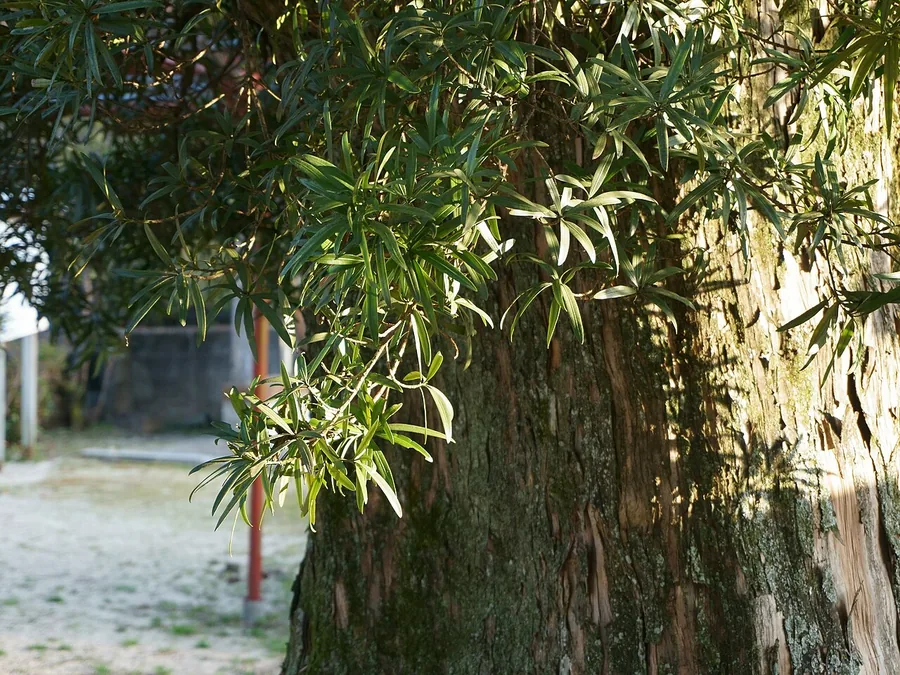
Foliage: Linear-lanceolate leaves 7 to 12 cm long on vigorous shoots (shorter on twiggy growth), spirally arranged but appearing two-ranked, dark glossy green above with a paler green underside. Leathery and stiff, with a prominent midrib.
Bark & trunk: Gray-brown, becoming shallowly fissured and peeling in thin strips with age; the trunk thickens slowly and takes on convincing maturity even in modest sizes.
Growth habit / form: Naturally a dense, upright, columnar-to-conical small tree; responds to pruning with tight, layered foliage pads.
Flowers / fruit: Dioecious. Males bear catkin-like cones; females produce a seed sitting on a swollen, fleshy purple-red aril (the "fruit"). The aril is edible-looking but the seed and foliage are toxic; do not treat it as food.
Look-alikes & how to tell them apart: Frequently confused with **English yew (Taxus baccata)**: both have flat dark needles and a fleshy red/purple aril. Podocarpus leaves are much longer (7 to 12 cm vs. yew's 1 to 3 cm) and strap-like, while yew needles are short and soft. It is also confused with Podocarpus gracilior (fern pine), which has smaller, finer leaves.
Climate & USDA Zone
Hardy in USDA zones 8 to 11. It tolerates brief dips to about −4 °C (25 °F) but foliage burns and shoots die back below that; sustained frost will kill it. Ideal growth is at 15 to 30 °C (60 to 86 °F). In zones 7 and colder it must be treated as an indoor or greenhouse tree, moved out only after the last frost and brought in well before the first. Even indoor specimens benefit from a spell outdoors in the warm months for stronger growth and tighter foliage.
Light
Give it the brightest spot you can indoors, a south or west window, but it will also grow in surprisingly low light. Outdoors it takes full sun in mild climates but appreciates afternoon shade in hot regions to prevent leaf scorch. Rotate an indoor tree periodically so all sides receive light and pads develop evenly.
Watering
Water thoroughly, then let the top 2 to 3 cm of soil dry before watering again; lean toward slightly dry rather than constantly moist.
- Check the surface daily; frequency varies with season, indoor heating, and pot size.
- Reduce watering noticeably in winter when growth slows and evaporation is low.
- Never let the pot stand in a saucer of water; Podocarpus roots rot quickly when waterlogged.
- It tolerates dry indoor air better than most bonsai, but occasional misting keeps foliage clean.
Soil & Root Care
Soil: A free-draining, slightly acidic mix. A blend of akadama, pumice, and lava (roughly equal parts) with a small proportion of composted bark works well; the aim is drainage plus modest moisture retention.
Repotting:
- Repot young trees every 2 to 4 years, older specimens every 4 to 5 years.
- Best done in spring as growth resumes, or in early summer for indoor trees.
- Roots are moderately fine and tolerate careful pruning; remove no more than about a third at once.
- Aftercare: keep in bright shade, out of strong sun and wind, and water carefully until new growth confirms recovery; do not fertilize for 3 to 4 weeks.
Feeding
Feed regularly through the growing season, roughly from spring to early autumn. A balanced organic or slow-release fertilizer every 2 to 4 weeks, or a diluted liquid feed more often, suits it well. Because Podocarpus prefers slightly acidic conditions, an occasional acidifying feed helps maintain deep green foliage. Reduce or stop feeding in winter when growth is minimal, especially for trees resting indoors.
Pruning & Styling
- Prune structural branches in spring; the species back-buds well on old wood, so hard pruning is well tolerated.
- Pinch or cut new shoots back to 2 to 3 leaves through the growing season to build dense pads and reduce leaf size.
- Wire while shoots are semi-hardened; branches are somewhat stiff, so wire firmly but watch for wire bite on the smooth bark.
- Suited to formal upright, informal upright, slanting, and group plantings; its columnar habit lends itself especially to formal upright.
- Remove the longest juvenile leaves selectively to encourage shorter foliage and refinement.
Propagation & Cuttings
Ease: Moderate. Best methods: semi-hardwood cuttings; seed.
Buddhist pine (Podocarpus macrophyllus) roots from semi-hardwood cuttings taken in summer to autumn with IBA under humidity at moderate rates; slow but reliable, and the usual way to clone good forms. Fresh seed germinates after cleaning and a short warm/moist period. It air-layers. Keep tender in cold climates. For bonsai the dark strap-like leaves and tolerance of indoor life make it popular; cuttings keep dwarf forms true, and it back-buds on old wood and shears into dense pads.
Pests
- Scale insects (soft and armored), the most common Podocarpus pest indoors; treat with horticultural oil and remove by hand; systemic imidacloprid for heavy infestations.
- **Podocarpus aphid (Neophyllaphis podocarpi)**: a species-specific bluish-white aphid that attacks new growth; spray with insecticidal soap.
- Mealybugs: cottony masses in leaf axils; dab with alcohol or treat with oil.
- Spider mites: appear in hot, dry indoor conditions; raise humidity and treat with miticide if webbing appears.
Disease, Fungus & Infection
- **Root rot (Phytophthora / Pythium)**: by far the main disease, caused by overwatering and poor drainage; roots turn brown and mushy and foliage yellows. Improve drainage and let soil dry.
- Sooty mold: a black film growing on the honeydew left by scale and aphids; controlling the insects resolves it.
- Leaf tip burn: usually not a pathogen but a symptom of salt buildup, fluoride in water, or over-fertilizing.
Prevention: use a truly free-draining mix, avoid standing water, keep good airflow, and control sap-sucking insects promptly to prevent secondary mold.
Most Common Causes of Death
1. Root rot from overwatering in a poorly draining pot: the number-one killer; use a gritty mix and let the surface dry between waterings. 2. Hard frost / freezing: foliage and roots are damaged below about −4 °C; bring indoors before hard frost. 3. Chronic waterlogging: a saucer of standing water suffocates roots even without classic rot; empty saucers. 4. Severe scale infestation left untreated: heavy scale weakens the tree and invites sooty mold; inspect and treat early. 5. Overpotting into water-retentive soil: dense organic soil stays wet too long; repot into free-draining media.
Seasonal Calendar
- Spring: Prime repotting window; growth resumes; begin feeding and structural pruning; move outdoors after the last frost.
- Summer: Strongest growth; water attentively, feed regularly, pinch new shoots, and provide afternoon shade in hot climates.
- Autumn: Growth slows; taper feeding, and bring the tree indoors or under cover before the first frost.
- Winter: Rest period; keep in a bright, cool-to-warm indoor spot above about 5 °C; water sparingly and do not feed.
Close-up photo reference
Compare your tree against these to confirm the species and spot problems early.

Sources
- Bonsai Empire: Podocarpus bonsai care
- Wikipedia: *Podocarpus macrophyllus*
- Missouri Botanical Garden: *Podocarpus macrophyllus*
Buy a Buddhist Pine bonsai
- Small Flowering Podocarpus "curved" Bonsai, 12 Years Old (Podocarpus macrophyllus) — $59.95
- Medium Flowering Podocarpus "curved" Bonsai, 16 Years Old (Podocarpus macrophyllus) — $81.95
- Extra Large Flowering Podocarpus Bonsai, 17 Years Old (Podocarpus macrophyllus) — $145.00
- Flowering Podocarpus Bonsai, Curved Trunk, 28 Years Old (Podocarpus macrophyllus) — $495.00
- All species
- Shop bonsai trees, tools & supplies
- How to Water a Bonsai (Without Killing It)
- Bonsai Soil: What to Buy, What to Mix, and What It Costs
- Why Bonsai Die After Repotting: Diagnosing a Failed Repot
- Pruning vs. Pinching: Shaping Your Bonsai
- Overwintering Bonsai: Cold-Season Care
- Indoor Bonsai Light and Humidity: Making a Windowsill Actually Work
- Root Rot on bonsai
- Overwatering on bonsai
- Winter / Frost Damage on bonsai
- Leaf Scorch / Sunburn on bonsai
- Insufficient Light (Etiolation) on bonsai
- Coast Redwood bonsai care
- Fire Chief Arborvitae bonsai care
- Gold Arborvitae bonsai care
- Japanese Yew bonsai care