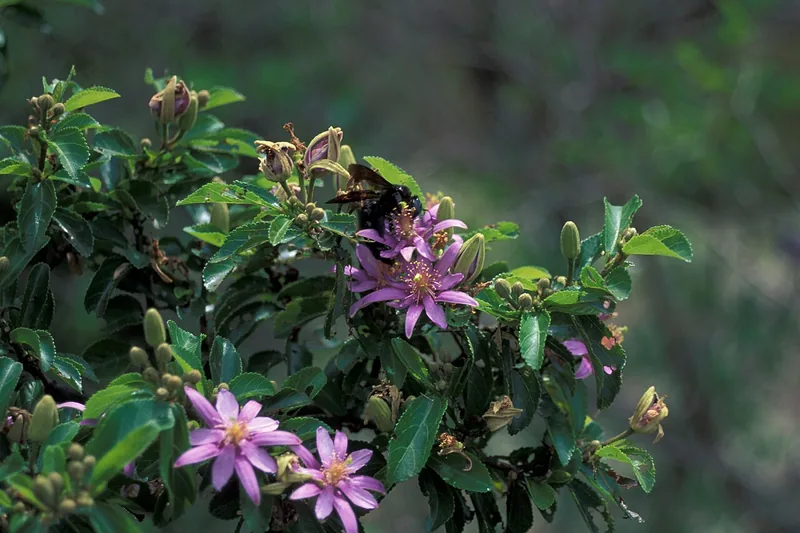
Lavender Star Flower Bonsai Care
Grewia occidentalis
2 Lavender Star Flower bonsai in stock, from $43.95 Shipped direct from our nursery partners, with a 48-hour live-arrival guarantee. See the trees
Zones 9a to 11, outdoor. A South African shrub with two things going for it as bonsai: the flowers and the fruit. Most are lost to cold damage.
Malvaceae (mallow family; older books place it in Tiliaceae) · Subtropical deciduous scrambling shrub or small tree, flowering and fruiting
Lavender Star Flower quick reference
| USDA zones | 9a–11 outdoors year-round; container and winter protection elsewhere |
|---|---|
| Indoor / outdoor | Outdoors through the growing season; protected over winter below zone 9 |
| Light | Full sun or light shade — full sun gives the heaviest flowering |
| Water | Evenly moist. It flowers and grows best with regular water and dislikes drying out |
| Soil | Sandy loam-based, free-draining, and acid-leaning — alkaline soil causes chlorosis |
| Repot | Every 1–2 years, spring |
| Frost | Brief dips to about 30°F (−1°C); protect below 40°F for anything sustained |
| Mature height (as bonsai) | 3–10 m in the wild; 20–50 cm as bonsai |
| Growth rate | Medium |
| Season of interest | Mauve-purple star-shaped flowers spring through autumn, then shiny four-lobed berries that persist for months |
| Leaf reduction | Leaves are naturally small to medium; reduction potential is not well documented |
| #1 cause of death | Iron chlorosis from alkaline soil or hard tap water, followed by cold damage |
Overview & Character
A South African shrub with two things going for it as bonsai: the flowers and the fruit. The flowers are pink-mauve stars about 2–3 cm across, produced over a long season rather than in one short flush. The fruit that follows is stranger and arguably better — a shiny reddish-brown berry divided into four distinct lobes, which is where "four-corner" and "crossberry" come from, and which hangs on the plant for months.
It is a scrambler by nature, which means it wants to throw long shoots and lean on something. In a pot that translates into a plant that needs regular cutting back but responds well to it.
The thing that separates this species from most tropical bonsai is its specific and well-documented nutritional weakness: it goes chlorotic in alkaline conditions. If your tap water is hard, this is the tree on your bench that will tell you first.
Identification
Foliage: Simple alternate leaves, 5–7 cm, glossy deep green, slightly hairy, with small rounded teeth on the margin and — the useful detail — three distinct veins radiating from the leaf base. Held horizontally toward the light.
Bark & trunk: Grey-brown, developing texture slowly. The habit is scrambling rather than self-supporting, so trained trunks need building.
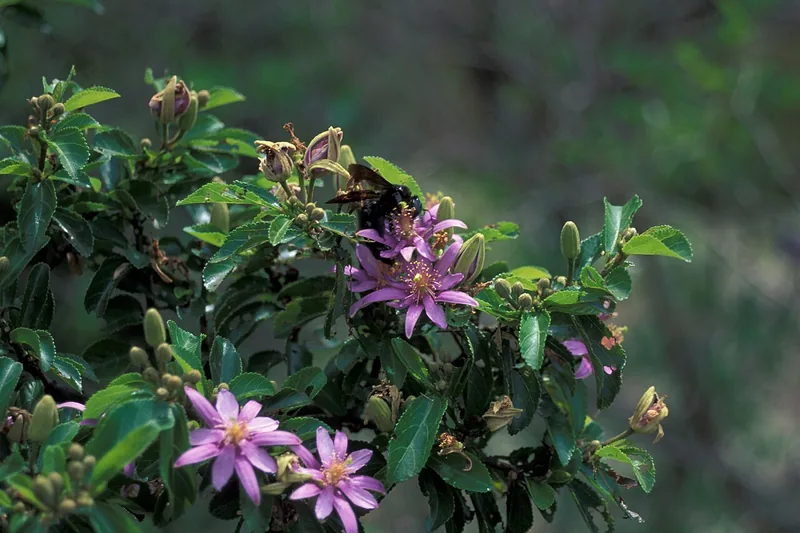
Flowers & fruit: Star-shaped mauve to pink-purple flowers, 1.5–3 cm, appearing over a long season. Fruit is the giveaway: a shiny reddish-brown to purple berry with four obvious lobes, persisting long after ripening.
Look-alikes: The four-lobed fruit is the most reliable identifier — nothing else commonly grown as bonsai carries it. Out of fruit, the three-veined leaf base narrows it down.
Climate & USDA Zone
Zones 9a–11 outdoors year-round. In colder regions it is a container plant that summers outside and overwinters under protection. It will take a brief dip to around 30°F (−1°C) without lasting harm, but sustained cold below 40°F is a problem and hard frost will kill a potted specimen whose roots have no ground to insulate them.
Light
Full sun for the best flowering; it will accept semi-shade and simply bloom less. Indoors over winter it needs a genuinely bright position — this is a plant used to South African light levels.
Watering
Evenly moist. Regular watering is specifically flagged as necessary for good growth. Do not let the rootball dry out — flowering suffers immediately and leaf drop follows. Equally, the mix must drain; evenly moist means damp throughout, not sitting wet.
Water quality matters here more than for most species. If your tap water is hard, use rainwater or filtered water where you can. Carbonates raise substrate pH over months, and this species responds by going chlorotic.
Soil & Root Care
Sandy, loam-based, free-draining, and on the acid side of neutral. An ericaceous or acid-leaning bonsai mix suits it better than a standard blend if your water is hard. Repot roughly every one to two years in spring — this is a bonsai-practice recommendation rather than a documented species requirement, as authoritative repotting data for Grewia is thin.
Feed iron annually as a preventative, particularly in hard-water areas.
Feeding
Feed through the growing season with a balanced fertiliser, and use an acid-loving (ericaceous) formulation if your water or soil trends alkaline. Roughly three feeds spread across the season plus an annual iron supplement is the pattern recommended for garden specimens; in a bonsai pot, feed more often and more weakly.
Pruning & Styling
Prune annually after the main flowering finishes, and pinch through the season to keep the scrambling habit in check. Regular cutting back is what keeps it compact — left alone it reverts to long lax shoots.
Honest gap: no source we could find documents wiring behaviour, brittleness or back-budding for this species specifically. Treat it with normal caution and learn from your own tree.
Propagation & Cuttings
Ease: Moderate. Best method: seed.
In the wild, germination is improved by seed passing through an animal's gut, which breaks down chemical inhibitors — so wild-collected seed is erratic. Scarified or nursery-supplied seed germinates reasonably well. Cutting propagation is not well documented for this species.
Pests
In its native range the leaves feed the larvae of the rufous-winged elfin and buff-tipped skipper butterflies — irrelevant outside Africa. For cultivated specimens there is no documented pest profile; aphids and scale are the sensible things to watch for indoors in winter, but that is a general expectation rather than a sourced fact for Grewia.
Disease, Fungus & Infection
No documented disease profile for this species. The failure mode that is documented is nutritional: iron chlorosis in alkaline conditions, presenting as yellowing leaves with green veins, then general decline. Correct the substrate and the water before assuming an infection.
Most Common Causes of Death
1. Iron chlorosis from alkaline soil or hard water. The distinctive killer for this species — a slow yellowing decline rather than a sudden collapse. Acid-leaning mix, soft water, annual iron. 2. Cold damage. Brief 30°F is survivable; a hard frost on an unprotected pot is not. 3. Drying out. It wants steady moisture and punishes neglect with leaf and flower drop. 4. Root rot. From the opposite error — steady moisture in a mix that has stopped draining.
Seasonal Calendar
- Spring: Repot if due; feed with an acid-loving fertiliser; move outdoors once frost risk has passed.
- Summer: Full sun, regular water, main flowering flush. Pinch extending shoots.
- Autumn: Prune back after flowering finishes; bring under protection before hard frost.
- Winter: Bright, frost-free, reduced watering. Do not let it dry out completely.
Toxicity, Safety & Handling
No toxicity is documented, and the fruit is eaten in southern Africa — raw, fermented, or made into a milk drink. No thorns or spines. This is one of the safer species in the collection around children and pets.
Close-up photo reference
Compare your tree against these to confirm the species and spot problems early.

Sources
- Grewia occidentalis — PlantZAfrica, SANBI
- Grewia occidentalis — Wikipedia
- Grewia occidentalis — Top Tropicals Plant Encyclopedia
Buy a Lavender Star Flower bonsai
- All species
- Shop bonsai trees, tools & supplies
- How to Water a Bonsai (Without Killing It)
- Bonsai Soil: What to Buy, What to Mix, and What It Costs
- Why Bonsai Die After Repotting: Diagnosing a Failed Repot
- Pruning vs. Pinching: Shaping Your Bonsai
- Overwintering Bonsai: Cold-Season Care
- Indoor Bonsai Light and Humidity: Making a Windowsill Actually Work
- Root Rot on bonsai
- Underwatering (Drought Stress) on bonsai
- Winter / Frost Damage on bonsai
- Scale Insects on bonsai
- Aphids on bonsai
- Jamaican Raintree bonsai care
- American Elm bonsai care
- American Beech bonsai care
- Blueberry bonsai care