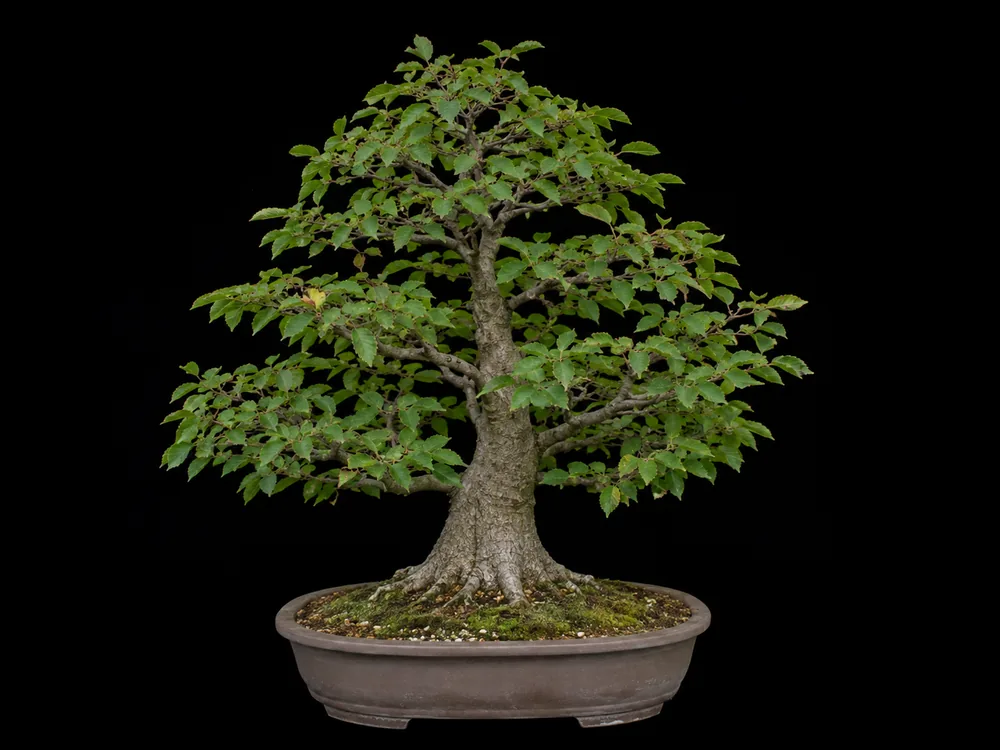
Korean Hornbeam Bonsai Care
Carpinus turczaninowii
2 Korean Hornbeam bonsai in stock, from $64.95 Shipped direct from our nursery partners, with a 48-hour live-arrival guarantee. See the trees
Zones 5 to 8, outdoor. One of the most prized deciduous species. Most are lost to overwatering.
Betulaceae (birch family) · Deciduous broadleaf tree, grown as an outdoor bonsai
Korean Hornbeam quick reference
| USDA zones | 5–8 (thrives in zone 7; needs protection at the cold edge) |
|---|---|
| Indoor / outdoor | Outdoor year-round — it requires a genuine winter dormancy |
| Light | Full sun to light afternoon shade; some shade in peak summer to prevent leaf scorch |
| Water | On the drier side — let the soil approach (but never reach) dryness between waterings; do not keep soggy |
| Soil | Free-draining, slightly moisture-retentive inorganic mix (akadama / pumice / lava, roughly equal parts) |
| Repot | Young trees every 1–2 years; mature trees every 2–4 years, in early spring before bud break |
| Frost | Hardy and cold-loving, but pot roots need protection below about −5 to −10 °C |
| Mature height (as bonsai) | 10-15m wild; 20-60cm as bonsai |
| Growth rate | Moderate; back-buds readily |
| Season of interest | Orange-yellow autumn; fine winter silhouette |
| Leaf reduction | Reduces well with defoliation and pinching |
| #1 cause of death | Root rot from overwatering / sour, compacted soil — and branch dieback from canker |
Overview & Character
The Korean Hornbeam is one of the most prized deciduous species in all of bonsai. It produces extremely fine twigging (ramification), holds small leaves that reduce well under bonsai culture, and delivers a reliable autumn display ranging from warm yellow through orange to deep russet-red. The trunk develops a characteristic fluted, muscular, sinewy appearance with smooth grey bark, giving even young trees an aged, dignified look. It is slow-to-moderate in growth, patient under pruning, and back-buds readily on old wood, which makes it forgiving to restyle. Its main demand is a dry-leaning watering regime and a real cold winter — it is emphatically not an indoor tree.
Identification
FOLIAGE: Simple, alternate leaves (note: alternate, unlike maples) that are ovate with a pointed tip and a strongly doubly-serrate (double-toothed) margin. Leaves are smaller than European or American hornbeam, typically 2–5 cm, with deeply impressed parallel veins giving a corrugated texture. Fresh spring growth often flushes reddish before turning green.
BARK & TRUNK: Smooth, grey, and famously fluted — the trunk and larger branches develop vertical ridges and hollows that look like flexed muscle. This sinewy, sculpted trunk is a signature feature.
GROWTH HABIT / FORM: Naturally a small, dense, twiggy tree or large shrub. Under bonsai culture it builds tight ramification and a fine, broom-like or informal-upright silhouette.
FLOWERS / FRUIT / SEEDS: Wind-pollinated catkins in spring. The seeds are small nutlets each attached to a distinctive three-lobed, leaf-like winged bract (involucre) that hangs in clusters — a key hornbeam giveaway.
Look-alikes & how to tell them apart: Hornbeam is distinguished by its fluted, muscular trunk + doubly-serrate leaves + winged seed bracts. Beech (Fagus) has a smoother round trunk, single-toothed/wavy leaf margins, and pointed cigar-shaped buds. Elm (Ulmus) leaves have an asymmetric base and produce flat disc-like samaras, not winged bract clusters. Maples have opposite leaves and paired winged samaras — Korean Hornbeam leaves are alternate.
Climate & USDA Zone
Best in USDA zones 5–8, performing superbly in zone 7. It needs a clear seasonal cycle including a cold winter dormancy to stay healthy and to deliver autumn color. In colder zones (5–6) and in any container, the roots must be sheltered from hard freezes. In hot zones (8) provide afternoon shade in summer to protect the foliage.
Light
Give full morning sun with bright light all day. In spring and autumn it can take full sun. During the hottest part of summer, light afternoon shade prevents leaf scorch and protects the delicate leaf margins. Adequate light is what keeps internodes short and ramification tight.
Watering
Lean dry. Korean Hornbeam prefers to be on the drier side and should be allowed to approach dryness between waterings — but never to bone-dry, which causes leaf crisping and twig dieback. The cardinal sin is overwatering: constantly saturated soil drives root rot. Check the soil surface and the pot weight, and water thoroughly only when the top has begun to dry. In hot weather it will need water more often, but the goal is always a well-drained, never swampy, root zone.
Soil & Root Care
Use a free-draining, predominantly inorganic mix — for example akadama, pumice, and lava rock in roughly equal parts. Good drainage and air exchange in the root zone are essential to prevent the soil going "sour" (anaerobic and compacted), which is the precursor to root rot. Repot young trees every 1–2 years and mature trees every 2–4 years in early spring just before buds open, combing out and trimming the roots and refreshing the substrate to keep the "shin" (the soil/root core) sweet and oxygenated.
Feeding
Feed regularly through the growing season. Begin a few weeks after the spring flush has hardened off and continue into early autumn. Use a balanced organic fertilizer for general vigor; ease off high nitrogen on refined, ramified trees to keep leaves small and internodes short. Stop feeding as the tree shuts down for dormancy.
Pruning & Styling
Hornbeam back-buds well on old wood, making it ideal for building dense ramification. Let new shoots extend to a few pairs of leaves, then cut back to one or two nodes to force division. Pinch or trim through the growing season to refine. Major structural pruning is best in late winter to early spring before bud break, or in summer for hardwood cuts. The tree wires well while shoots are young and flexible; protect the thin grey bark with raffia or wire padding and remove wire before it bites in. Defoliation (partial) on healthy, established trees can be used to reduce leaf size and boost ramification.
Propagation & Cuttings
Ease: Moderate. Best methods: seed; cuttings; layering.
Carpinus turczaninowii is grown from seed with the usual hornbeam double dormancy — sow fresh for germination after two winters, or warm-then-cold stratify. Softwood cuttings in early summer root at moderate rates with IBA, and air-layering in spring is reliable. For bonsai this small-leaved hornbeam is a favourite; layering builds trunk quickly, and the species back-buds strongly, ramifies finely, and colours well in autumn.
Pests
Watch for aphids (on soft new growth), spider mites (in hot, dry conditions — look for stippling and fine webbing), scale insects, caterpillars, and leaf miners. Inspect leaf undersides regularly. Treat early with a strong water jet, horticultural/neem oil, insecticidal soap, or an appropriate insecticide for heavier infestations. Good airflow and avoiding heat stress greatly reduce mite problems.
Disease, Fungus & Infection
Coral spot and other fungal pathogens can colonize weakened or dead wood. Canker, caused by several fungi, is the most serious disease: it causes infected branches to die back, and if the canker girdles the trunk it can kill the entire tree. Sun scorch (not a disease but often confused with one) browns leaf margins in intense summer sun. Prevent disease with clean cuts sealed where appropriate, good air circulation, removal of dead wood, watering the soil rather than the foliage, and not letting the tree become weak or stressed.
Most Common Causes of Death
1. Root rot from overwatering / sour soil. The number one killer. Keep the tree on the drier side, use a free-draining inorganic mix, and repot on schedule so the root core stays oxygenated. Prevention: water only as the soil begins to dry; never leave it soggy. 2. Canker girdling the trunk. Fungal canker can dieback branches and kill the whole tree if it rings the trunk. Prevention: keep the tree vigorous, make clean cuts, remove and dispose of infected wood promptly. 3. Drying out completely. Although it likes to lean dry, a fully desiccated rootball kills fine roots and twigs fast, especially in summer heat. Prevention: monitor daily in hot weather; never let it reach bone-dry. 4. Winter root freeze. Pot roots are far more exposed than in-ground roots. Prevention: overwinter in a cold frame, mulch/heel-in the pot, or shelter in an unheated space. 5. Keeping it indoors. Denied dormancy and proper light, the tree weakens, drops lower branches, and declines. Prevention: grow it outdoors year-round. 6. Summer leaf scorch weakening the tree. Repeated scorch saps vigor and invites disease. Prevention: afternoon shade in peak summer, consistent (but not soggy) moisture. 7. Untreated pest infestations (mites/scale/aphids). Heavy populations defoliate and weaken the tree, opening the door to disease. Prevention: inspect often and treat early.
Seasonal Calendar
- Spring: Repot before bud break in free-draining mix. Protect the tender flush from late frosts. Begin feeding once new growth hardens. Start pest watch (aphids).
- Summer: Water diligently but keep it well-drained; provide afternoon shade in heat to prevent scorch. Pinch and trim to build ramification; consider partial defoliation on strong trees. Watch for spider mites.
- Autumn: Enjoy the yellow-to-russet color. Reduce then stop feeding. Do structural assessment; light pruning as leaves drop. Begin preparing winter protection.
- Winter: Fully dormant — provide a cold winter but protect roots from hard freeze (cold frame / mulch / unheated shelter). Do major structural pruning and wiring on the bare silhouette in late winter before buds swell. Keep soil just barely moist.
Sources
- Bonsai Empire — Hornbeam and Beech (Carpinus and Fagus) care guide
- Bonsai4Me — Carpinus / Hornbeam Bonsai species guide
- Bonsai Mary — Korean Hornbeam Bonsai (Carpinus turczaninowii) care guide
- North Carolina Extension Gardener Plant Toolbox — Carpinus turczaninovii
Buy a Korean Hornbeam bonsai
- All species
- Shop bonsai trees, tools & supplies
- How to Water a Bonsai (Without Killing It)
- Bonsai Soil: What to Buy, What to Mix, and What It Costs
- Why Bonsai Die After Repotting: Diagnosing a Failed Repot
- Pruning vs. Pinching: Shaping Your Bonsai
- Overwintering Bonsai: Cold-Season Care
- Indoor Bonsai Light and Humidity: Making a Windowsill Actually Work
- Root Rot on bonsai
- Overwatering on bonsai
- Underwatering (Drought Stress) on bonsai
- Winter / Frost Damage on bonsai
- Leaf Scorch / Sunburn on bonsai
- American Hornbeam bonsai care
- Hornbeam bonsai care
- American Elm bonsai care
- Amur Maple bonsai care