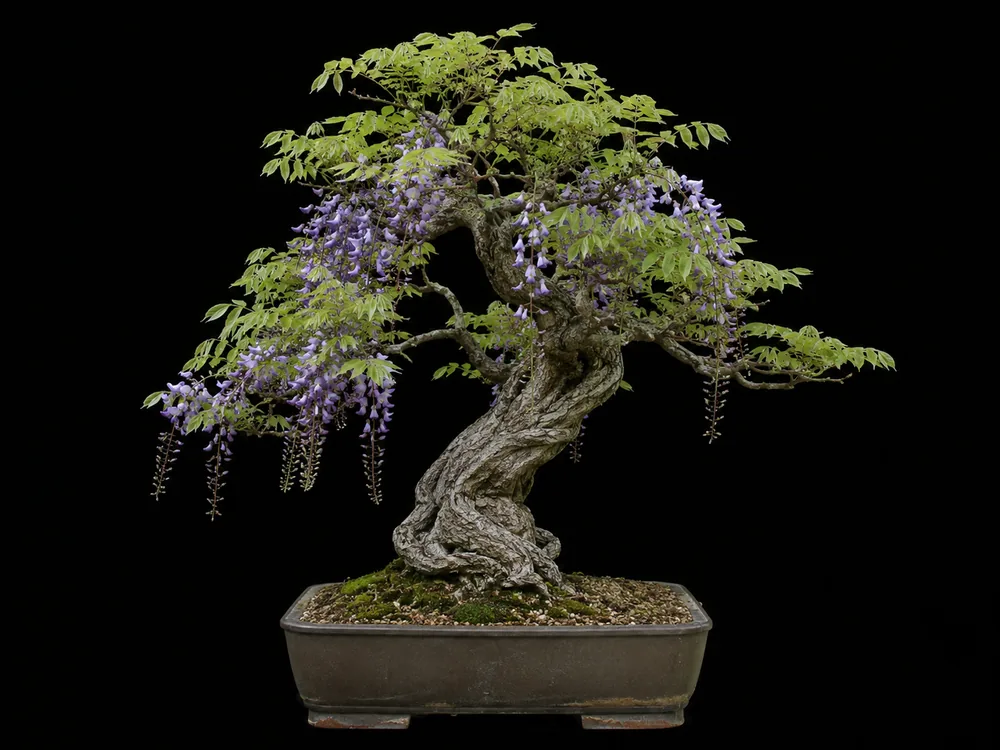
Japanese Wisteria Bonsai Care
Wisteria floribunda
Zones 5 to 9, outdoor. Grown for one spectacular event: the cascade of long, pendulous, fragrant flower racemes. Most are lost to overwatering.
Fabaceae (the legume/pea family) · Deciduous, twining, flowering woody vine trained as bonsai; outdoor only
Japanese Wisteria quick reference
| USDA zones | 5–9 |
|---|---|
| Indoor / outdoor | Outdoor — needs full sun and a cold winter dormancy; will not thrive indoors |
| Light | Full sun, minimum 6 hours direct daily — sun is the fuel that sets flower buds |
| Water | Very thirsty in growing season (can sit in a water tray); moist-not-soggy in autumn/winter |
| Soil | Free-draining, moisture-retentive, slightly acidic; akadama-based mixes work well |
| Repot | Young: every 1–2 years; older: every 2–3 years, in early spring or autumn after leaf fall |
| Frost | Hardy and needs winter chill; protect roots in the shallow pot during hard freezes |
| Mature height (as bonsai) | Vine to 9 m; 30-70 cm as bonsai |
| Growth rate | Fast |
| Season of interest | Long fragrant purple flower racemes in spring |
| Leaf reduction | Limited - grown for flowers not leaves |
| #1 cause of death | Root rot from a waterlogged rootball — especially staying too wet during dormancy |
Overview & Character
Japanese Wisteria is grown for one spectacular event: the cascade of long, pendulous, fragrant flower racemes (lavender, violet, pink, or white) that drape down in mid-to-late spring, on W. floribunda typically opening as or just before the leaves emerge. The racemes of Japanese wisteria are notably long, and the vine twines clockwise (a quick way to distinguish it from Chinese wisteria, which twines counter-clockwise). It is one of the great display bonsai precisely because the bloom is so dramatic against the gnarled, muscular trunk.
The catch: wisteria is a vine, not naturally a tree, so it is grown more as a "flowering object" than a refined, ramified bonsai — vigorous tendrils must be relentlessly controlled. It is also slow to reach flowering maturity (often many years from seed), and the most common frustration owners face is a healthy plant that refuses to bloom. Patience, full sun, the right feeding, and correct pruning timing are the answers.
Identification
Foliage: Pinnately compound leaves — each leaf a central stem bearing many (typically 11–19 on W. floribunda) small oval leaflets in opposite pairs with a single terminal leaflet. Bright fresh green, soft, deciduous; turns yellow before dropping in autumn. The high leaflet count is a quick separator from Chinese wisteria (usually 7–13).
Bark & trunk: Grey-brown bark, smooth when young, becoming rough and fissured with great age; trunks grow muscular, gnarled, and often dramatically twisted — half the appeal as a bonsai.
Growth habit/form: A twining woody vine, not a self-supporting tree. W. floribunda twines clockwise (Chinese wisteria twines counter-clockwise) — a definitive ID check. It throws long, whippy tendrils that must be controlled constantly.
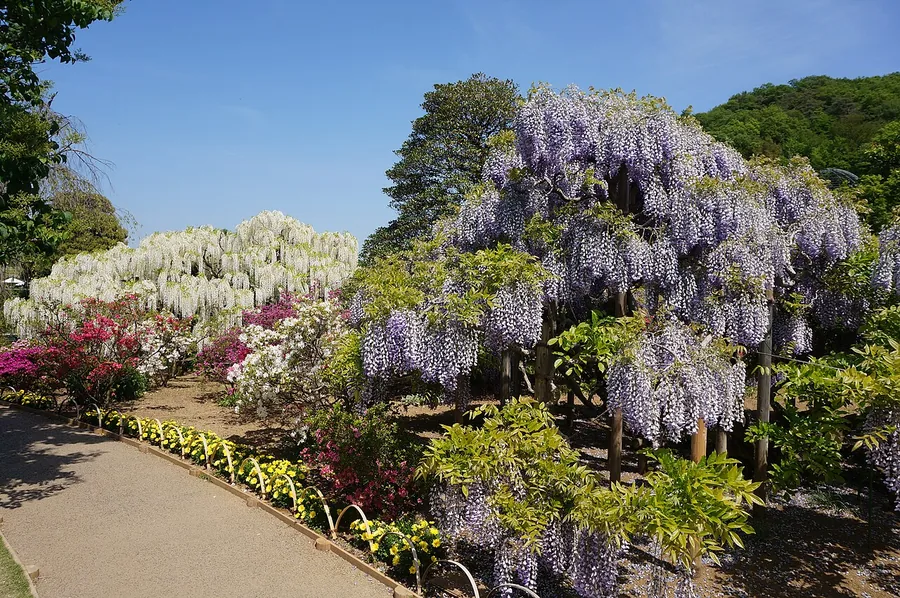
Flowers/fruit (key ID feature): The signature feature — long, pendulous, fragrant flower racemes (often very long on Japanese wisteria) that drape downward in mid-to-late spring, opening progressively from top to bottom, typically as or just before the leaves emerge. Colors are lavender, violet, blue-purple, pink, or white. Flowers form on short spurs on older wood. Followed by long, flattened, velvety bean-like seed pods (it is a legume).
Look-alikes & how to tell them apart: Distinguished from Chinese wisteria (W. sinensis) by clockwise twining, more leaflets, longer racemes, and flowers opening with/after the leaves and gradually rather than all at once. The pinnate compound leaves + hanging racemes + twining vine + bean pods together are unmistakable versus any non-legume climber.
Climate & USDA Zone
Hardy in USDA zones 5–9. Wisteria requires a genuine cold winter dormancy to perform, so it is unsuited to frost-free climates and impossible as a permanent indoor plant. Because the rootball in a bonsai pot is far more exposed than an established garden vine, give winter protection — a cold frame, unheated shelter, or heeling the pot into the ground — when hard freezes threaten, especially as the wet dormant rootball is vulnerable to freeze-thaw and rot.
Light
Full sun is non-negotiable. Give at least six hours of direct sunlight daily; more is better. Sunlight is what drives the plant to differentiate flower buds for the following spring, so a shaded wisteria grows lush leaves and vines but few or no flowers. Strong light also strengthens overall structure. Insufficient light is one of the leading reasons a wisteria fails to bloom.
Watering
Split personality by season. During the growing season wisteria is one of the thirstiest of all bonsai — it drinks enormous amounts of water, and in summer many growers stand the pot in a shallow tray of water so the rootball never dries out. Underwatering in summer stresses the plant and aborts buds.
In autumn and winter, however, the dynamic reverses: keep the roots only moist, not soaking. A rootball left sodden during dormancy is the classic route to root rot and death. So: generous water (even a standing tray) in spring and summer, and disciplined, restrained watering once the leaves drop and the tree is dormant.
Soil & Root Care
Use a free-draining yet moisture-retentive, slightly acidic medium — an akadama-based bonsai mix (often with pumice/lava for drainage) suits it well. Good drainage matters enormously because of the overwatering/rot risk, while moisture retention supports the heavy summer water demand.
Repot young trees every 1–2 years and older trees every 2–3 years, in early spring before bud-break or in autumn after leaf fall. Wisteria roots are vigorous and fleshy; prune them firmly at repotting. A degree of root confinement actually helps — a somewhat pot-bound wisteria flowers better than one given excess root room, so resist the urge to over-pot.
Feeding
Feeding strategy is central to getting blooms. Feed well through the season, but shift the balance: use a fertilizer low in nitrogen and richer in phosphorus and potassium, particularly in summer and autumn. Excess nitrogen drives leafy, vining growth at the direct expense of flowers — over-fertilizing with high-nitrogen feed is a top cause of a non-blooming wisteria. (Note that phosphorus alone does not "force" flowering; the goal is simply to avoid excess nitrogen and keep the plant well-nourished with a balanced-to-bloom feed once buds should be setting.) Feed heavily after flowering to rebuild strength, then favor the lower-nitrogen mix as the season progresses.
Pruning & Styling
Wisteria flowers on short spurs on older/established wood, from buds set the previous summer — so pruning timing is decisive. The proven cycle:
- After flowering / early summer: Do major structural pruning then. Cut back the long whippy tendrils. Through the season, let new tendrils extend until around July, then cut them back hard (to roughly 5–6 inches / a few buds), which encourages the formation of short flowering spurs rather than endless vine.
- Late winter, before growth: A second cleanup, shortening the spurs further — but be careful not to cut off the fat, rounded flower buds (they are plumper than the pointed leaf buds). Incorrect winter pruning that removes the flower buds is a common reason a wisteria doesn't bloom.
Vigorous tendril control all summer is the main ongoing job. Wire is used on young branches to set the structure, but much shaping is done by directing and cutting the rampant new growth. Removing some leaves (leaving four to six leaves per shoot) in summer is sometimes used to encourage spur and bud formation.
Propagation & Cuttings
Ease: Moderate. Best methods: cuttings; layering; grafting (seed slow to flower).
Wisteria floribunda, like Chinese wisteria, must be propagated vegetatively for reliable early flowering — seedlings can take 10–20 years to bloom. Softwood cuttings in early summer and hardwood/root cuttings in winter root at moderate rates with hormone; layering (peg a stem down in spring) is very reliable, and named forms are grafted. For bonsai, always start from a proven flowering clone via cutting, layer, or graft so the long flower racemes come soon.
Pests
Watch for scale insects (a frequent and stubborn wisteria pest), aphids (especially on tender new growth and buds), spider mites, and leaf-rolling/leaf-eating caterpillars. Scale timing matters: the crawler stage (around late spring/early summer) is when contact treatment is effective — spraying outside that window is largely wasted and harms beneficial insects. Treat with horticultural oil, insecticidal soap, or an appropriate systemic for heavy scale.
Disease, Fungus & Infection
The dominant disease threat is root rot from waterlogging — see causes of death. On foliage, wisteria can suffer powdery mildew, leaf spots, and occasionally crown gall (bacterial swellings). As a legume it is generally robust; most disease problems trace back to overwatering, poor drainage, or poor airflow. Keep the dormant rootball on the dry side, ensure good drainage, and remove fallen infected leaves.
Most Common Causes of Death
1. Root rot in dormancy. Extremely thirsty in summer but rots if left wet and cold in winter; reduce water sharply once dormant. 2. Drying out in summer. A huge water user in growth (many stand the pot in a water tray in summer); a dry-out drops flowers and weakens it. 3. No bloom from wrong feeding/pruning. Flowers on old-wood spurs; excess nitrogen and ill-timed pruning prevent bloom — use low-N feed and cut back whips to spurs. 4. Winter root freeze. Shelter potted roots in hard freezes. 5. Pests. Aphids, scale, and spider mites — treat early.
Seasonal Calendar
- Spring: Bloom on bare/old wood; repot just after flowering; resume feeding (low nitrogen).
- Summer: Very thirsty — water heavily (tray method ok); cut back long tendrils to ~2 buds in mid-summer to set flower spurs.
- Autumn: Reduce feeding; begin tapering water as growth slows.
- Winter: Dormant; keep on the dry side (not bone-dry); protect potted roots; structural pruning while leafless.
Close-up photo reference
Compare your tree against these to confirm the species and spot problems early.

Sources
Where to buy a Japanese Wisteria bonsai
We don’t stock Japanese Wisteria at the moment. These species need similar care and we have them now — they are the closest match in our catalogue.
- Chinese Elm — similar care, in stock now
Browse all bonsai trees for sale or find a species matched to your climate and space.
- All species
- Shop bonsai trees, tools & supplies
- How to Water a Bonsai (Without Killing It)
- Bonsai Soil: What to Buy, What to Mix, and What It Costs
- Why Bonsai Die After Repotting: Diagnosing a Failed Repot
- Pruning vs. Pinching: Shaping Your Bonsai
- Overwintering Bonsai: Cold-Season Care
- Indoor Bonsai Light and Humidity: Making a Windowsill Actually Work
- Root Rot on bonsai
- Overwatering on bonsai
- Underwatering (Drought Stress) on bonsai
- Winter / Frost Damage on bonsai
- Insufficient Light (Etiolation) on bonsai
- Chinese Wisteria bonsai care
- Chinese Elm bonsai care
- American Beech bonsai care
- Amur Maple bonsai care