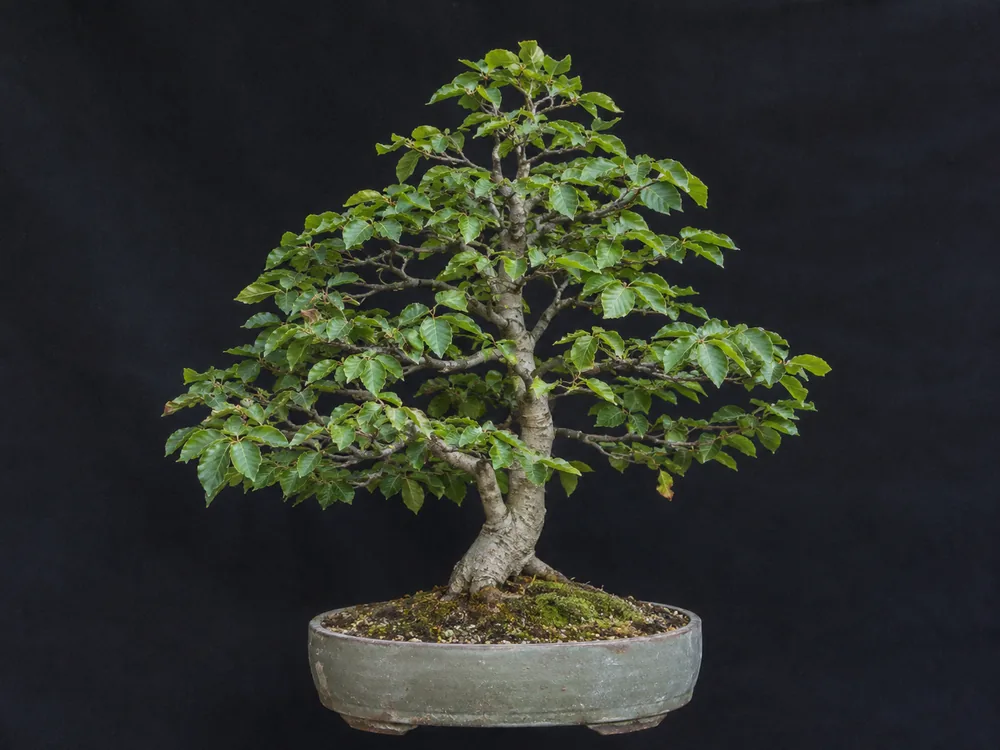
European Beech Bonsai Care
Fagus sylvatica
Zones 4 to 7, outdoor only. A stately, slow-growing deciduous tree treasured in bonsai for its smooth silver-grey bark. Most are lost to drying out.
Fagaceae (beech family) · Deciduous broadleaf tree; outdoor bonsai
European Beech quick reference
| USDA zones | 4–7 (commonly cited; some sources extend the species' range to 3–9) |
|---|---|
| Indoor / outdoor | Outdoor only — requires winter dormancy |
| Light | Full sun to light shade; afternoon shade in extreme heat to prevent leaf scorch |
| Water | Keep evenly moist — beech transpires heavily and must never dry out completely, but avoid waterlogging. On the moist side. |
| Soil | Free-draining bonsai mix (akadama / pumice / lava); slightly acidic preferred |
| Repot | Every 2–5 years depending on age and root growth, spring before leaves open (slower-growing than maples/elms) |
| Frost | Hardy, but protect container roots from hard freeze; new growth is frost-tender |
| Mature height (as bonsai) | Tree to 40 m; kept 40-100 cm as bonsai |
| Growth rate | Slow to moderate |
| Season of interest | Fresh spring green, retained coppery winter leaves |
| Leaf reduction | Good with defoliation |
| #1 cause of death | Root rot from overwatering; also drying out, and frost damage to soft spring growth |
Overview & Character
The European beech is a stately, slow-growing deciduous tree treasured in bonsai for its smooth silver-grey bark, elegant branch structure, and large, glossy, wavy-edged leaves that emerge a soft downy green in spring, deepen through summer, and turn warm copper-bronze in autumn. A defining and beloved feature is marcescence: the cured, reddish-brown leaves cling to the twigs through much of winter, giving the bare tree a distinctive papery presence until new buds push them off in spring. The buds themselves — long, pointed, cigar-shaped and coppery — are ornamental in their own right.
Beech grows more slowly and flushes less freely than maples or elms, so it demands patience, but it builds into refined, dignified trees. It suits formal and informal upright, twin-trunk, and especially group/forest plantings, where its grey trunks and uniform foliage create a luminous woodland feel.
Identification
Foliage. Leaves are alternate, simple, oval to elliptical, roughly 2–4 in (5–10 cm), glossy and emerging a soft downy green (fringed with fine hairs when young), maturing dark green and turning warm copper-bronze in autumn. The margin is distinctively wavy/undulate and nearly entire (untoothed) with prominent straight parallel veins. Strongly marcescent — cured reddish-brown leaves cling through much of winter.
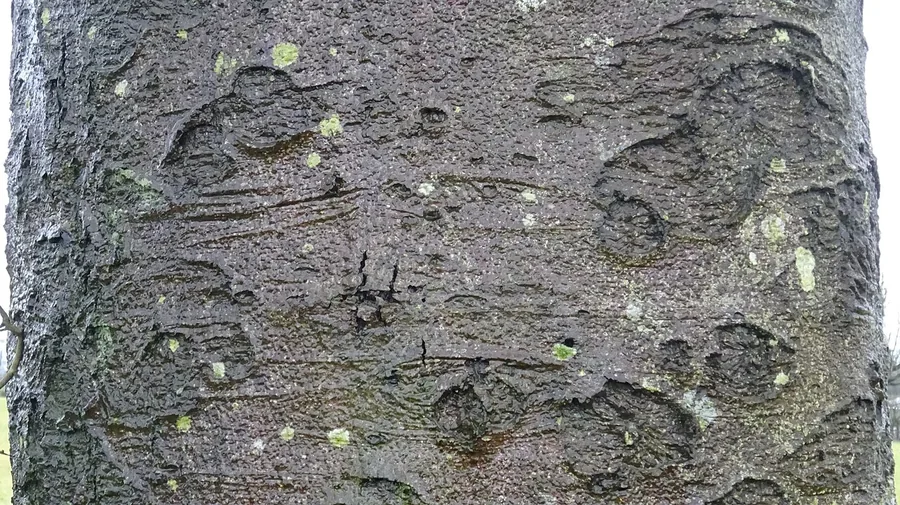
Bark & trunk. Smooth, taut, silvery-grey bark over a rounded, un-fluted trunk (smooth all over, not sinewy). The bark stays smooth even with age.
Growth habit / form. A slow-growing, stately tree with a single annual flush; refined, dignified branch structure.
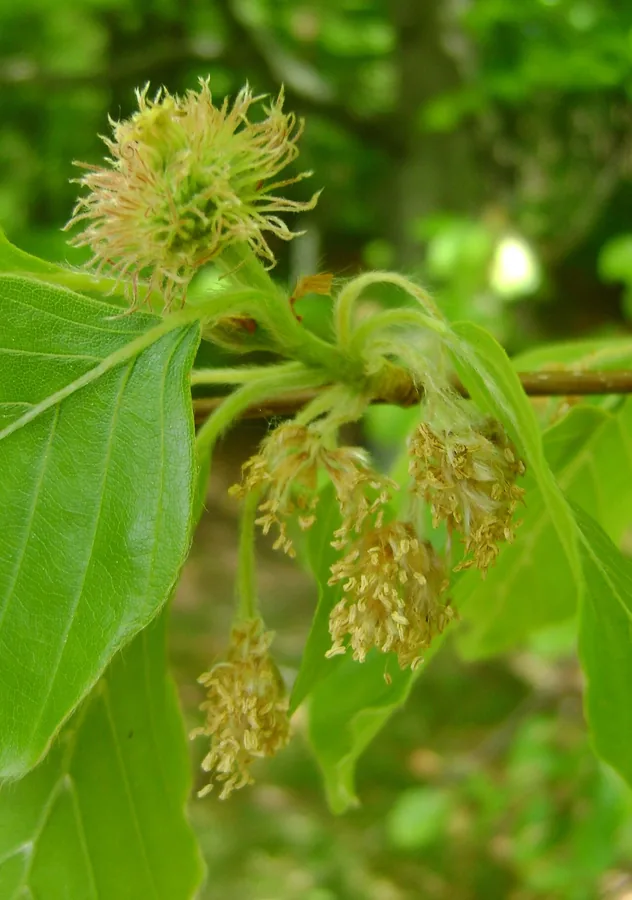
Flowers / fruit / seeds. A hallmark feature even in winter: long, slender, pointed, cigar-shaped coppery buds. Wind-pollinated spring flowers yield small triangular nuts (beechmast) enclosed in a soft-spiny four-lobed husk.
Look-alikes & how to tell them apart: Most confused with hornbeam. The decisive contrasts: beech has smooth round bark, wavy entire (un-serrated) leaf margins, long cigar-shaped buds, and triangular nuts in a spiky husk, while hornbeam has a ribbed/fluted "muscle" trunk, doubly-serrated corrugated leaves, short buds, and seeds on three-lobed leafy bracts.
Climate & USDA Zone
Fagus sylvatica is commonly grown in USDA zones 4–7 (with the species sometimes listed across zones 3–9). It requires a genuine winter dormancy and must be grown outdoors year-round. As with hornbeam, the ground-grown tree is very frost-hardy thanks to deep, insulated roots, but a beech in a shallow pot has exposed roots that must be protected from hard freezes. The single annual flush of soft spring growth is also frost-tender, so guard against late frosts when the new leaves emerge.
Light
Give full sun to light shade. Strong light keeps the tree compact and supports good structure, but the large, thin leaves can scorch in intense summer sun and heat, so light afternoon shade is wise in hot climates or heatwaves. A bright, airy spot with good airflow keeps foliage healthy and discourages mildew.
Watering
Beech sits on the moist side of the spectrum. It transpires heavily through its large leaves, so regular and generous watering is essential throughout the growing season — the rootball must never be allowed to dry out completely, which scorches leaves and kills fine roots. At the same time the soil must drain freely; standing water causes the root rot that is the species' most common fatal problem. Keep the soil evenly damp but not sodden, and reduce watering frequency in winter while keeping the mix from drying out entirely.
Soil & Root Care
Use a free-draining bonsai mix such as akadama, pumice and lava in roughly equal parts; beech prefers a slightly acidic medium. Because beech is slow-growing, it is repotted less often than maples or elms — typically every two to five years depending on age and how quickly the pot fills with roots — always in spring before the leaves open. Be conservative with root reduction on this slower species; remove a modest portion (up to about a third on a strong, younger tree, less on old specimens) and avoid bare-rooting. Disturbing the roots too aggressively or too frequently sets a beech back markedly.
Feeding
Feed from when the spring leaves harden through to autumn with a balanced fertilizer; because beech makes essentially a single flush of growth per year, feeding supports that flush and the following year's buds rather than continuous extension. Reduce nitrogen on refined trees to keep the large leaves as small as possible. Withhold feed right after repotting and ease off in peak summer heat; a potassium-rich autumn feed helps harden growth.
Pruning & Styling
Beech typically extends in one main flush each spring, which shapes the working calendar. Allow the new shoots to extend and harden, then prune back to one or two pairs of leaves to build ramification — done patiently over years this creates the fine twigging the species is admired for. Beech back-buds, but more reluctantly and slowly than elms, so structural pruning should be deliberate; seal all larger cuts, as beech can be slow to heal and prone to dieback around wounds.
Because the species produces a single flush, defoliation is used cautiously — only on vigorous, well-established trees, and not every year, to reduce leaf size and encourage finer secondary growth; over-doing it weakens the tree. Wire while branches are young; the smooth grey bark scars very easily and marks are slow to fade, so check wire frequently and remove it before it bites in.
Propagation & Cuttings
Ease: Difficult from cuttings; easiest from seed. Best methods: seed; grafting.
Like American beech, this species barely roots from cuttings, so seed is standard: collect ripe mast in autumn, float off empties, cold-moist stratify ~3 months, and sow in spring; germination is uneven. Copper, weeping, and fern-leaf forms don't come true and are grafted onto seedling understock. For bonsai, seedlings, young nursery whips, or collected hedge material are the usual start; beech is slow and holds tan winter leaves, rewarding patient development.
Pests
Beeches (and hornbeams) are commonly attacked by mealybugs, scale insects and woolly aphids; leaf-eating caterpillars and red spider mites also occur. Watch in particular for beech woolly aphid and scale, which hide in bark crevices and on leaf undersides. Inspect regularly and treat with insecticidal soap, horticultural oil, or a systemic insecticide for stubborn scale and mealybug, alongside improved growing conditions.
Disease, Fungus & Infection
Powdery mildew is common on beech in humid, stagnant air, showing as a white film on the leaves. Leaf spot, canker and various fungal blights can also occur, and beech bark disease (a scale-insect-plus-fungus complex) affects the genus in nature. The most dangerous problem for a bonsai, however, is root rot from overwatering or poorly draining soil. Prevention rests on free-draining soil, correct watering, good airflow, leaf hygiene, and clean tools with sealed cuts.
Most Common Causes of Death
1. Drying out. A heavy transpirer; the rootball must not dry fully or you lose branches — keep evenly moist. 2. Over-frequent repotting / heavy root work. Slow, single-flush species; repot only every 2–5 years and remove roots conservatively. 3. Defoliating too hard. Only one flush per year — over-defoliation severely weakens it; defoliate sparingly, only on strong trees. 4. Winter root freeze. Shelter potted roots in hard freezes. 5. Overwatering / root rot; indoor keeping. Keep free-draining and outdoors with dormancy.
Seasonal Calendar
- Spring: Repot only if due; let the single flush extend fully before any work; resume feeding.
- Summer: Even moisture; partial shade in extreme heat; minimal pruning; watch for beech woolly aphid and scale.
- Autumn: Coppery marcescent leaves often persist; taper feeding/water.
- Winter: Dormant; protect potted roots; structural pruning while leafless.
Close-up photo reference
Compare your tree against these to confirm the species and spot problems early.
,_Anderson%27s_Mount,_Stewarton.jpg)

Sources
Where to buy a European Beech bonsai
We don’t stock European Beech at the moment. These species need similar care and we have them now — they are the closest match in our catalogue.
- Japanese Blue Beech — similar care, in stock now
Browse all bonsai trees for sale or find a species matched to your climate and space.
- All species
- Shop bonsai trees, tools & supplies
- How to Water a Bonsai (Without Killing It)
- Bonsai Soil: What to Buy, What to Mix, and What It Costs
- Why Bonsai Die After Repotting: Diagnosing a Failed Repot
- Pruning vs. Pinching: Shaping Your Bonsai
- Overwintering Bonsai: Cold-Season Care
- Indoor Bonsai Light and Humidity: Making a Windowsill Actually Work
- Root Rot on bonsai
- Overwatering on bonsai
- Underwatering (Drought Stress) on bonsai
- Winter / Frost Damage on bonsai
- Leaf Scorch / Sunburn on bonsai
- American Beech bonsai care
- Japanese Blue Beech bonsai care
- American Elm bonsai care
- American Hornbeam bonsai care