Japanese Blue Beech Bonsai Care
Fagus japonica
1 Japanese Blue Beech bonsai in stock, from $68.95 Shipped direct from our nursery partners, with a 48-hour live-arrival guarantee. See the trees
Zones 7b to 8a, outdoor only. A scattered forest tree of Japan, distinguished from its better-known relative Fagus. Most are lost to overwatering.
Fagaceae (beech family) · Deciduous broadleaf tree, usually multi-stemmed from the base; rare in cultivation
Japanese Blue Beech quick reference
| USDA zones | 7b–8a — notably less hardy than the other beeches we cover |
|---|---|
| Indoor / outdoor | Outdoor only. It needs full winter dormancy |
| Light | Full sun to partial shade; young trees tolerate shade |
| Water | Evenly moist and free-draining. Do not let it dry out completely |
| Soil | Well-drained, fertile; the genus tolerates a range from acid to alkaline |
| Repot | Every 2–3 years, early spring just before bud break |
| Frost | Specifically noted as more susceptible to late spring frosts than Japanese Beech |
| Mature height (as bonsai) | To 25 m in the wild, usually multi-stemmed; small to medium as bonsai |
| Growth rate | Slow |
| Season of interest | Brilliant slender green new foliage in spring; winter silhouette |
| Leaf reduction | Not documented for this species |
| #1 cause of death | Late spring frost damage to emerging foliage; then root rot from poor drainage |
Overview & Character
Japanese Blue Beech is a scattered forest tree of Japan, distinguished from its better-known relative Fagus crenata by its multi-stemmed habit, its bluish-glaucous leaf undersides, and its lower-elevation preference. Where F. crenata forms single-trunked dominant stands, F. japonica tends to rise as several stems from one base.
That multi-stem habit is the interesting bonsai proposition: it lends itself naturally to clump and multi-trunk compositions rather than the formal single trunk, and it is a genuinely different silhouette from the beeches most collections already hold.
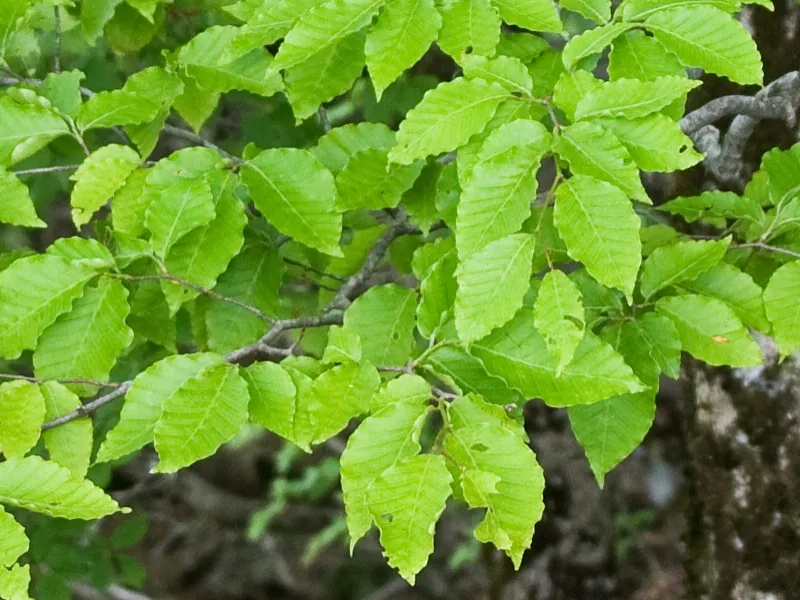
The spring foliage is the other draw — observers at the Royal Botanic Garden Edinburgh describe the emerging leaves as slender and brilliant green, notably vivid.
Identification
**Versus Fagus crenata (Japanese Beech):**
- Leaf undersides are glaucous — bluish and waxy. This is the most distinctive character.
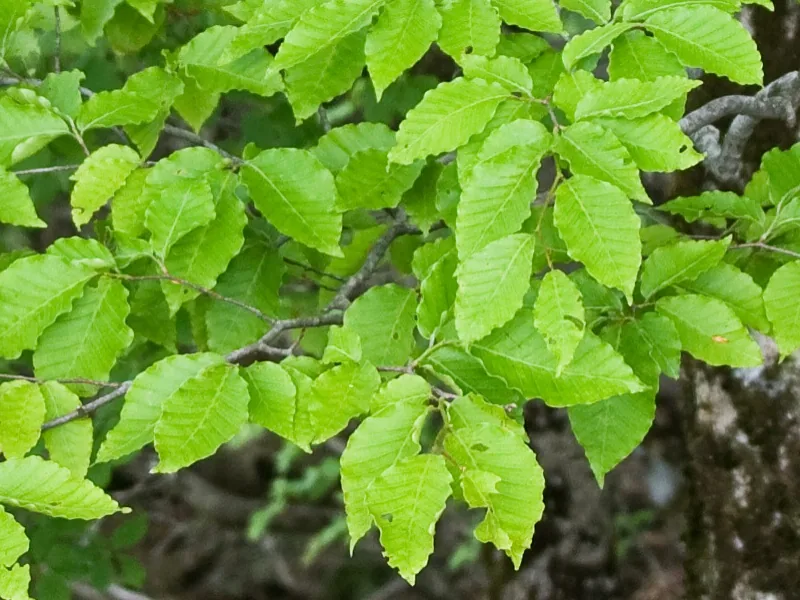
- Leaves are ovate to elliptic-ovate with 10–14 pairs of lateral veins, pubescent when young, becoming smooth above but staying hairy along the midrib beneath. F. crenata has rounder leaves with more crenulated margins.
- The fruit stalk is long, slender and hairless, and the husk is noticeably shorter than the nut. On F. crenata the cupule encloses the nut more fully.
- Habit: multi-stemmed from the base, versus crenata's single trunk.
- It is less cold-hardy than F. crenata.
**Versus Fagus sylvatica (European Beech):** F. sylvatica has larger, more broadly ovate leaves with fewer lateral vein pairs, and is a much hardier, larger, single-trunked tree. (This comparison is from general genus botany rather than a directly cited source.)
**Versus Fagus grandifolia (American Beech):** F. grandifolia has longer, more sharply serrate leaves and suckers strongly from the roots to form thickets — a habit not documented for F. japonica, which multi-stems from a single base instead.
Also confusable with Fagus engleriana of China, which Sargent explicitly compared it to for the same glaucous undersides and multi-stemmed habit.
Climate & USDA Zone
Zones 7b–8a, RHS hardiness H5. The variety multinervis is rated slightly hardier at zone 6–7.
This is the practical headline of the whole guide. Those zones are meaningfully warmer than F. crenata (4a–8b) or F. sylvatica and F. grandifolia (typically zone 4–5). Trees and Shrubs Online states directly that F. japonica "is more susceptible to late spring freezes and is probably less cold hardy overall".
If you already grow beech bonsai, do not overwinter this one the way you overwinter those. It needs a warmer, more sheltered position, and its emerging spring foliage needs protecting from late frosts that your European Beech would shrug off.
Light
Full sun to partial shade, with young trees tolerating shade — consistent with beech behaviour generally. Not directly documented for this species.
Watering
Evenly moist, well drained. The standard beech requirement: never let the rootball dry out completely, never let it stand wet. Beech in pots dry faster than you expect in summer and resent it.
Soil & Root Care
Well-drained and fertile. The closest documented relative, F. crenata, tolerates a range from acid to alkaline in clay, loam or high-organic soils.
Repot every two to three years in early spring just before bud break, in a free-draining but moisture-retentive mix. **This interval is general beech-bonsai practice, not documented for F. japonica.**
Feeding
Feed moderately through the growing season and stop by late summer so growth hardens before winter. Beeches do not want to be pushed.
Pruning & Styling
General beech principles apply, and they matter more here than with most genera: beech buds are brittle at the base and easily knocked off by careless handling. Work slowly around dormant buds when wiring and pruning.
Beeches as a genus show marcescence — they hold dead coppery leaves through the winter, which many growers deliberately encourage as a display feature by timing partial defoliation. We could not confirm whether F. japonica marcesces as reliably as F. sylvatica and F. crenata do; treat it as likely but unconfirmed.
The natural multi-stemmed habit is the obvious styling opportunity — clump and multi-trunk forms rather than a forced single trunk.
Propagation & Cuttings
Ease: Difficult. Best method: seed.
Seed is the recommended strategy for beeches generally. For F. japonica specifically, Trees and Shrubs Online records that var. multinervis fruits abundantly in mast years and hardly at all in others, and that seedlings from one collection attempt failed to survive — possibly for want of the right mycorrhizal associations. That difficulty is part of why the species is scarce and why specimens are expensive.
Pests
**No pest data specific to Fagus japonica exists in any source we could find.** This species is too rare in cultivation to have generated the literature. Watch for the pests that affect beech generally — aphids, scale, beech woolly aphid — but we are flagging this as a genuine gap rather than guessing.
Disease, Fungus & Infection
Likewise undocumented for this species. Root rot from poor drainage is the general beech risk worth managing.
Most Common Causes of Death
We could not find a documented cause of death for F. japonica in bonsai cultivation, because there is essentially no literature. By strong analogy to closely related beeches, and given what is documented about this species:
1. Late spring frost damage to emerging foliage. This is the one risk specifically documented as worse for F. japonica than for its relatives. Protect the new growth. 2. Root rot from poor drainage. The general beech failure mode. 3. Overwintering it as hard as a European Beech. A zone 7b–8a tree treated like a zone 4 tree will not survive many winters, particularly with its roots in a pot.
Seasonal Calendar
- Spring: Repot before bud break if due. Protect emerging foliage from late frosts — the key seasonal task for this species. Brilliant green new growth.
- Summer: Even moisture, partial shade in extreme heat, moderate feeding.
- Autumn: Stop feeding; allow growth to harden; leaf colour and marcescence.
- Winter: Dormant outdoors, but sheltered and with the pot protected — more so than you would for the other beeches on this site.
Toxicity, Safety & Handling
Fagus crenata, the closest documented relative, carries a low-severity poison rating from NC State Extension: the seeds contain a saponic glycoside that causes stomach upset if eaten raw in quantity. Treat F. japonica the same way by default. Not a serious hazard, but not a nut to snack on.
Close-up photo reference
Compare your tree against these to confirm the species and spot problems early.

Sources
- Fagus japonica — Trees and Shrubs Online (Grimshaw & Christian)
- Fagus crenata — NC State Extension Gardener Plant Toolbox
- Japanese blue beech — Encyclopaedia Britannica
Buy a Japanese Blue Beech bonsai
- All species
- Shop bonsai trees, tools & supplies
- How to Water a Bonsai (Without Killing It)
- Bonsai Soil: What to Buy, What to Mix, and What It Costs
- Why Bonsai Die After Repotting: Diagnosing a Failed Repot
- Pruning vs. Pinching: Shaping Your Bonsai
- Overwintering Bonsai: Cold-Season Care
- Indoor Bonsai Light and Humidity: Making a Windowsill Actually Work
- Root Rot on bonsai
- Underwatering (Drought Stress) on bonsai
- Winter / Frost Damage on bonsai
- Scale Insects on bonsai
- Aphids on bonsai
- American Beech bonsai care
- European Beech bonsai care
- American Elm bonsai care
- American Hornbeam bonsai care