
Douglas Fir Bonsai Care
Pseudotsuga menziesii
Zones 4 to 6, outdoor. A magnificent western North American conifer, one of the tallest trees on earth in the wild. Most are lost to overwatering.
Pinaceae (the pine family) · Evergreen coniferous tree
Douglas Fir quick reference
| USDA zones | 4 to 6 (coastal var.); interior var. to zone 3 |
|---|---|
| Indoor / outdoor | Outdoor: a hardy conifer that requires cold winters and open air; never an indoor tree. |
| Light | Full sun to light shade: strong light for tight foliage, some afternoon shade in hot climates. |
| Water | Evenly moist: dislikes both drought and waterlogging; mesic forest species. |
| Soil | Well-draining, slightly acidic conifer mix. |
| Repot | Every 3 to 5 years; conifers resent frequent root disturbance. |
| Frost | Very cold-hardy; interior var. survives well below −30 °C (−22 °F). |
| Mature height | Tree to 60 m; kept 40-90 cm as bonsai |
| Growth rate | Moderate to fast |
| Season of interest | Year-round evergreen, soft needles |
| Leaf reduction | Moderate with pinching |
| #1 cause of death | Root disturbance / over-repotting and root rot: Douglas fir is fussy about root work and drainage. |
Overview & Character
Douglas fir is a magnificent western North American conifer, one of the tallest trees on earth in the wild, and as bonsai it offers soft, fragrant, radially-arranged needles, distinctive pointed reddish-brown buds, and the potential for craggy, plated bark on old trunks. It is less commonly seen as bonsai than pines or junipers, partly because it is more temperamental about root disturbance, but a well-handled Douglas fir develops a convincingly wild, forest-mountain feeling and back-buds reasonably on younger wood. Yamadori collected from mountain sites make especially characterful specimens.
The care keys: keep it outdoors in full sun to light shade with a genuine cold winter, water to keep the rootball evenly moist but never soggy, feed moderately, and above all treat the roots gently; this species does not tolerate the aggressive bare-rooting some deciduous trees accept. Prune and pinch in the growing season to build density, and protect against the root-rot pathogens that plague it in overly wet media.
Identification
Foliage: Soft, flat, flexible needles about 2 to 3.5 cm long, arranged spirally but appearing two-ranked, blunt or slightly pointed, dark yellow-green above with two whitish stomatal bands beneath; crushed foliage is sweetly resinous. Terminal buds are sharply pointed, spindle-shaped, and glossy reddish-brown, a reliable field mark.
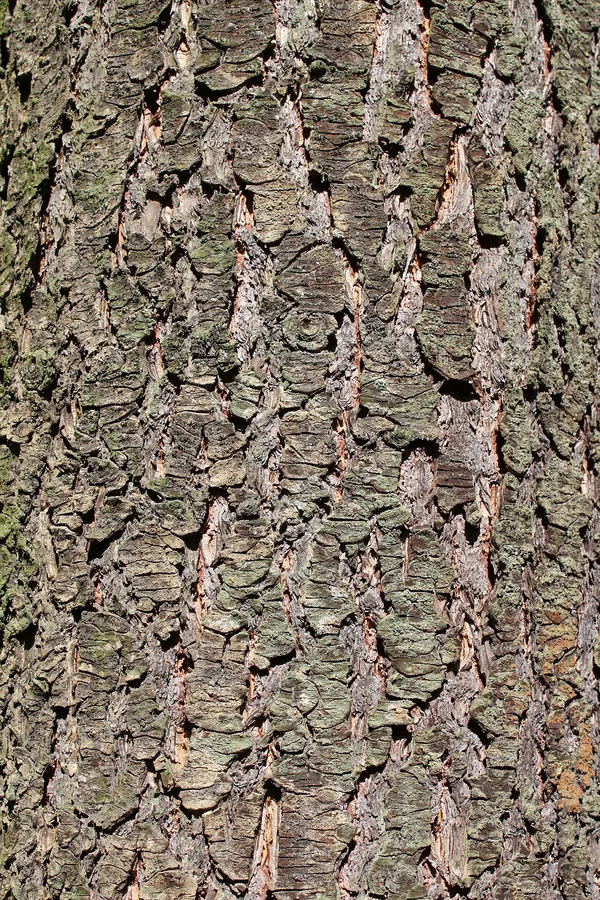
Bark & trunk: Smooth gray-brown with resin blisters when young, developing into very thick, deeply furrowed, corky reddish-brown plated bark on old trunks.
Growth habit / form: Strongly conical/pyramidal when young with a straight leader and whorled branches; old trees become columnar with an irregular crown.
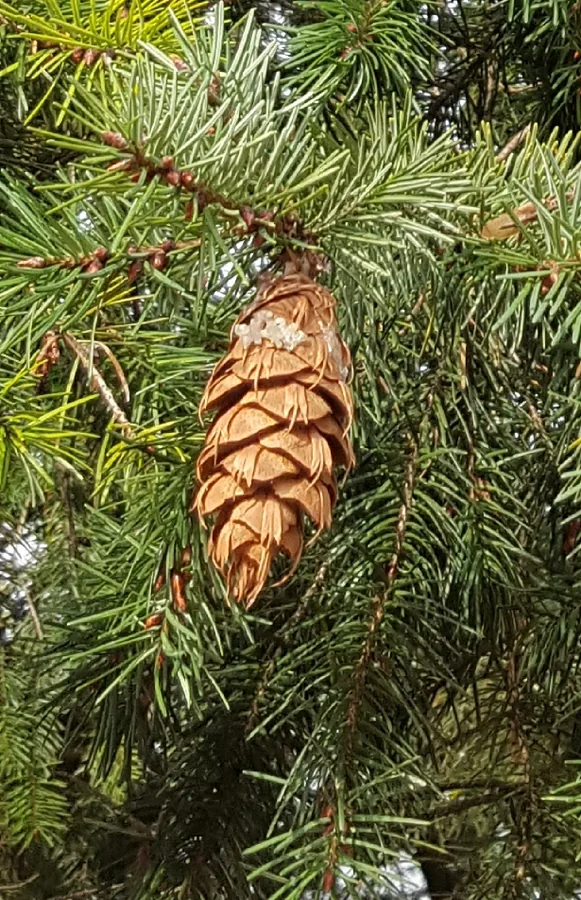
Flowers / fruit: Pendulous cones 5 to 10 cm long with the unmistakable three-pointed exserted bracts ("mouse tails" or trident bracts) protruding between the scales; no other common conifer has this.
Look-alikes & how to tell them apart: Often confused with true firs (Abies) and spruces (Picea). True firs have upright, non-pendulous cones that disintegrate on the tree and needles that leave round flat scars; spruces have needles set on woody pegs and rougher foliage. Douglas fir is separated instantly by its pointed reddish buds and, when present, the pitchfork-bracted hanging cones; Pseudotsuga is neither a true fir nor a spruce.
Climate & USDA Zone
Douglas fir is very cold-hardy. The coastal variety (var. menziesii) suits USDA zones 4 to 6, while the Rocky Mountain interior variety (var. glauca) is hardier still, tolerating zone 3 and winter lows well below −30 °C (−22 °F). It needs a real, cold winter dormancy and does not adapt to hot, humid lowland summers well; coastal and interior forms both prefer cool, mesic conditions. Grow outdoors all year. In containers, shield roots from hard freeze-thaw cycling, and in hot regions (upper zone 6 and warmer) give afternoon shade and watch for heat stress; sustained heat above roughly 30 °C (86 °F) is not to its liking.
Light
Give full sun to light shade; strong light keeps needles short and internodes tight. In cool climates full sun is ideal; in hot-summer regions provide light afternoon shade to prevent needle scorch and reduce heat stress on the pot. Deep shade produces leggy, sparse growth.
Watering
Keep the rootball evenly moist; Douglas fir is a mesic forest tree that tolerates neither drought nor standing water.
- Water when the surface begins to dry; do not let the rootball fully dry out.
- Never leave it sitting in water; waterlogged roots invite the root-rot pathogens this species is prone to.
- Increase frequency in summer heat; misting foliage in dry heat is beneficial.
- Ease back in winter dormancy, keeping the soil just damp.
Soil & Root Care
Soil: A well-draining, slightly acidic conifer mix: akadama, pumice and lava rock in roughly equal parts, with a little composted bark. Good drainage is critical because of the species' susceptibility to root rot.
Repotting:
- Repot only every 3 to 5 years; this conifer resents frequent root disturbance.
- Timing: early spring as buds begin to swell, before the flush of new growth.
- Be conservative with root work; comb out and trim only the outer roots, never bare-root aggressively. Preserve mycorrhizae by not washing all the old soil away.
- Aftercare: keep in a sheltered, brightly shaded spot out of wind, water carefully, and do not fertilize for about a month while new roots form.
Feeding
Feed moderately through the growing season with a balanced conifer fertilizer from spring after the new growth firms up, easing off in the heat of midsummer and resuming lightly into autumn to build cold hardiness. A slightly lower-nitrogen, organic feed suits its slow, steady growth better than a high-nitrogen push, which produces coarse needles. Preserving the tree's mycorrhizal associations (by not over-repotting or over-fertilizing) supports vigor.
Pruning & Styling
- Pinch or pluck the elongating new candle-like shoots in spring by hand (thumb and finger) to reduce extension and encourage back-budding; avoid cutting through needles with scissors, which browns the cut tips.
- Back-budding occurs mainly on younger wood, so build ramification while branches are young; old bare wood rarely re-buds.
- Suitable styles: formal and informal upright (chokkan, moyogi), and windswept or literati forms that echo mountain specimens; the natural conical habit lends itself to classic tree shapes.
- Wire in autumn to winter when the tree is not in active growth; the wood is somewhat brittle, so bend with care and check for wire bite.
- Remove dead interior needles and thin dense areas to admit light and air.
Propagation & Cuttings
Ease: Difficult from cuttings. Best methods: seed; collected.
Pseudotsuga is grown from seed: cold-moist stratify ~1 to 2 months and sow in spring in well-drained mix; germination is fair and seedlings are moderately slow. Cuttings root poorly and are rarely used. It does not layer. For bonsai, seedlings or collected young saplings/yamadori are the route; Douglas fir back-buds only modestly on old wood, so keep some young growth and develop the tree patiently with its natural whorled branching in mind.
Pests
- **Douglas fir needle midge (Contarinia spp.)**: larvae cause needle galls and premature needle drop; remove and destroy affected needles.
- **Cooley spruce gall adelgid (Adelges cooleyi)**: Douglas fir is the alternate host, causing yellow spotting and distorted needles; treat with horticultural oil in dormancy.
- Spider mites: stippling and bronzing of needles in hot dry weather; spray foliage and apply miticide.
- Aphids and scale: sap-suckers on shoots; treat with insecticidal soap or horticultural oil.
Treatment across these: a dormant-season horticultural oil application smothers overwintering adelgids, mite eggs and scale.
Disease, Fungus & Infection
- Phytophthora and Armillaria root rot: the major threat, thriving in waterlogged or heavy soil; ensure sharp drainage and never overwater. There is no cure once advanced; prevent it.
- **Rhabdocline needle cast (Rhabdocline pseudotsugae)**: yellow-then-brown mottling and needle drop in wet spring conditions; improve airflow, remove infected needles.
- **Swiss needle cast (Phaeocryptopus gaeumannii)**: yellowing and premature loss of older needles, rows of black fruiting bodies visible on needle undersides; improve air circulation.
- Diplodia / canker fungi: dieback of shoots in stressed trees; prune out and sterilize tools.
Prevention: excellent drainage, full airflow, careful watering, clean fallen needles, and keeping the tree unstressed prevent the great majority of these problems.
Most Common Causes of Death
1. Root disturbance from over-frequent or too-aggressive repotting: the single most common killer; Douglas fir hates having its roots washed and cut hard. Repot rarely and gently, preserving fine roots and mycorrhizae. 2. Root rot from waterlogged or poorly draining soil: Phytophthora and Armillaria thrive in wet media; use a sharply draining mix and never let the pot stand in water. 3. Summer heat and drought stress: a cool-climate tree that suffers in hot, dry conditions; provide afternoon shade and consistent moisture in warm regions. 4. Loss of mycorrhizae: stripping all old soil or over-fertilizing kills the fungal partners it depends on; keep some native soil and feed modestly. 5. Cutting old bare wood expecting back-budding: it won't re-bud on old wood and can be weakened by hard cuts; build structure on young growth.
Seasonal Calendar
- Spring: Buds swell and new candle-like shoots elongate; the window to repot (gently) and to pinch new growth for density; begin feeding once growth firms.
- Summer: Water consistently and provide afternoon shade in heat; watch for mites, midge and adelgid; ease feeding in peak heat.
- Autumn: Resume light feeding to harden off; wire now while dormant; keep evenly moist as growth slows.
- Winter: Fully dormant outdoors; protect container roots from hard freeze-thaw, keep soil just damp, apply dormant horticultural oil, avoid root work.
Close-up photo reference
Compare your tree against these to confirm the species and spot problems early.

_on_a_tree_in_Salisbury,_UK.jpg)
Sources
- Wikipedia: *Pseudotsuga menziesii*
- Missouri Botanical Garden: *Pseudotsuga menziesii* plant profile
- The Gymnosperm Database: *Pseudotsuga menziesii*
Growing a Douglas Fir bonsai
We don’t currently stock Douglas Fir trees. If you already have one — or you are sourcing one elsewhere — these are the supplies its care depends on:
- Bonsai Decorative Crushed Shale Top of Soil Dressing — $4.95
- Bonsai Zen Garden Grooming Rake — $8.95
- Metal Impression Tags Package of 4 — $2.95
Browse all bonsai trees, tools and soil or find a species we stock that suits your conditions.
- All species
- Shop bonsai trees, tools & supplies
- How to Water a Bonsai (Without Killing It)
- Bonsai Soil: What to Buy, What to Mix, and What It Costs
- Why Bonsai Die After Repotting: Diagnosing a Failed Repot
- Pruning vs. Pinching: Shaping Your Bonsai
- Overwintering Bonsai: Cold-Season Care
- Indoor Bonsai Light and Humidity: Making a Windowsill Actually Work
- Root Rot on bonsai
- Overwatering on bonsai
- Underwatering (Drought Stress) on bonsai
- Winter / Frost Damage on bonsai
- Leaf Scorch / Sunburn on bonsai
- Eastern White Pine bonsai care
- Fire Chief Arborvitae bonsai care
- Gold Arborvitae bonsai care
- Japanese Yew bonsai care