Atlantic White Cedar Bonsai Care
Chamaecyparis thyoides
Zones 4 to 8, outdoor only. Not a cedar. Most are lost to drying out.
_(31257220486).jpg)
Cupressaceae (cypress family) · Evergreen conifer
Atlantic White Cedar quick reference
| USDA zones | 4 to 8 |
|---|---|
| Indoor / outdoor | Outdoor only; it will not survive indoors |
| Light | Full sun, six or more hours; light shade in the hottest climates |
| Water | Water-loving; a bog species that must never dry out |
| Soil | Water-retentive mix; more akadama, and it accepts a slightly acidic mix |
| Repot | Every 2 to 3 years in early spring |
| Frost | Very hardy; a native of northern swamps |
| Mature height (as bonsai) | Tree to 25 m; 30 to 90 cm as bonsai |
| Growth rate | Slow to moderate |
| Season of interest | Blue-green foliage year round, bronze-purple winter cast, fibrous red bark |
| Leaf reduction | Not applicable; foliage is scale-like and already fine |
| #1 cause of death | Drying out, which kills conifer foliage permanently |
Overview & Character
Atlantic White Cedar is not a cedar. True cedars belong to Cedrus, in the pine family; this is a Chamaecyparis, a false cypress, and its closest garden relatives are Hinoki, Sawara and Lawson Cypress. The common name is a colonial-era description that outlived its accuracy.
What it is, is one of the most distinctive native conifers of eastern North America: a narrow, spire-shaped tree of coastal freshwater swamps and bogs, running in a thin ribbon from Maine down the seaboard and around to Mississippi. It grows with its roots in saturated, acidic, peaty ground, often in standing water, and the wood it produces is so rot resistant that the species was logged nearly out of existence for shingles and boat building.
For bonsai it offers three things. Foliage that is finer and softer than most cypresses, in a distinctly blue-green cast that turns bronze-purple through winter. Reddish-brown bark that shreds into long fibrous strips and reads as old very early. And an entirely unusual watering requirement: this is a conifer you cannot overwater, which removes the single most common way people kill conifers.
The catch is the reverse of that. It has no drought tolerance at all, and conifer foliage that dries out does not recover. A deciduous tree that loses its leaves to a dry pot pushes a new flush. A Chamaecyparis that browns stays brown, and the branch is gone.
'Top Point' is a dwarf, compact, naturally conical selection of this species, and is the form most often offered as trained bonsai material. Its care is identical to the type.
Identification
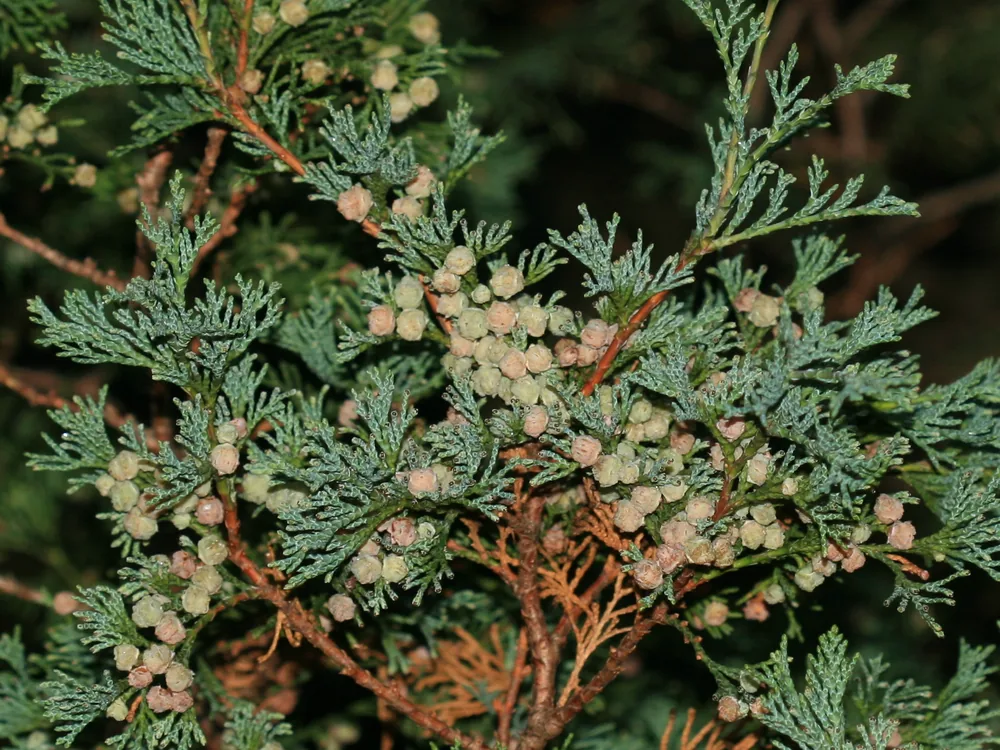
Foliage: Small, scale-like leaves closely pressed to the shoot in overlapping pairs, giving slender, slightly irregular, three-dimensional sprays rather than the flat fans of a Thuja. Blue-green to grey-green, often with a fine white bloom, taking on a bronze to purplish tint in cold weather. Crushed foliage is aromatic.
Bark & trunk: Reddish-brown to ash-grey, thin, and peeling in long narrow fibrous strips that spiral slightly around the trunk. This mature character develops young and is a large part of the species' appeal.
Growth habit / form: Narrow, upright, densely conical in the wild, often with a slightly irregular crown. Suits formal upright, informal upright and literati styles.
Flowers / fruit: Tiny cones, roughly 4 to 6 mm across, round and slightly fleshy when young with a blue-grey bloom, ripening to brown and woody with a small point on each scale. They are noticeably smaller and rounder than the cones of most cypresses.
Look-alikes & how to tell them apart: Sawara Cypress (C. pisifera) has sprays that are flatter with sharper, more spreading scale tips. Northern White Cedar (Thuja occidentalis) has distinctly flat, fan-like sprays and small elongated cones with overlapping scales, not the little round balls seen here. Eastern Red Cedar (Juniperus virginiana) carries fleshy blue berry-like cones and often has sharp juvenile needles mixed into the scale foliage. The combination of small round bloomy cones, blue-green three-dimensional sprays and fibrous red bark is diagnostic.
Climate & USDA Zone
Hardy through USDA zones 4 to 8, and genuinely cold tolerant; this is a tree of northern swamps that stands hard winters as a matter of routine. It requires a cold dormancy and cannot be kept indoors. A warm house will kill it within one or two seasons, and the decline is quiet enough that people usually mistake the cause.
Over winter, protect the container rather than the tree. Mulch the pot, sink it into a garden bed, or move it into an unheated shed or cold frame. The concern is a shallow root ball freezing solid and, more importantly, drying out while frozen. Winter desiccation is a real risk for an evergreen that keeps transpiring on bright cold days while its roots cannot take up water from frozen soil.
In the hottest southern climates give it light afternoon shade and pay very close attention to water.
Light
Full sun, six hours or more. It grows in open swamp canopy and wants strong light to stay dense and compact. In shade it thins, the interior dies back, and the foliage loses its blue cast.
The important qualification is that full sun and its water requirement are linked. A tree in full summer sun in a shallow pot will need water more than once a day. If you cannot guarantee that, light afternoon shade is the safer compromise, because underwatering will do far more damage than slightly reduced light.
Watering
This is a bog species. Keep the soil wet at all times. It will not tolerate drought.
- Never allow the root ball to dry out, not even once, not even briefly. Conifer foliage that browns from drought does not green up again, and the branch it was on is usually lost.
- Standing water is acceptable here in a way it is not for other conifers. A shallow tray of water beneath the pot through summer is legitimate practice for this species.
- In hot weather expect to water at least daily, often twice.
- Continue watering through winter dormancy whenever the soil is not frozen. Winter drought kills more evergreens than winter cold does.
- Because it is a swamp native, it appreciates rainwater or soft water; it is adapted to acidic, low-mineral conditions.
Soil & Root Care
Soil: Weight the mix towards moisture retention. Akadama with a smaller proportion of pumice and lava, and a modest organic or peat component, reproduces the damp acidic ground it evolved in. A fast, sharply draining conifer mix designed for junipers is the wrong choice here and will dry too quickly.
Repotting:
- Frequency: every two to three years, in early spring as growth begins to move.
- Root work should be moderate. It is not as forgiving of bare-rooting as a deciduous tree; work half the root ball at a time on older specimens.
- Retain some of the existing soil around the roots, as with most conifers, to preserve the beneficial mycorrhizal fungi it depends on.
- Aftercare: keep it wet, shelter it from drying wind, and give it light shade for two to three weeks.
Feeding
Feed from the point spring growth begins until late summer. A balanced fertiliser, either solid organic replaced every four to six weeks or a liquid feed at half strength every two weeks, suits it. An acidic or ericaceous fertiliser matches its natural preference and is worth using where the local water is hard.
Stop feeding by early autumn so growth hardens before winter, and give nothing during dormancy. Do not feed for six weeks after repotting.
Pruning & Styling
- Pinch, do not cut, the foliage pads. As with most scale-foliage cypresses, cutting through a spray with scissors leaves cut ends that brown and stay brown. Pinch or twist out the extending tips with your fingers instead.
- Work through the growing season, removing the strongest extending shoots to keep pads even and light reaching the interior.
- This species does not reliably back-bud on bare old wood. A branch cut back beyond its green foliage will usually not resprout. Plan structural work in advance and never strip a branch of all its foliage in the hope of regrowth.
- Thin congested interior growth so light and air reach inside the pads, otherwise the interior browns off and you lose the ability to shorten branches later.
- Wiring: best in autumn or late winter. Young shoots are flexible; older wood is stiff and brittle. The bark is thin and fibrous, so pad the wire or check it every four to six weeks, since bite marks on this bark are slow to disappear.
- Deadwood work suits it. The species is famously rot resistant, so jin and shari hold up well, and the fibrous bark and pale weathered wood contrast strongly.
Propagation & Cuttings
Ease: Moderate. Best methods: semi-hardwood and hardwood cuttings; seed.
Cuttings taken from late summer through winter root reasonably well with bottom heat and high humidity, though more slowly than most cypresses, and cuttings from a named dwarf selection such as 'Top Point' are the only way to keep that form true. Seed requires a period of cold stratification and germinates unevenly, and seedlings vary considerably in habit and foliage colour, which is interesting for a grower and unhelpful for anyone wanting a particular form.
Layering works where a low branch can be pinned into damp medium, which reflects how the species naturally layers in the wild when a branch is pressed into wet peat.
Pests
- Spider mites, the most serious pest, encouraged by hot dry conditions
- Bagworms, which can defoliate a small tree quickly and must be picked off
- Juniper scale and related armoured scales
- Cypress tip miner, which browns the shoot tips
- Root aphids in the container
Spider mites are the one to watch. Hold a sheet of white paper under a branch and tap it; moving specks confirm them. They thrive in exactly the hot dry conditions that also stress this species, so good watering is itself a control measure.
Disease, Fungus & Infection
- Drought browning, the most common problem and not a disease at all, though it is often mistaken for one. It is permanent.
- Phytophthora root rot, possible in stagnant airless soil, though the species is far more resistant than most conifers.
- Kabatina and Phomopsis tip blight, causing dieback of shoot tips, typically after damage or in prolonged wet still weather. Prune out affected tips into clean wood.
- Winter desiccation, browning on the windward side from bright cold days with frozen soil. Shelter and water when unfrozen.
Most Common Causes of Death
1. Drying out. The overwhelming cause. No drought tolerance whatsoever, and the damage is permanent rather than recoverable. 2. Being kept indoors. It needs cold dormancy and full outdoor light. Indoors it dies, slowly enough that the cause gets missed. 3. Winter desiccation. An evergreen transpiring on a bright frozen day with no water available at the roots. Shelter the pot and water on mild days. 4. Cutting back beyond green foliage. It will not resprout from bare wood. This does not kill the tree but it permanently destroys the branch. 5. A fast-draining conifer soil mix. Correct for a juniper, wrong for a swamp species, and it results in a tree that is chronically drought-stressed.
Seasonal Calendar
- Early spring: Repot if due, as growth begins to move. Resume feeding once the tree is growing. Check that winter has not dried any branches.
- Late spring and summer: Full sun with water at least daily. Pinch extending tips through the season. Feed steadily. Watch closely for spider mites in heat.
- Autumn: Stop feeding so growth hardens. Wiring is well timed now. Foliage takes on its bronze-purple winter cast. Continue watering.
- Winter: Full dormancy outdoors. Protect the pot from freezing solid. Water whenever the soil thaws. Shelter from drying winter wind. Structural planning, but no cutting into bare wood.
Sources
- Wikipedia, Chamaecyparis thyoides
- USDA Forest Service, Silvics of North America: Chamaecyparis thyoides
- Missouri Botanical Garden Plant Finder, Chamaecyparis thyoides
Buy a Atlantic White Cedar bonsai
- All species
- Shop bonsai trees, tools & supplies
- How to Water a Bonsai (Without Killing It)
- Bonsai Soil: What to Buy, What to Mix, and What It Costs
- Why Bonsai Die After Repotting: Diagnosing a Failed Repot
- Pruning vs. Pinching: Shaping Your Bonsai
- Overwintering Bonsai: Cold-Season Care
- Indoor Bonsai Light and Humidity: Making a Windowsill Actually Work
- Root Rot on bonsai
- Overwatering on bonsai
- Underwatering (Drought Stress) on bonsai
- Winter / Frost Damage on bonsai
- Spider Mites on bonsai
- Lawson Cypress bonsai care
- Sawara Cypress bonsai care
- Hinoki Cypress bonsai care
- Cryptomeria / Japanese Cedar bonsai care