Hinoki Cypress Bonsai Care
Chamaecyparis obtusa
2 Hinoki Cypress bonsai in stock, from $49.95 Shipped direct from our nursery partners, with a 48-hour live-arrival guarantee. See the trees
One of the most elegant conifers in bonsai, valued for its soft, scale-like foliage arranged. Most are lost to overwatering.
Cupressaceae · Evergreen coniferous tree with soft, scale-like (not needle) foliage held in flattened, fan-like sprays
Hinoki Cypress quick reference
| USDA zones | Roughly 4–8; larger trees with more soil tolerate cold better than small specimens in shallow pots |
|---|---|
| Indoor / outdoor | Strictly outdoor, year-round |
| Light | Full sun to bright light; needs strong light, but constant foliage maintenance is required so interior gets light |
| Water | MOIST (but not wet). Keep slightly and evenly moist; never let it fully dry, and never let it sit waterlogged |
| Soil | Free-draining bonsai mix; use lime-free (soft/acidic) water |
| Repot | Every 2–4 years (younger more often), in early spring |
| Frost | Good on larger trees; small specimens/shallow trays are prone to tip dieback in hard cold — protect them |
| Mature height (as bonsai) | Tree to 35 m; 25-70 cm as bonsai |
| Growth rate | Slow |
| Season of interest | Year-round rich green fan-like foliage |
| Leaf reduction | Good - naturally compact sprays |
| #1 cause of death | Phytophthora root rot from waterlogged soil (no cure once established) |
Overview & Character
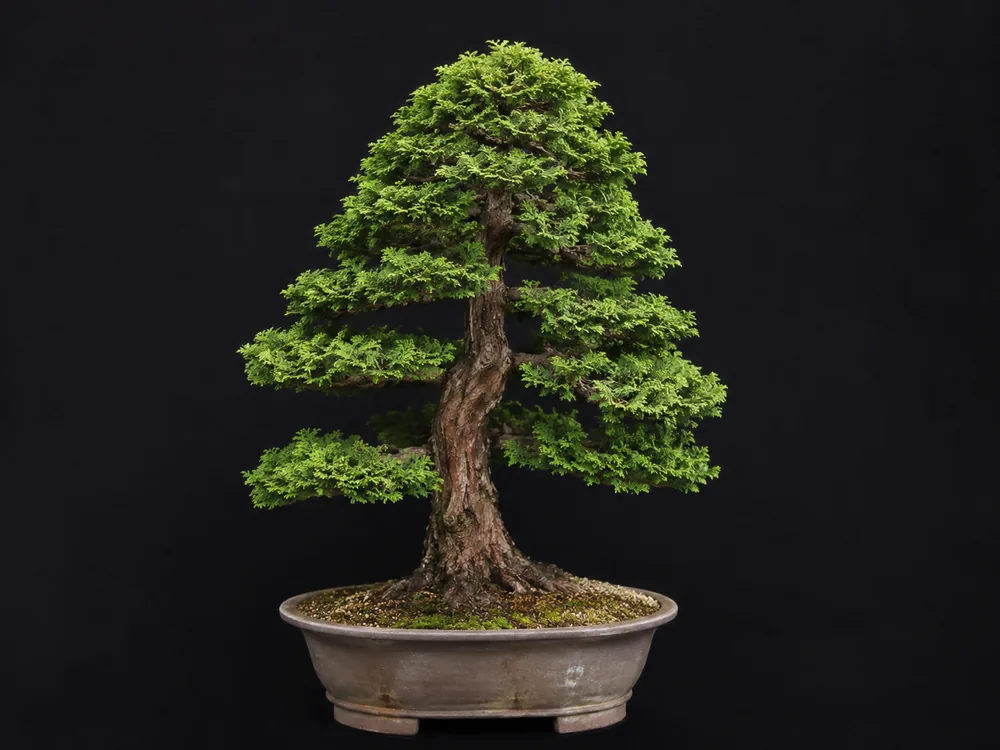
The Hinoki Cypress is one of the most elegant conifers in bonsai, valued for its soft, scale-like foliage arranged in flattened, fan-shaped sprays of rich green, its layered, cloud-like pads, and the reddish-brown, stringy bark of mature trees. Numerous dwarf cultivars (such as 'Nana Gracilis') are popular because their naturally compact, congested foliage suits small pots.
The defining care fact for Hinoki is its growth biology: it does not form new buds on old, bare wood. If you cut back into old growth, those branches will not regrow. All shaping must work with new growth, and the interior must be kept open and well-lit or inner and lower branches die from shade. This makes ongoing, attentive foliage maintenance essential rather than optional. Hinoki is moderately demanding and rewards a grower who keeps up with it.
Identification
Foliage (the giveaway): Not true needles but soft, blunt, scale-like leaves pressed against the shoot and held in flattened, fan-like sprays. The defining detail is on the underside of the sprays: distinct white stomatal markings shaped like the letters Y and X between the scales — a reliable, close-up ID feature. Foliage is rich green above; evergreen.
Bark & trunk: Reddish-brown, fibrous and stringy, peeling in vertical strips on older trees.
Growth habit / form: A conical evergreen tree in nature; in bonsai it is built into soft, layered, cloud-like pads. Many dwarf cultivars (e.g. 'Nana Gracilis') have congested, shell-like sprays. Cones: Small, round, woody, about 8–12 mm, ripening brown — markedly smaller and rounder than most cypress cones.
Look-alikes & how to tell them apart: Distinguished from junipers, which have either prickly awl needles or scale foliage but lack the crisp white Y/X stomatal pattern beneath flattened sprays. Sawara Cypress (Chamaecyparis pisifera) is similar but has pointed, spreading scale tips and white X/butterfly-shaped marks, versus Hinoki's blunt tips and Y/X marks. Lemon Cypress differs by its golden color and strong lemon scent.
Climate & USDA Zone
Native to Japan, Hinoki Cypress is hardy in roughly USDA zones 4–8. Larger trees with greater soil volume tolerate cold down to around 20–25°F (-4 to -7°C); small specimens or those in shallow trays are more vulnerable and may suffer tip dieback in harder freezes. It is an outdoor tree year-round, appreciating a temperate climate with adequate humidity and good air movement. In hot regions provide some afternoon shade.
Light
Give it full sun to very bright light to keep foliage compact and healthy. However, because Hinoki foliage is dense and the species sheds shaded interior growth permanently, the practical priority is keeping light reaching the inner and lower branches. That means full sun plus regular thinning and opening of the pads. Insufficient light to the interior causes irreversible dieback of those branches.
Watering
Moist, but never waterlogged. Hinoki likes to stay slightly and evenly moist. Through the growing season (early spring to late fall) check it once or twice a day; most specimens need watering at least daily, sometimes twice in heat. Keep the soil moist but not wet — water when the surface is dry but particles beneath still hold moisture, and never let the root mass dry out completely. At the same time, the roots must not sit in standing water, which causes fatal root rot. Use lime-free (soft, slightly acidic) water; hard, alkaline water degrades foliage health and color over time.
Soil & Root Care
Use a free-draining bonsai mix (for example akadama with pumice and lava) that holds moisture while still draining freely — the balance point is "evenly moist, never soggy." Avoid dense, water-retentive soils that stay wet.
Repot every 2–4 years (younger trees toward the shorter interval) in early spring before strong growth begins. Hinoki has relatively fine roots; remove no more than about a third, work gently, and keep the tree sheltered and out of strong sun/wind while it recovers. Maintaining good drainage at every repot is your main defense against root rot.
Feeding
Feed regularly through the growing season — spring through autumn — to support the constant foliage replacement this species demands, easing off in winter dormancy. A balanced fertilizer with steady nitrogen keeps foliage green and vigorous; an acidic-leaning regime suits its preference for soft water and slightly acidic conditions. Avoid overfeeding, which produces coarse, juvenile foliage.
Pruning & Styling
The cardinal rule: only prune/pinch new growth — never cut back into old, bare wood, because Hinoki does not back-bud on old wood and those branches will not regrow.
- Pinching new growth: During the growing season, pinch back extending tips with your fingers to maintain shape and density (avoid scissors on the soft foliage where possible, as cut scale tips can brown). Pinch regularly and lightly rather than hard occasionally.
- Thinning for light: Continuously thin congested areas and open the foliage pads so light and air reach the interior and lower branches. This is the single most important ongoing task — neglect it and the inner/lower foliage dies permanently.
- Structural work: Set branch placement and reductions while the framework still carries foliage you intend to keep; do not rely on regrowth from bare cuts.
- Wiring: Wire carefully; the foliage pads are easily disturbed and bark marks. Best done when the tree is healthy and growth is moderate; check wire so it does not bite in.
Propagation & Cuttings
Ease: Easy (roots from cuttings). Best method: cuttings.
Chamaecyparis obtusa is propagated from cuttings — this is how the many dwarf cultivars are produced true. Take semi-hardwood cuttings with a heel in autumn to late winter, dip in IBA, and keep humid and cool; rooting is reliable but slow (2–4 months). Seed germinates after short cold stratification but seedlings vary and won't match named forms. It doesn't layer readily. For bonsai, cuttings clone good compact foliage; note Hinoki back-buds poorly on old bare wood, so never strip interior growth.
Pests
- Spider mites — common, especially in hot, dry, stagnant conditions; cause stippling and bronzing of foliage. Look for fine webbing.
- Scale insects — sap-suckers on foliage and stems.
- Wood-boring beetles — particularly troublesome; can damage branches and trunk.
- Aphids — occasional, on soft new growth.
Inspect regularly, maintain airflow, and treat with horticultural oil or an appropriate insecticide; act early, as a thinning, neglected Hinoki recovers slowly.
Disease, Fungus & Infection
- Phytophthora root rot: the chief killer — caused by waterlogged soil and Phytophthora pathogens. Symptoms: gradual thinning, yellowing foliage starting low/inside, and blackened roots lacking white tips. There is no cure once established — prevention through drainage and correct watering is the only reliable defense.
- Tip blight: browning and dieback of foliage tips; treat with an appropriate fungicide and improve airflow.
- Other foliar fungi: favored by wet, stagnant conditions; managed by ventilation and avoiding overhead wetting in humid weather.
Most Common Causes of Death
1. Phytophthora root rot from waterlogging. The top killer; keep moist but free-draining — never let it sit wet. 2. Cutting into bare old wood. It does NOT back-bud on bare old wood — never cut a branch back beyond green foliage or it dies. 3. Shaded, congested interior. Inner foliage dies without light; thin and keep the interior open. 4. Hard water / lime. Prefers lime-free (soft) water; hard water causes problems over time. 5. Drying out / unprotected winter roots. Don't let it bone-dry; shelter potted roots in hard freezes.
Seasonal Calendar
- Spring: Repot if due; resume feeding; pinch/thin foliage sprays (never cut into bare wood); wire carefully.
- Summer: Full sun to light shade; keep evenly moist with soft water; thin congested growth for interior light.
- Autumn: Taper feeding/water; light thinning.
- Winter: Hardy dormancy outdoors; protect potted roots; keep from fully drying.
Sources
Buy a Hinoki Cypress bonsai
- All species
- Shop bonsai trees, tools & supplies
- How to Water a Bonsai (Without Killing It)
- Bonsai Soil: What to Buy, What to Mix, and What It Costs
- Why Bonsai Die After Repotting: Diagnosing a Failed Repot
- Pruning vs. Pinching: Shaping Your Bonsai
- Overwintering Bonsai: Cold-Season Care
- Indoor Bonsai Light and Humidity: Making a Windowsill Actually Work
- Root Rot on bonsai
- Underwatering (Drought Stress) on bonsai
- Winter / Frost Damage on bonsai
- Insufficient Light (Etiolation) on bonsai
- Spider Mites on bonsai
- Atlantic White Cedar bonsai care
- Lawson Cypress bonsai care
- Sawara Cypress bonsai care
- Bristlecone Pine bonsai care