Tropical Boxwood Bonsai Care
Neea buxifolia
Zones 10 to 11, indoor or out. Not a boxwood. Most are lost to overwatering.
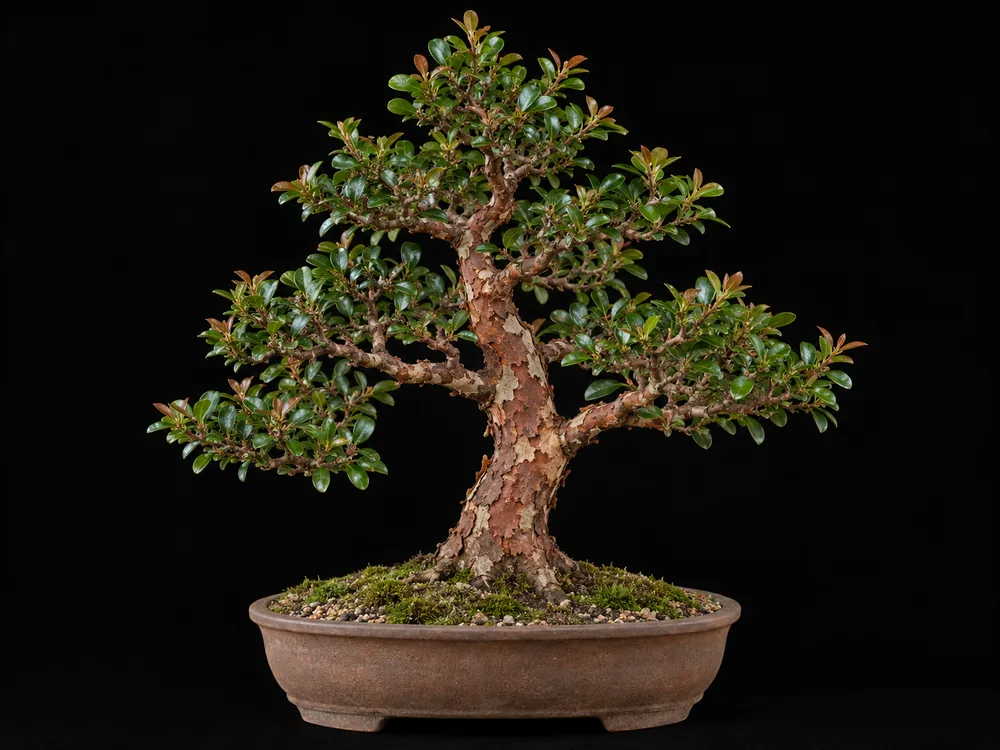
Nyctaginaceae (four o'clock family) · Tropical flowering evergreen shrub
Tropical Boxwood quick reference
| USDA zones | 10 to 11 |
|---|---|
| Indoor / outdoor | Indoor-capable; outdoors only in a frost-free climate or for the summer |
| Light | Bright, indirect to part direct sun; it scorches in hard midday glare |
| Water | Keep evenly moist; never let it dry out completely |
| Soil | Free-draining bonsai mix with a little extra water retention |
| Repot | Every 2 to 3 years in late spring; it is slow and dislikes disturbance |
| Frost | None. Damage begins around 50 F (10 C) |
| Mature height (as bonsai) | Shrub to 4 m; 15 to 45 cm as bonsai |
| Growth rate | Slow to moderate |
| Season of interest | Coppery new growth, reddish flaky bark, small berries on female plants |
| Leaf reduction | Excellent; leaves are already tiny |
| #1 cause of death | Cold, then root rot from a pot that does not drain |
Overview & Character
Tropical Boxwood is not a boxwood. Neea buxifolia belongs to the Nyctaginaceae, the four o'clock family, which makes its nearest familiar relative bougainvillea rather than anything in Buxus. The name is descriptive only: small, dense, dark, opposite leaves on a twiggy shrub, which is what a boxwood looks like from three paces.
It is native to Puerto Rico and neighbouring parts of the Caribbean, where it grows on limestone in the coastal forest. In bonsai it has a particular and slightly cult following, because it does something few tropicals do well: it holds genuinely tiny leaves, builds fine twiggy ramification, and develops a beautiful reddish-brown flaky bark far younger than most species. That combination makes it one of the best subjects available for small and very small bonsai, shohin and mame, where a large leaf ruins the illusion of scale.
The cost of those qualities is pace. It is slow. A trunk you want is a trunk you wait for, or a trunk you buy. It also has no cold tolerance whatever, which puts it firmly in the indoor or heated-greenhouse category for most growers.
New growth emerges a warm coppery bronze and hardens to deep glossy green, which gives an established tree two colours at once through the growing season.
Identification
Foliage: Small, opposite, obovate to spoon-shaped leaves, typically 1 to 3 cm long, thick and slightly leathery, glossy dark green when mature and coppery bronze when new. Margins are smooth. They sit close along the twig, which is what produces the dense boxwood impression.
Bark & trunk: The signature feature. Reddish-brown, thin, and flaking in small papery plates to reveal paler patches beneath, giving a mature textured look on a trunk that is still relatively young and slender.
Growth habit / form: Dense, upright, strongly twiggy. It divides freely into fine branches without much encouragement, which is why ramification comes easily. Suits formal and informal upright, broom, and clump styles at small sizes.
Flowers / fruit: The plant is dioecious, so individual plants are male or female. Flowers are small, pale yellow-green to whitish, tubular, and not showy; they appear in small clusters in the leaf axils. Female plants follow with small fleshy berries that ripen red to purple-black. Many trees in cultivation never flower noticeably indoors, and that is normal.
Look-alikes & how to tell them apart: True boxwood (Buxus) has a distinctly sharp, musty smell when the foliage is crushed and does not have flaking reddish bark. Kingsville Boxwood (Buxus microphylla 'Compacta') is the species most often confused with it in a nursery, and is separated instantly by that scent and by grey rather than red-brown bark. Neea is also frost tender where every Buxus is hardy, so a plant sold as a boxwood but labelled indoor-only is worth a second look.
Climate & USDA Zone
Hardy only in USDA zones 10 to 11. This is a true tropical with no dormancy requirement and no frost tolerance. Damage begins somewhere around 50 F (10 C), well above freezing, and a night near 40 F (4 C) can defoliate a tree or kill it outright.
For nearly everyone this means an indoor tree, or a greenhouse tree, with an optional holiday outdoors in high summer. If you do move it outside, do so once night temperatures are reliably above 60 F (15 C), acclimatise it to brighter light over two weeks to avoid scorching the leaves, and bring it back in well before the first cool nights of autumn.
It appreciates humidity. Indoor winter air is dry, and a humidity tray or a group planting arrangement helps more than misting does.
Light
Bright light, indirect or gently filtered, with some direct sun tolerated. This is a forest-margin plant rather than a full-exposure one. It wants plenty of light to keep the internodes short and the leaves small, but harsh unfiltered midday sun through glass will scorch the foliage.
The practical answer indoors is the brightest window you have, set back slightly from the glass, or a bright window with a sheer curtain. If growth becomes leggy with widely spaced leaves, it needs more light. If leaf edges brown and crisp, it needs less direct exposure or more humidity.
Watering
Keep the soil evenly moist. Do not let it dry out completely, and do not leave it sodden.
- Water when the surface has just begun to dry, before the root ball dries down through its depth.
- Warm indoor conditions dry a small pot quickly, so check daily even in winter.
- A tree that dries out hard will drop leaves and, because it is slow, will take a long time to rebuild what it lost.
- Equally, a pot standing in water will rot the roots. Even moisture through a mix that drains freely is the target.
Soil & Root Care
Soil: A free-draining bonsai mix that still holds some moisture. Akadama with pumice and lava, weighted a little towards the akadama, suits it. In its native range it grows on limestone, so it is untroubled by neutral to slightly alkaline water.
Repotting:
- Frequency: every two to three years, which is longer than most tropicals because it is slow and fills a pot slowly.
- Timing: late spring, into warmth, once the tree is in active growth. Never repot a cold or dormant-looking tree.
- Be conservative with the roots. Remove no more than a quarter of the root mass at once. It does not regenerate roots as fast as a ficus and resents heavy work.
- Aftercare: warmth, humidity, shade from direct sun for two to three weeks, and careful watering while the reduced root system re-establishes.
Feeding
Feed lightly and regularly rather than heavily. A balanced liquid fertiliser at half strength every two weeks through the warm months suits its pace; solid organic fertiliser also works if replaced every six weeks. Because it grows year round indoors, continue a reduced feed through winter, roughly monthly, rather than stopping entirely. Do not feed for six weeks after repotting.
Over-feeding a slow species does not speed it up. It produces soft, oversized leaves and loses you the fine texture that is the entire point of growing this plant.
Pruning & Styling
- Prune throughout the growing season. It back-buds well, including on older wood, and responds to cutting by dividing into finer twigs.
- Let a shoot extend three to four pairs of leaves, then cut back to one or two. Done consistently, this builds dense ramification and keeps the leaves at their smallest.
- Hard structural cuts are tolerated but heal slowly, so make them deliberately and seal larger wounds.
- Wiring: young shoots wire easily. Older wood is brittle and snaps rather than bending, so shape early or use guy wires and cut-and-grow on established branches. Check wire every four to six weeks; the bark is thin and marks readily.
- Its natural density means the interior can become congested. Thin crossing and inward-growing twigs to let light and air reach the inner branches, or the interior will die back.
Propagation & Cuttings
Ease: Moderate. Best methods: semi-hardwood cuttings; air layering.
Cuttings of semi-hardened wood taken in late spring or summer will root with bottom heat, high humidity and patience, but they are slower and less certain than a ficus or a privet. Air layering is the more reliable route for producing a plant with a usable trunk, and it is the standard method for turning a leggy branch into a new tree. Seed is rarely available, and because the species is dioecious, seed requires both a male and a female plant in flower together.
The slow, uncertain propagation is a large part of why good Neea material carries the price it does.
Pests
- Scale insects, the most frequent problem on indoor plants
- Mealybugs, in leaf axils and around the root collar
- Spider mites, encouraged by dry indoor air
- Aphids on soft new growth
Dense twiggy growth hides pests well, so inspect the interior and the undersides of leaves regularly rather than only the outline. Horticultural oil and insecticidal soap are effective; raising humidity discourages mites.
Disease, Fungus & Infection
Few diseases of note. As with most tropicals kept indoors, the problems are cultural:
- Root rot, from a pot that does not drain or a saucer left standing full.
- Leaf drop, the standard tropical response to cold, draught, a sudden move, or a hard dry-out.
- Interior dieback, from congestion and poor light penetration rather than infection. Thin the twigs.
- Sooty mould, growing on the honeydew left by scale or mealybug. Treat the insect and the mould goes.
Most Common Causes of Death
1. Cold. No frost tolerance and damage well above freezing. A night on a windowsill behind a closed curtain, or a trip home from the nursery in a cold car, can be enough. 2. Root rot. Even moisture is the goal; standing water is not. 3. Drying out completely. Recovery is slow because the plant is slow. 4. Heavy root pruning. It does not take the aggressive root work a ficus shrugs off. Quarter of the roots at most. 5. Cold draughts and heating vents. Both dry and chill it. Keep it away from doors that open to winter air and from forced-air outlets.
Seasonal Calendar
- Spring: Growth accelerates as light returns. Repot in late spring if due. Resume full feeding. Begin the season's pruning.
- Summer: Strongest growth. Prune and pinch regularly. Optional move outdoors once nights are above 60 F (15 C), acclimatised gradually. Water daily.
- Autumn: Bring any outdoor tree back inside well before nights cool. Reduce feed. Watch for pests carried in from outside.
- Winter: Brightest available light. Maintain humidity against dry heated air. Water carefully, less often but never to dryness. Light monthly feed. Keep well clear of cold glass and draughts.
Sources
- Wikipedia, Neea
- Smithsonian Tropical Research Institute, Neea buxifolia
- Plants of the World Online, Neea buxifolia
Buy a Tropical Boxwood bonsai
- All species
- Shop bonsai trees, tools & supplies
- How to Water a Bonsai (Without Killing It)
- Bonsai Soil: What to Buy, What to Mix, and What It Costs
- Why Bonsai Die After Repotting: Diagnosing a Failed Repot
- Pruning vs. Pinching: Shaping Your Bonsai
- Overwintering Bonsai: Cold-Season Care
- Indoor Bonsai Light and Humidity: Making a Windowsill Actually Work
- Root Rot on bonsai
- Underwatering (Drought Stress) on bonsai
- Winter / Frost Damage on bonsai
- Leaf Scorch / Sunburn on bonsai
- Spider Mites on bonsai
- Bahama Berry bonsai care
- Black Olive bonsai care
- Downy Jasmine bonsai care
- Ming Aralia bonsai care