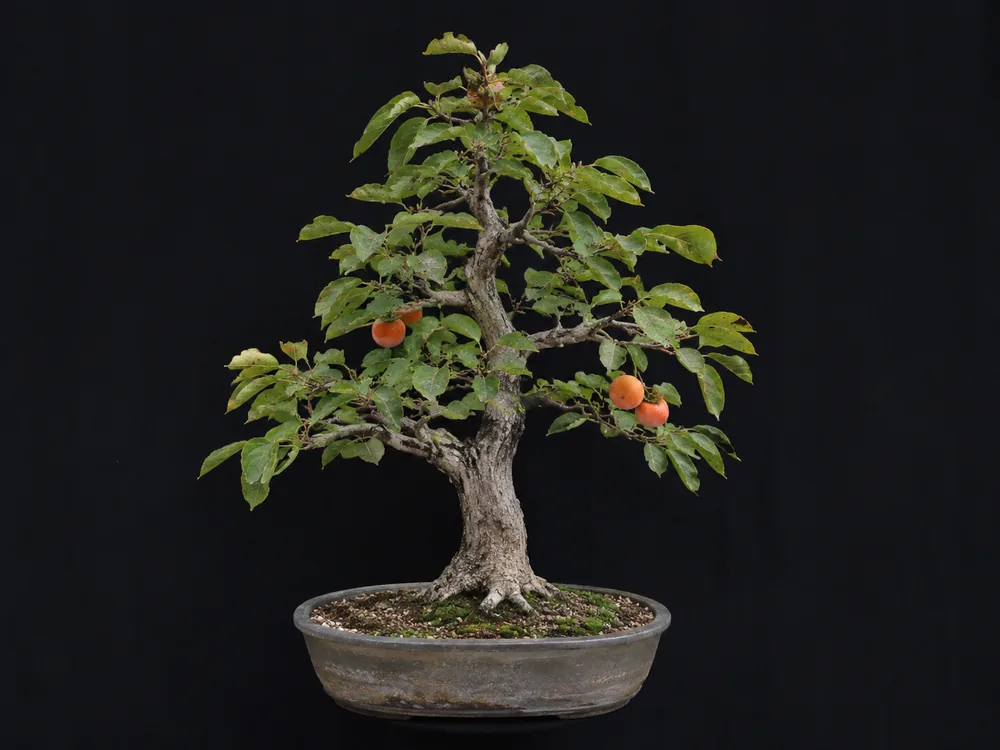
Persimmon Bonsai Care
Diospyros kaki
The Japanese persimmon, or kaki, is grown as a bonsai above all for its spectacular ornamental fruit. Most are lost to drying out.
Ebenaceae (ebony family) · Deciduous broadleaf fruiting tree; outdoor bonsai
Persimmon quick reference
| USDA zones | Roughly Zones 7–10 (best Zones 7–9); tolerates cold but protect potted roots below about -4°C (~25°F) |
|---|---|
| Indoor / outdoor | Strictly outdoor — needs full sun and seasonal change; protect roots in hard winters |
| Light | Full sun; 5–6+ hours of direct sun daily, especially in spring and summer |
| Water | Likes plenty of water — keep evenly MOIST; do not let it go dry (dryness desiccates and drops the fruit). But never leave it standing in water |
| Soil | Free-draining bonsai mix (akadama / pumice / lava) that still holds moisture |
| Repot | Young trees every 1–2 years; older trees every 2–3 years, in spring |
| Frost | Wood is fairly hardy; potted roots are vulnerable — shelter in a cold greenhouse/sheltered spot below ~-4°C |
| Mature height (as bonsai) | 8-15m wild; 30-60cm as bonsai |
| Growth rate | Moderate; coarse growth habit |
| Season of interest | Orange fruit on bare winter branches |
| Leaf reduction | Large leaves reduce poorly; grown for fruit |
| #1 cause of death | Drought stress (lets fruit and tree desiccate) and root rot from poor drainage; winter root freeze in the pot |
Overview & Character
The Japanese persimmon, or kaki, is grown as a bonsai above all for its spectacular ornamental fruit — glossy orange globes that hang on the bare branches in autumn and early winter after the leaves have dropped, glowing like lanterns. It also offers fiery spring and autumn foliage color and develops characterful, often rugged trunks suited to upright and cascade styles.
It is, however, a somewhat slow, coarse, and demanding bonsai subject. Persimmons are slower to develop fine ramification than maples or elms, can be tricky to bring into reliable fruiting (they may not fruit until around 5–7 years old), and are intolerant of drying out. For these reasons it is best regarded as an intermediate-to-advanced species — rewarding, but not a beginner's first tree.
Identification
FOLIAGE: Alternate, simple, broadly ovate to elliptic leaves, fairly large and leathery with a glossy dark-green upper surface and entire (untoothed) margins. Leaves are relatively coarse and large for bonsai. Autumn color is excellent — yellow, orange, and red.
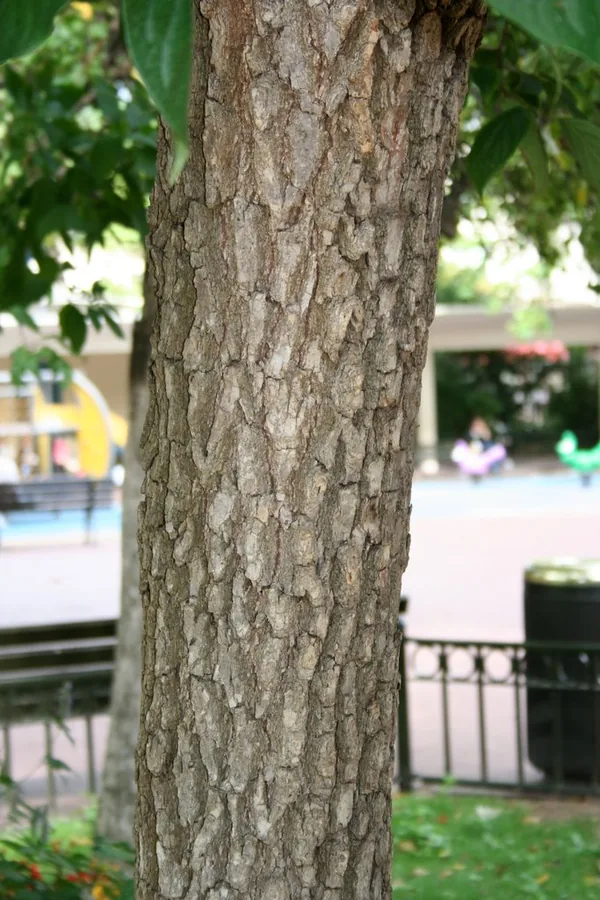
BARK & TRUNK: Bark is grey-brown to dark, becoming blocky, fissured, and rugged with age, breaking into a distinctive checkered/scaly pattern on old trees (a trait of the ebony family). The characterful trunk is a major part of the tree's appeal.
GROWTH HABIT / FORM: Naturally a small-to-medium spreading tree; growth is somewhat coarse and slow, with relatively few but strong shoots. Lends itself to upright and especially cascade styling that displays hanging fruit.
FLOWERS / FRUIT + season + old/new wood: Small, inconspicuous greenish-yellow flowers appear in late spring/early summer. The prize is the fruit — large orange berries that ripen in autumn and persist on the bare tree into early winter. Persimmon flowers and sets fruit on NEW (current-season) growth — flowers are borne on the new shoots that emerge in spring. This is the opposite of crabapple and ume, and it dictates pruning timing (see Pruning). Note that some cultivars are parthenocarpic (set fruit without pollination) while others need a pollinator; many bonsai produce fruit without a separate male tree.
Look-alikes & how to tell them apart: Persimmon can be confused with **American persimmon (Diospyros virginiana)** — which has smaller fruit and is hardier — and at a glance with other large-leaved fruiting trees. The blocky, checkered grey bark, the large glossy leathery untoothed leaves, and above all the large orange autumn/winter fruit hanging on bare branches are distinctive to Diospyros kaki. The fruit alone, when present, is the clearest identifier.
Climate & USDA Zone
Persimmon is a warm-temperate to subtropical tree that thrives in USDA Zones 7–10, preferring mild winters and warm summers (best around Zones 7–9 for fruiting bonsai). The species is quite cold-tolerant overall, but the potted rootball is far more exposed than a tree in the ground — protect the roots in a cold greenhouse or sheltered spot when temperatures fall below roughly -4°C (~25°F). It still requires the seasonal change (a cool dormancy) of a temperate climate and is not an indoor plant.
Light
Give persimmon full sun — ideally 5–6 or more hours of direct sun per day, especially through spring and summer when it is actively growing and developing fruit. Strong light supports flowering, fruit ripening, foliage color, and compact growth. Insufficient light leads to weak growth and poor fruit set.
Watering
Persimmon needs a generous, steady water supply — keep the soil evenly MOIST and do not let it dry out. The species reacts badly to drying: drought stress causes the developing fruit to shrivel (desiccate) and drop, and can damage the tree. Water thoroughly, ideally early in the day so the tree has water available through the heat, and aim for all standing water to be used up by nightfall.
At the same time, allow the surface to dry slightly between waterings and never leave the pot sitting in standing water — soggy, airless soil causes root rot. So: keep it well-watered and moist, but in free-draining soil that doesn't stay waterlogged. Water demand is highest in summer and while carrying fruit.
Soil & Root Care
Use a free-draining bonsai substrate that still retains useful moisture — akadama, pumice, and lava (roughly equal parts) works well, with akadama helping hold the moisture this species likes. Good drainage is essential to avoid root rot, but the mix should not dry out too fast given the tree's thirst.
Repot young trees every 1–2 years and older, established trees every 2–3 years, in spring as buds begin to move. Persimmons can be sensitive to heavy root disturbance, so root-prune moderately rather than aggressively, and avoid bare-rooting. Keep drainage free at all times.
Feeding
Feed regularly through the growing season to support the tree and its fruit. Use a balanced fertilizer after the spring flush for general vigor, then move toward a lower-nitrogen, higher-phosphorus/potassium feed from mid/late summer to favor flowering and fruit development over soft leafy growth. Avoid over-feeding with high nitrogen, which can promote leaf at the expense of fruit. Stop feeding as the tree goes dormant, and do not feed a freshly repotted or stressed tree.
Pruning & Styling
Old vs new wood — the key rule: persimmon flowers and fruits on NEW (current-season) growth. Because of this, hard structural pruning is best done in the dormant season (after leaf and fruit drop, when the bare branch structure is clearly visible) so that the tree pushes fresh fruit-bearing shoots in spring — pruning then does not sacrifice the coming crop. Removing dead or damaged branches and shortening over-long growth in early spring is also appropriate.
Key points:
- Do main structural pruning in winter dormancy / early spring, while you can read the branch structure — this preserves rather than removes future fruit (which comes on the new shoots).
- Be conservative: persimmon is slow and coarse, back-buds less freely than maples/elms, and recovers slowly from heavy cuts. Build structure patiently.
- Fruit thinning is important. A heavy crop stresses the tree and can prevent it fruiting the following year. Thin out excess young fruit in early summer so the remaining fruit develops large and well-colored and the tree is not exhausted.
- Wire carefully on suitable wood; the tree's relatively few, stiff branches need patient development. Upright and cascade styles best display the hanging fruit.
Propagation & Cuttings
Ease: Moderate. Best methods: seed; grafting; root cuttings.
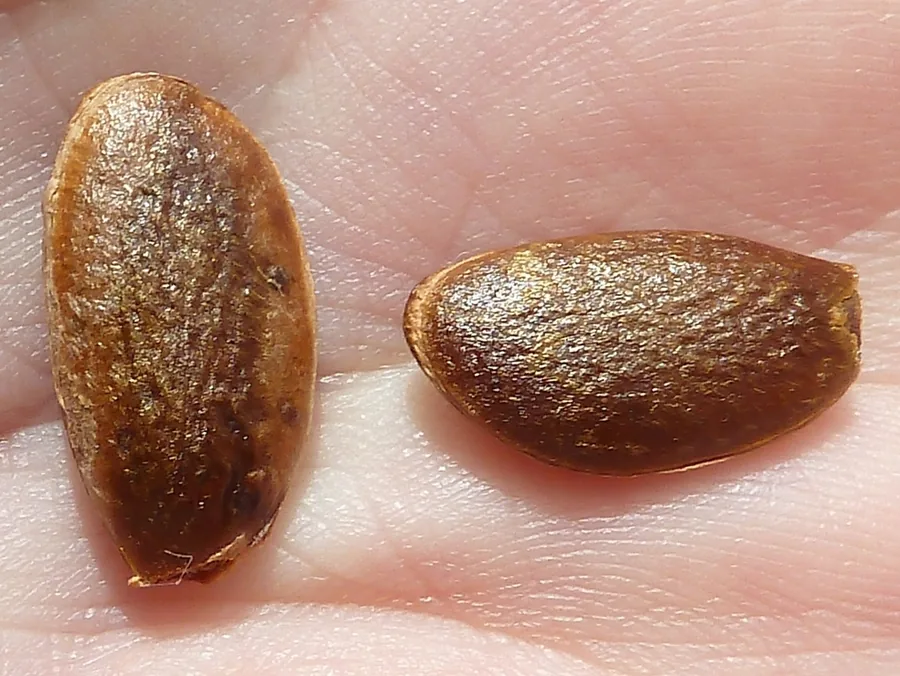
Diospyros kaki grows from seed — clean from ripe fruit, cold-moist stratify ~2–3 months, and sow warm in spring; germination is fair, but seedlings are dioecious and slow to fruit. Named fruiting forms are grafted onto Diospyros rootstock. Root cuttings can sprout. For bonsai the orange autumn fruit on bare branches is spectacular; graft or use a known clone for fruit, and note persimmon has coarse roots and resents heavy root disturbance, so repot conservatively.
Pests
Persimmon is largely pest- and disease-resistant, but watch for:
- Aphids — attack soft new shoots; distort growth and produce honeydew. Treat with neem oil or insecticidal soap.
- Scale insects — the most likely recurring pest; cause leaf yellowing and weaken the tree. Remove manually and/or treat with horticultural/neem oil, repeated as needed.
- Spider mites — possible in hot, dry conditions; cause stippling. Hose foliage, raise humidity, use a miticide if needed.
- Mealybugs can also appear. Inspect regularly and treat early.
Disease, Fungus & Infection
Persimmon is generally a healthy, disease-resistant species when grown well. The main risks are cultural/fungal:
- Root rot — from waterlogged or poorly drained soil; a real risk given the tree's high water needs paired with intolerance of standing water. Prevent with free-draining mix, free-draining pot, correct watering.
- Leaf spot / anthracnose — fungal leaf blotching in humid, stagnant conditions; improve airflow, remove affected/fallen leaves.
- Crown gall / canker — occasional; prune out affected wood with sterilized tools.
- Premature fruit drop — usually a physiological response to drought, sudden water swings, over-cropping, or stress rather than infection. Keep watering steady and thin the crop to reduce it.
Prevention is cultural: full sun, good airflow, steady moisture (no drought or waterlogging), clean fallen leaves and fruit, and clean tools.
Most Common Causes of Death
1. Drought / letting the rootball dry out — persimmon reacts badly to dryness; it desiccates fruit, drops leaves, and stresses the tree, and repeated drying kills roots. Prevention: keep the soil evenly moist, water in the morning, check daily in summer. 2. Root rot from waterlogged / poorly drained soil — the flip side of its thirst; standing water rots the roots. Prevention: free-draining substrate and pot; let the surface dry slightly between waterings; never leave it in standing water. 3. Winter root freeze in the pot — wood is hardy but potted roots are exposed; an unprotected pot can freeze, especially below ~-4°C. Prevention: shelter the pot/roots over hard frosts (cold greenhouse or protected spot). 4. Over-cropping / fruit stress — too many fruit exhaust the tree and can kill weak specimens or stop future fruiting. Prevention: thin young fruit in early summer. 5. Heavy/badly timed pruning shock — persimmon is slow, coarse, and recovers poorly from aggressive cuts. Prevention: prune conservatively, mainly in dormancy/early spring, and develop structure patiently. 6. Severe root disturbance at repotting — the species resents heavy root work. Prevention: repot in spring, root-prune moderately, do not bare-root. 7. Untreated scale / sap-sucking pests — progressively weaken an already slow-growing tree. Prevention: inspect regularly, treat early with oil/neem.
Seasonal Calendar
- Early spring (Mar): Repot if due (young 1–2 yrs, older 2–3 yrs) as buds move; root-prune lightly. Remove dead/damaged branches; light shaping. Keep soil moist.
- Late spring (Apr–May): New shoots extend and bear the flowers — do not cut these off. Begin feeding. Full sun. Watch for aphids.
- Early summer (Jun): Flowering/fruit set. Thin excess young fruit so remaining fruit develops well. Water heavily and steadily — avoid drought that drops fruit.
- Midsummer (Jul–Aug): Peak water demand; keep evenly moist, water in the morning. Shift toward lower-N feed. Watch for scale/mites.
- Autumn (Sep–Oct): Fruit ripens to bright orange; superb autumn foliage color. Reduce feeding as growth slows. Keep watering steady until fruit colors.
- Late autumn / early winter (Nov): Leaves drop; fruit persists on bare branches — the signature display. Best time to read structure for dormant pruning.
- Winter (Dec–Feb): Dormant; do main structural pruning while bare. Protect roots from hard frost (below ~-4°C). Keep slightly moist, never bone dry.
Close-up photo reference
Compare your tree against these to confirm the species and spot problems early.


Sources
- Bonsai Empire — Persimmon Bonsai (Diospyros, Kaki) care guide
- Ma-Ke Bonsai — Japanese Persimmon
- Bonsai Harmony — Methods to ensure fruiting of Persimmon Bonsai
- Gardenia.net — Diospyros kaki (Japanese Persimmon)
Growing a Persimmon bonsai
We don’t currently stock Persimmon trees. If you already have one — or you are sourcing one elsewhere — these are the supplies its care depends on:
- Bonsai Decorative Crushed Shale Top of Soil Dressing — $4.95
- Bonsai Zen Garden Grooming Rake — $8.95
- Metal Impression Tags Package of 4 — $2.95
Browse all bonsai trees, tools and soil or find a species we stock that suits your conditions.
- All species
- Shop bonsai trees, tools & supplies
- How to Water a Bonsai (Without Killing It)
- Bonsai Soil: What to Buy, What to Mix, and What It Costs
- Why Bonsai Die After Repotting: Diagnosing a Failed Repot
- Pruning vs. Pinching: Shaping Your Bonsai
- Overwintering Bonsai: Cold-Season Care
- Indoor Bonsai Light and Humidity: Making a Windowsill Actually Work
- Root Rot on bonsai
- Underwatering (Drought Stress) on bonsai
- Winter / Frost Damage on bonsai
- Insufficient Light (Etiolation) on bonsai
- Spider Mites on bonsai
- American Elm bonsai care
- American Hornbeam bonsai care
- Amur Maple bonsai care
- Cedar Elm bonsai care