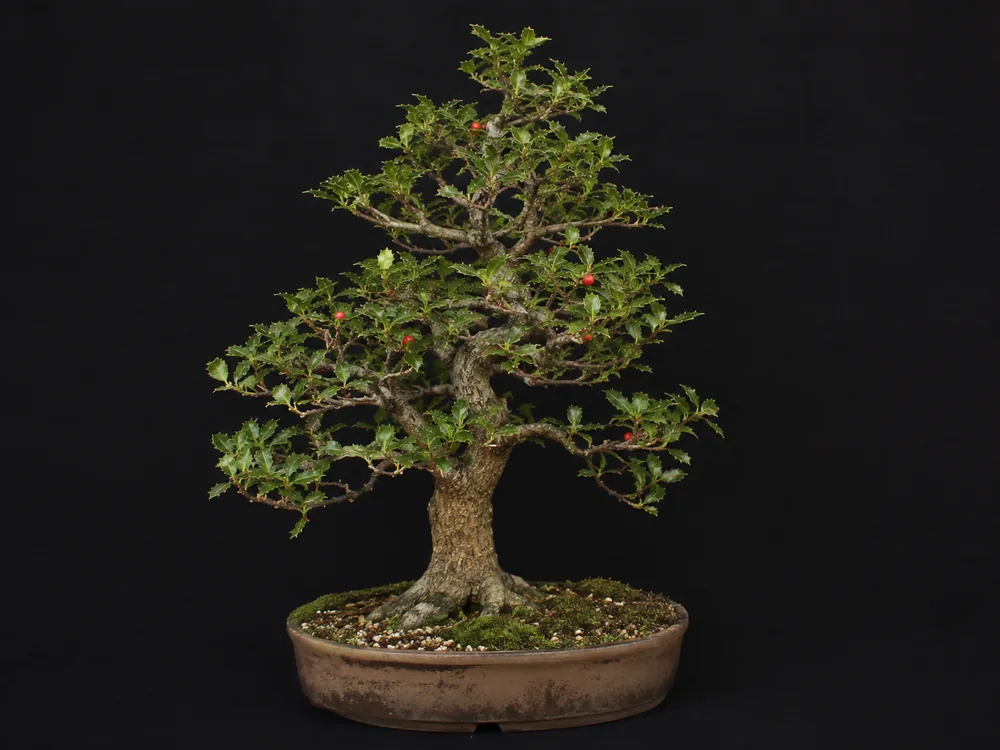
Japanese Holly Bonsai Care
Ilex serrata
1 Japanese Holly bonsai in stock, from $70.95 Shipped direct from our nursery partners, with a 48-hour live-arrival guarantee. See the trees
Japanese Winterberry (Ilex serrata) is one of the finest berrying deciduous bonsai. Most are lost to drying out.
Aquifoliaceae (holly family) · Deciduous broadleaf berrying shrub/tree; outdoor bonsai — dioecious (separate male and female plants)
Japanese Holly quick reference
| USDA zones | Roughly Zones 5–8 (*Ilex serrata*); *Ilex crenata* ~Zones 5/6–8. Hardy but protect potted roots from very low temperatures |
|---|---|
| Indoor / outdoor | Strictly outdoor — needs full sun for berries and a cool winter |
| Light | Lots of sun for fruit set; shelter from the most intense midday heat/sun in high summer |
| Water | Keep on the MOIST side — do not let it dry out completely. Water as soon as the surface dries; needs reliable moisture but not waterlogging |
| Soil | Free-draining, slightly acidic bonsai mix (akadama / pumice / lava); holly dislikes lime and stagnant water |
| Repot | Young trees every 1–2 years; older trees every 2–3 years, in spring |
| Frost | Frost hardy, but shallow potted roots need protection from hard/prolonged frost |
| Mature height (as bonsai) | Shrub to 5 m; 20-45 cm as bonsai |
| Growth rate | Slow to moderate |
| Season of interest | Year-round small glossy leaves, black berries |
| Leaf reduction | Excellent - tiny box-like leaves |
| #1 cause of death | Drying out the rootball (and, for berries, simply not having both a male and a female plant); plus root rot from soggy soil |
Overview & Character
Japanese Winterberry (Ilex serrata) is one of the finest berrying deciduous bonsai. After the leaves fall in autumn, the bare twigs are studded with masses of small, glossy red berries (occasionally white or yellow forms) that persist deep into winter, giving a long and striking cold-season display. In spring it carries tiny pink/white flowers, and it builds fine, dense twigging that suits broom and informal upright styling on a small scale.
The one non-negotiable fact about growing it for berries: it is dioecious. Male and female flowers are on separate plants, so a female tree will only fruit if a male holly of the same/compatible species is flowering nearby at the same time to pollinate it. Without a pollinator you will have a healthy tree but no berries. (Ilex crenata, grown for foliage rather than fruit, is likewise dioecious but its small black berries are minor — it is valued for its dense, box-like evergreen leaves.)
Identification
FOLIAGE: Ilex serrata — alternate, simple, elliptic, very finely toothed (serrate) dull-green leaves to about 5 cm, deciduous (they drop in autumn to reveal the berries). Ilex crenata — small, oval, glossy, evergreen leaves resembling boxwood, with shallow rounded teeth; densely set.
BARK & TRUNK: Slender, smooth twigs that can be purplish/dark on young growth; bark becomes greyer and more textured with age. Builds fine, twiggy ramification well.
GROWTH HABIT / FORM: A twiggy deciduous shrub or small tree (serrata) or a dense, fine-leaved evergreen shrub (crenata). Both ramify densely and take well to clip-and-grow and broom/informal upright styles.
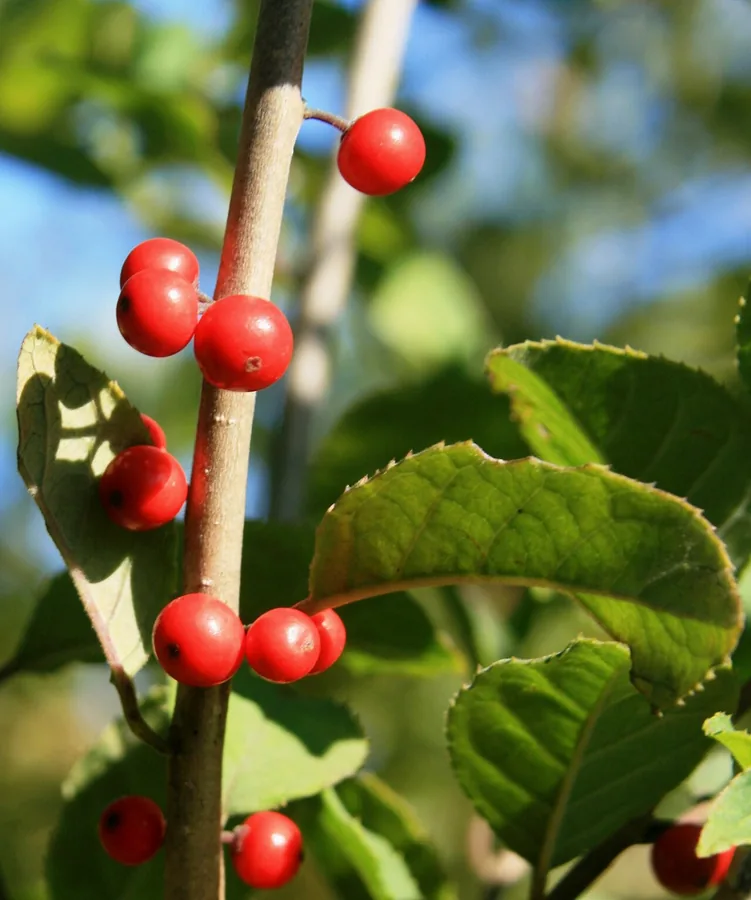
FLOWERS / FRUIT + season + old/new wood: Small pink-to-white flowers in late spring/early summer; on female plants (with a male present) these are followed by bright red berries that ripen in autumn and persist through winter on the bare branches. Flowers/berries are borne on the current season's growth, and importantly fruit develops on the shoots you let run — so pruning must STOP in early summer to allow flowers and fruit to form (see Pruning). Crucially, berries require a male AND a female plant flowering together — this is the dominant factor in whether the tree fruits at all.
Look-alikes & how to tell them apart: Ilex serrata is very close to the American **winterberry (Ilex verticillata)** — both are deciduous, red-berried, dioecious hollies; serrata tends to have smaller, more finely serrated leaves and smaller berries. It is distinguished from spiny "Christmas hollies" (e.g. Ilex aquifolium) by its soft, non-spiny, finely toothed deciduous leaves. Ilex crenata is easily mistaken for **boxwood (Buxus)**: tell them apart by leaf arrangement — holly leaves are alternate, boxwood leaves are opposite. The deciduous, fine-toothed leaves plus red winter berries identify Ilex serrata.
Climate & USDA Zone
Japanese Winterberry is a cool-temperate species that needs full seasonal change and a cool winter; it is reliably hardy in roughly USDA Zones 5–8 (Ilex crenata similar, around Zones 5/6–8). It is frost hardy in the ground, but the potted rootball is far more exposed, so protect the roots from very low/prolonged freezing temperatures. It is strictly an outdoor plant — it will not berry or thrive indoors.
Light
Give it a sunny position — plenty of sun is needed for good flowering and berry set, particularly for the female plant. However, protect it from the most intense heat and direct sun during the hottest summer days, which can scorch foliage and stress the tree. The practical target: a bright, open, mostly sunny spot with relief from extreme midday heat in high summer.
Watering
Keep Japanese Winterberry on the MOIST side — do not let it dry out completely. Water thoroughly as soon as the soil surface begins to dry; consistent moisture supports flowering, berry development, and healthy foliage. As a wetland-edge relative (winterberries naturally grow in damp ground), it tolerates more moisture than many bonsai and resents drought.
Nonetheless, avoid permanently waterlogged, stagnant soil, which causes root rot — use a free-draining mix so the rootball stays moist but aerated. Water demand peaks in summer and while it is fruiting; keep it evenly moist then. Do not let a dormant winter tree dry out either.
Soil & Root Care
Use a free-draining, moisture-retentive bonsai substrate that is slightly acidic — akadama, pumice, and lava (roughly equal parts) suits it; hollies dislike limey/alkaline conditions and stagnant water. The mix should hold moisture (matching the tree's preference) while still draining freely.
Repot young trees every 1–2 years and older trees every 2–3 years, in spring as growth begins. Root-prune moderately and keep good drainage. Avoid hard water/lime build-up over time where possible, as it can raise pH.
Feeding
Feed regularly through the growing season for healthy growth and a good berry crop. Use a balanced fertilizer after the spring flush, then a feed with relatively more phosphorus/potassium (lower nitrogen) from mid/late summer to favor flowering and fruiting rather than soft leafy growth. An acidic/ericaceous-leaning feed can help maintain the slightly acid conditions hollies prefer. Stop feeding into dormancy; do not feed freshly repotted or stressed trees.
Pruning & Styling
Old vs new wood / the key fruiting rule: Japanese Winterberry flowers and fruits on current-season growth, but only on shoots that are allowed to extend and mature — so the critical rule is about when to stop pruning, not just where to cut.
Correct timing to preserve berries:
- During the early growing season, build ramification by the standard method: let a shoot develop about four leaves, then cut it back to two leaves.
- Stop this pruning/pinching in early summer if you want flowers and fruit. Continuing to cut back through early summer removes the shoots and buds that would otherwise flower and set berries — this is the most common reason a healthy holly fails to fruit (aside from lacking a pollinator).
- After the berry display, and in late winter/early spring, you can carry out structural pruning and tidy the framework.
- Remember the dioecious requirement: all the correct pruning in the world produces no berries without a male holly flowering nearby to pollinate the female. Keep a male plant (same/compatible species) flowering at the same time, or graft/place one near the female, to guarantee fruit.
Wire on flexible younger wood, protecting the bark. The fine twigging suits broom, informal upright, and clump styles; for Ilex crenata, clip-and-grow produces dense foliage pads.
Propagation & Cuttings
Ease: Easy. Best methods: semi-hardwood cuttings; layering.
Ilex (serrata/crenata types) root reliably from semi-hardwood cuttings taken in summer to autumn with IBA under humidity; this is how the dense cultivars are produced true. It layers where low stems touch soil. Seed is slow (needs warm-then-cold stratification, often germinating the second year) and hollies are dioecious, so seedlings vary in sex. For bonsai, cuttings preserve the small-leaved form and let you build tight pads; the plant back-buds well and shears like boxwood.
Pests
- Aphids — attack young shoots; distort growth and excrete honeydew. Treat with insecticidal soap or neem.
- Scale insects — particularly on Ilex crenata; sap-suckers causing yellowing and weakening. Treat with horticultural oil.
- Spider mites — stippling/webbing in hot, dry conditions; hose foliage, raise humidity, use a miticide if needed.
- Holly leaf-miner moths — larvae tunnel within leaves leaving blotchy mines; remove affected leaves, treat with an appropriate systemic if severe.
- Vine weevil — adults notch leaf edges; the grubs eat roots in the pot and can be very destructive — check the rootball at repotting and treat with biological nematodes or appropriate control.
Disease, Fungus & Infection
Hollies are generally fairly tough, but watch for:
- Root rot — from waterlogged, stagnant, or limey soil; the main disease risk. Prevent with free-draining slightly-acid mix, good drainage, correct watering.
- Leaf spot / fungal blotch — in humid, still conditions; improve airflow, remove affected/fallen leaves.
- Black sooty mold — grows on the honeydew left by aphids/scale; not a primary disease but a sign of a pest problem — control the pest and the mold clears.
- Phytophthora root/collar rot can affect hollies in chronically wet soil — again a drainage/watering issue.
Prevention is cultural: a sunny, airy position, slightly acidic free-draining soil, steady moisture without waterlogging, prompt control of sap-sucking pests, and clean fallen leaves.
Most Common Causes of Death
1. Letting the rootball dry out — the top cultural killer; this moisture-loving holly is intolerant of drought, which causes leaf and berry drop and root death. Prevention: keep evenly moist, water as soon as the surface dries, check daily in summer. 2. Root rot from waterlogged / stagnant / limey soil — soggy or alkaline conditions rot the roots. Prevention: free-draining slightly-acidic mix, free-draining pot, avoid lime build-up. 3. No berries because of missing pollinator (a "failure," not death, but the usual disappointment) — a lone female, or all-male/all-female grouping, never fruits. Prevention: keep a compatible male holly flowering near the female at the same time. 4. Pruning too late into summer (kills the crop) — continued pinching removes the flowering/fruiting shoots. Prevention: stop pruning in early summer if you want berries. 5. Winter root freeze in the pot — hardy wood but exposed potted roots can freeze. Prevention: shelter the pot/roots over hard, prolonged frost. 6. Vine weevil grubs eating the roots — can destroy a potted holly's root system unseen. Prevention: inspect the rootball at repotting; treat with nematodes/controls at the first sign. 7. Untreated aphids/scale/leaf-miner — progressively weaken the tree and invite sooty mold. Prevention: inspect regularly, treat early.
Seasonal Calendar
- Early spring (Mar): Repot if due (young 1–2 yrs, older 2–3 yrs) as growth starts; use slightly-acid free-draining mix. Structural pruning while framework is visible. Check rootball for vine weevil grubs.
- Late spring (Apr–May): New growth and flowering (male and female must overlap). Begin feeding. Build ramification (4 leaves → cut to 2). Watch for aphids/leaf-miner.
- Early summer (Jun): Stop pruning/pinching now to let flowers and fruit set. Keep evenly moist; give relief from extreme midday heat. Ensure pollination occurred.
- Midsummer (Jul–Aug): Berries forming. Peak water demand — keep moist. Shift to lower-N feed. Watch for mites/scale.
- Autumn (Sep–Oct): Leaves color and drop, revealing ripening red berries. Reduce feeding as growth slows; keep watering steady.
- Late autumn / winter (Nov–Feb): Bare branches studded with persistent red berries — the signature display. Protect potted roots from hard frost. Keep slightly moist, never bone dry.
Close-up photo reference
Compare your tree against these to confirm the species and spot problems early.

Sources
- Bonsai Empire — Japanese Winterberry Bonsai (Ilex serrata) care guide
- Bonsai Empire — Japanese Holly Bonsai (Ilex crenata) care guide
- Bonsai4Me — Ilex (Holly) Bonsai species guide
- Bonsai Craft — Ilex crenata (Japanese Holly) Care & Growing Guide
Buy a Japanese Holly bonsai
- All species
- Shop bonsai trees, tools & supplies
- How to Water a Bonsai (Without Killing It)
- Bonsai Soil: What to Buy, What to Mix, and What It Costs
- Why Bonsai Die After Repotting: Diagnosing a Failed Repot
- Pruning vs. Pinching: Shaping Your Bonsai
- Overwintering Bonsai: Cold-Season Care
- Indoor Bonsai Light and Humidity: Making a Windowsill Actually Work
- Root Rot on bonsai
- Underwatering (Drought Stress) on bonsai
- Winter / Frost Damage on bonsai
- Leaf Scorch / Sunburn on bonsai
- Spider Mites on bonsai
- Winterberry Holly bonsai care
- Blackthorn bonsai care
- Blueberry bonsai care
- Crabapple bonsai care