Himalayan Birch Bonsai Care
Betula utilis
1 Himalayan Birch bonsai in stock, from $76.95 Shipped direct from our nursery partners, with a 48-hour live-arrival guarantee. See the trees
Zones 4a to 7a, outdoor only. A fast, upright, cold-hardy deciduous tree from the high Himalaya. Most are lost to drying out.
Betulaceae (birch family) · Hardy deciduous broadleaf tree; grown for its white bark
Himalayan Birch quick reference
| USDA zones | 4a–7a. Not recommended south of zone 7 — it dislikes heat and humidity |
|---|---|
| Indoor / outdoor | Outdoor only, year-round. It needs a real winter dormancy |
| Light | Full sun to part shade. Full sun gives the best bark and autumn colour |
| Water | Water-loving — keep it consistently moist. Birches do not tolerate drying out |
| Soil | Moist, acid-leaning, free-draining loam. Lean acidic in a pot |
| Repot | Every 2–3 years in spring, as the buds extend — not while fully dormant |
| Frost | Very hardy in the ground (RHS H7, below −20°C). Potted roots are not |
| Mature height (as bonsai) | 9–15 m in the landscape; small to large as bonsai |
| Growth rate | Rapid |
| Season of interest | White bark year-round, best in winter; yellow-brown catkins in early spring; golden autumn colour |
| Leaf reduction | Not documented for this species; leaves are naturally 5–8 cm and thin |
| #1 cause of death | Letting the roots dry out, which triggers branch dieback — and a stressed birch is exactly what bronze birch borer attacks |
Overview & Character
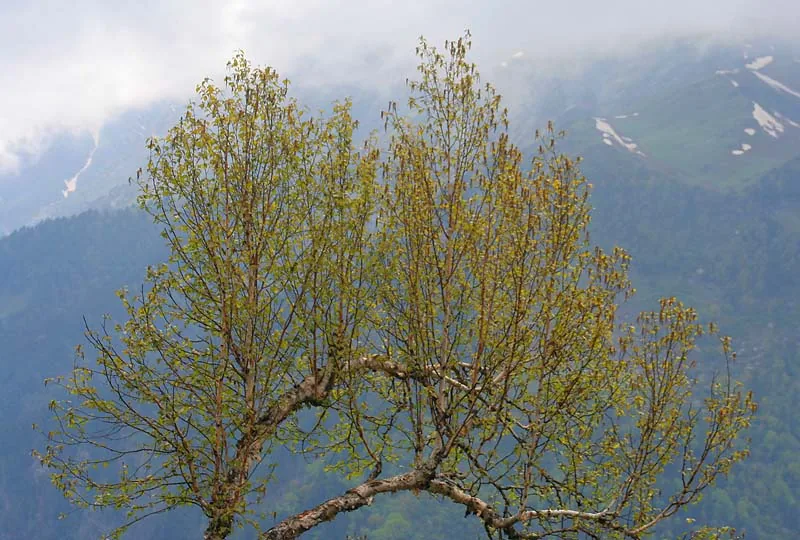
The West Himalayan Birch is a fast, upright, cold-hardy deciduous tree from the high Himalaya, grown across temperate gardens for bark that on a mature trunk is close to pure white with salmon-pink lenticels. It flushes early, colours gold in autumn, and holds a fine twiggy silhouette through winter — the season it looks best.
As a bonsai subject it is genuinely rewarding and genuinely awkward, and both halves are worth knowing before you start. It grows quickly, which builds trunks. It also bleeds heavily, dies back readily, and heals large wounds badly. Birch is not a species that forgives being worked in the wrong month.
Identification
Bark: The headline. Where mature, creamy-white with salmon-pink horizontal lenticels, tightening and smoothing with age rather than developing the rough black diamond fissures Betula pendula gets at the base.
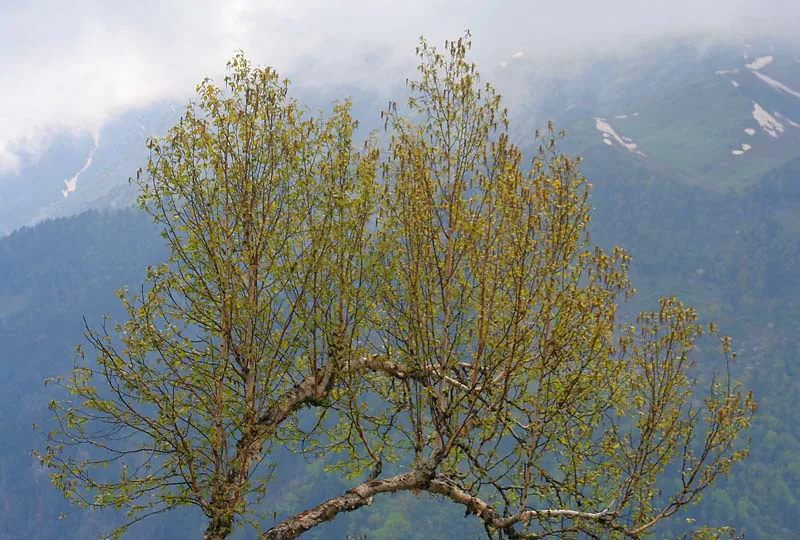
Foliage: Ovate to rhomboid leaves, 5–8 cm, doubly serrate, with 8–10 pairs of lateral veins and — the reliable detail — a rounded to slightly heart-shaped leaf base. Thin, limp in texture, glossy when young.
Growth habit: Upright and pyramidal. It does not weep.
Catkins: Male catkins yellow-brown, drooping, up to 12 cm, opening in early spring with or just before the leaves.
**How to tell it from Silver Birch (B. pendula), which we cover separately:**
- Leaf base is the giveaway. Jacquemontii is rounded to subcordate; pendula is triangular or diamond-shaped with a flat or wedge-shaped base.
- ***B. pendula weeps.* Its branchlets hang; jacquemontii's do not.
- Mature pendula develops rough black diamond fissuring low on the trunk; jacquemontii's white bark stays smoother.
Climate & USDA Zone
Zones 4a–7a. Extremely cold-hardy — the RHS rates it H7, hardy below −20°C — but it does not like heat or humidity, and NC State Extension specifically advises against planting it south of zone 7. If you are in the American South, this is the wrong birch.
The pot changes the cold calculation completely. Birch roots are fine and shallow, and in a bonsai container they sit far more exposed than they ever would in the ground. A tree rated to −20°C in open ground can lose roots and suffer twig dieback in a pot well above that. Protect the root ball below about −7°C: plunge the pot, mulch it heavily, or move it to an unheated but sheltered space.
Light
Full sun to part shade. Full sun is what develops the bark colour and the autumn gold, and bark whitening specifically requires direct summer sun on the trunk — which is an argument for open, airy styling rather than a dense canopy shading its own trunk.
Watering
Consistently moist. This is not a species to let dry out.
Birches are thirsty, and drying the rootball is the documented route to branch dieback on this genus. Check daily in the growing season; a fast-growing birch in a small pot in summer will drink more than you expect. Keep the roots cool as well as moist — birches naturally grow with shaded, cool root runs.
That said, moist is not waterlogged. The mix must still drain.
Soil & Root Care
Moist, acid-leaning, free-draining loam-based mix. The RHS records the species as tolerating a broad pH range in the ground, but NC State gives its cultural preference as acid (below 6.0), and in a pot leaning acidic is the safer choice.
Repot every two to three years in spring as the buds extend — not in deep dormancy. Birch is one of the species where slightly late root work is safer than early: better to repot just as growth begins than into cold, dormant, bleeding-prone wood.
Feeding
Feed through the growing season at moderate strength. This is a rapid grower and will use it, but pushing a birch hard produces long internodes and vigorous top growth at the expense of the lower branches you are trying to keep — and lost lower branches on a birch do not come back easily.
Pruning & Styling
This section matters more than usual. Birch punishes bad timing.
Never prune in winter or early spring. Birches bleed heavily when the sap is running, and NC State says so plainly for this genus: do not prune when sap is moving, because it will bleed. The correct window is after the spring flush has hardened off, through to late summer — roughly May to August in the northern hemisphere.
Expect dieback if you work outside that window. Birch has a well-earned reputation for unexplained branch loss. Pruning from late summer through spring encourages basal suckering and dieback of branches; a heavy trunk chop can die back along the length of trunk that no longer supports live branches.
Large wounds do not heal well. Birch wood rots quickly, so a big cut tends to become a rotting hollow rather than a clean callus. Keep cuts small, seal them immediately, and design around the assumption that a large wound is permanent. If you want deadwood features, birch is the wrong tree — the deadwood rots rather than weathering.
Wiring: wire cautiously. Weak branches can die when wired, and new shoots want to run vertically, so directional wiring needs repeating. Guy wires or hanging weights are often safer than tight coils. The bark is thin and it is the whole point of the tree — wire marks here are not a minor cosmetic issue.
Defoliation: a strong, healthy birch can be defoliated in summer. A weak one should not be.
Propagation & Cuttings
Ease: Moderate from cuttings; unreliable from seed if you want the bark.
Seed germinates but will not come true — birches hybridise readily, which is exactly why the good white-barked forms are sold as named clones. Softwood cuttings or grafting preserve the bark quality. If white bark is the point, do not grow this one from seed.
Pests
**Bronze birch borer (Agrilus anxius) — and this species is highly susceptible.**
We want to correct a common assumption here: Himalayan Birch does not have better borer resistance than Silver Birch. The Pacific Northwest Pest Management Handbook places jacquemontii in the same high-susceptibility tier as B. pendula. The birches with genuine resistance are the North American natives, which co-evolved with the beetle.
Borer attacks stressed trees. Keeping this one watered, cool-rooted and out of excessive heat is pest management as much as it is cultivation. Watch for thinning in the upper crown and D-shaped exit holes in the bark.
Also: aphids, leaf-mining sawflies, birch skeletonizer, Japanese beetle.
Disease, Fungus & Infection
Honey fungus, birch rust and powdery mildew. Leaf spot occurs. Most birch disease problems follow stress or wounding, which brings you back to watering and pruning discipline.
Most Common Causes of Death
1. Drying out the rootball. The primary killer. Birches are thirsty and respond to drought stress with branch dieback that does not reverse. 2. Bronze birch borer, following the above. A stressed birch of this species is a target; a well-watered one is much less so. 3. Pruning in the wrong season. Winter and early-spring cuts bleed heavily and invite dieback. 4. Heat. This is a high-altitude Himalayan tree. Sustained hot, humid summers weaken it, which loops back to causes 1 and 2. 5. Unprotected roots in a winter pot. Very hardy tree, very exposed root ball.
Seasonal Calendar
- Spring: Bud burst and catkins. Repot as the buds extend if due. Do not prune yet — sap is running.
- Summer: Main growth. Water generously and keep the roots cool. The safe pruning window runs from after the flush hardens to the end of summer. Defoliate only a strong tree.
- Autumn: Golden foliage. Stop pruning. Reduce feeding.
- Winter: Dormant, and at its most beautiful — bare white bark. Protect the pot from hard freezes.
Toxicity, Safety & Handling
Birch sap contains xylitol, which is reported toxic to dogs in quantity. Birch is also one of the most significant spring pollen allergens — relevant if someone in the household reacts to it, though as an outdoor-only tree it is less of an issue than a houseplant would be.
No thorns, no irritant sap.
Close-up photo reference
Compare your tree against these to confirm the species and spot problems early.
_I_IMG_3405.jpg)
Sources
- Betula utilis subsp. jacquemontii — Trees and Shrubs Online
- Jacquemontii Birch — NC State Extension Gardener Plant Toolbox
- Betula utilis subsp. jacquemontii — Royal Horticultural Society
- Birch (Betula) — Bronze birch borer — Pacific Northwest Pest Management Handbooks
Buy a Himalayan Birch bonsai
- All species
- Shop bonsai trees, tools & supplies
- How to Water a Bonsai (Without Killing It)
- Bonsai Soil: What to Buy, What to Mix, and What It Costs
- Why Bonsai Die After Repotting: Diagnosing a Failed Repot
- Pruning vs. Pinching: Shaping Your Bonsai
- Overwintering Bonsai: Cold-Season Care
- Indoor Bonsai Light and Humidity: Making a Windowsill Actually Work
- Root Rot on bonsai
- Underwatering (Drought Stress) on bonsai
- Winter / Frost Damage on bonsai
- Powdery Mildew on bonsai
- Aphids on bonsai
- Yellow Birch bonsai care
- Birch bonsai care
- American Beech bonsai care
- American Elm bonsai care