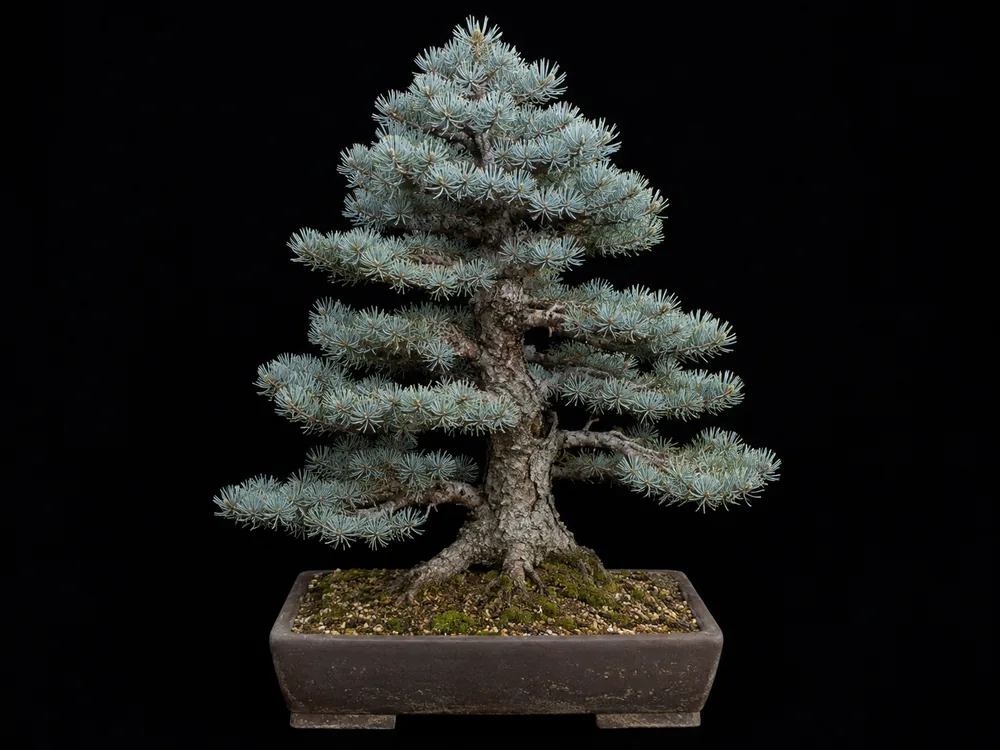
Colorado Blue Spruce Bonsai Care
Picea pungens
Zones 2 to 7. The iconic silver-blue conifer of the Rocky Mountains, famous for its striking glaucous blue, stiff. Most are lost to being kept indoors.
Pinaceae (the pine family) · Evergreen, single-needle coniferous tree; strictly outdoor bonsai, very cold-hardy
Colorado Blue Spruce quick reference
| USDA zones | 2–7 (very cold-hardy; some references extend to 8) |
|---|---|
| Indoor / outdoor | Strictly outdoor — never an indoor tree |
| Light | Full sun, all day |
| Water | Moist but well-drained. Likes consistent moisture; will NOT tolerate soggy/waterlogged roots |
| Soil | Free-draining mix that retains some moisture (akadama / pumice / lava); never water-logged |
| Repot | Every 2–4 years for developing trees, less often for established ones; early spring |
| Frost | Excellent — among the hardiest bonsai conifers; needs cold winter dormancy |
| Mature height (as bonsai) | Tree to 25 m; kept 30-70 cm as bonsai |
| Growth rate | Slow |
| Season of interest | Year-round silvery-blue needles |
| Leaf reduction | Moderate - needle length shortens with technique |
| #1 cause of death | Root rot from soggy soil / overwatering, and improper care (kept indoors / no dormancy) |
Overview & Character
The Colorado Blue Spruce is the iconic silver-blue conifer of the Rocky Mountains, famous for its striking glaucous blue, stiff, sharp needles. As bonsai it is a handsome, extremely cold-hardy evergreen with a naturally symmetrical, conical, formal-upright character that can be softened into more naturalistic mountain-tree styling. It is strictly an outdoor tree that depends on full sun, a real winter dormancy, and steady-but-drained moisture.
Its main quirk — and the thing every grower must internalize — is its branch architecture: spruce needles sit singly on small woody pegs (pulvini), and like the other "does-not-easily-back-bud-on-old-wood" conifers, Blue Spruce will not reliably re-sprout from bare old wood. It is therefore refined by pinching and shortening new shoots, never by hard cutting back into leafless branches.
Identification
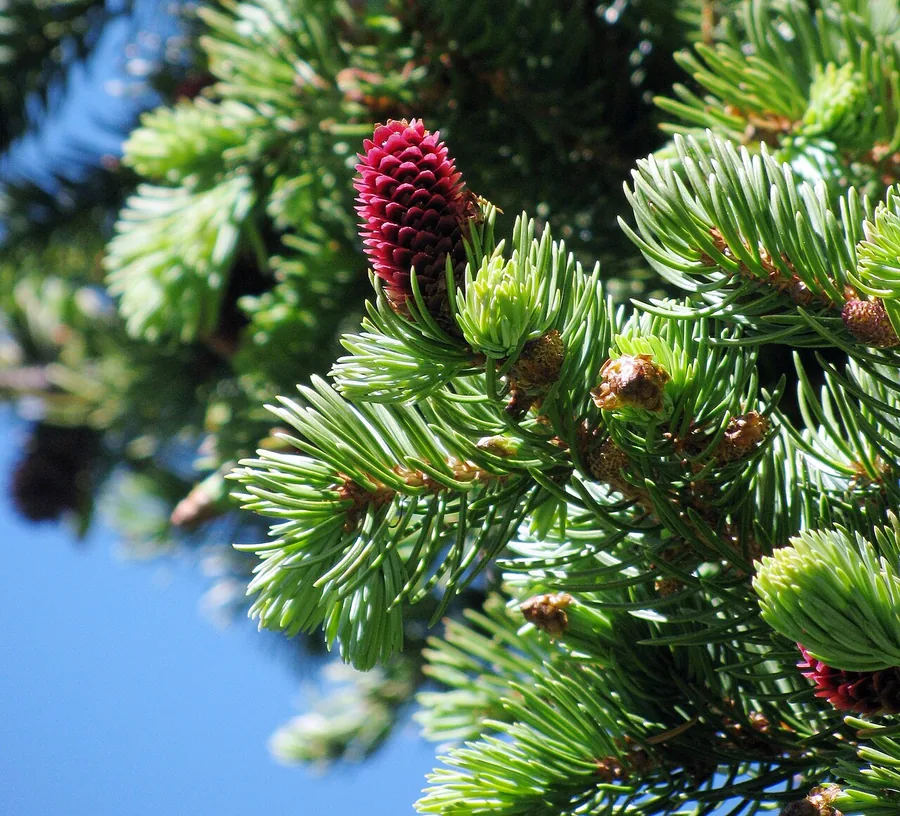
Foliage: Single needles (not in bundles) attached individually to the twig on small raised woody pegs, so a bare twig feels rough/peg-studded — a classic spruce trait. Needles are stiff, sharp-pointed (prickly to handle), roughly 0.75–1.2 inches (2–3 cm), and four-sided (square in cross-section), so they roll easily between the fingers. Color is the signature waxy glaucous blue to silver-blue (the wax bloom can be rubbed off).
Bark & trunk: Gray to gray-brown bark, thin and scaly in youth, becoming furrowed into rough, scaly ridges with age. Trunk is straight with whorled branching.
Growth habit / form: Naturally dense, stiff, and symmetrically conical with horizontal, whorled branches — formal and architectural. In bonsai it suits formal upright, informal upright, and naturalistic conifer styles.
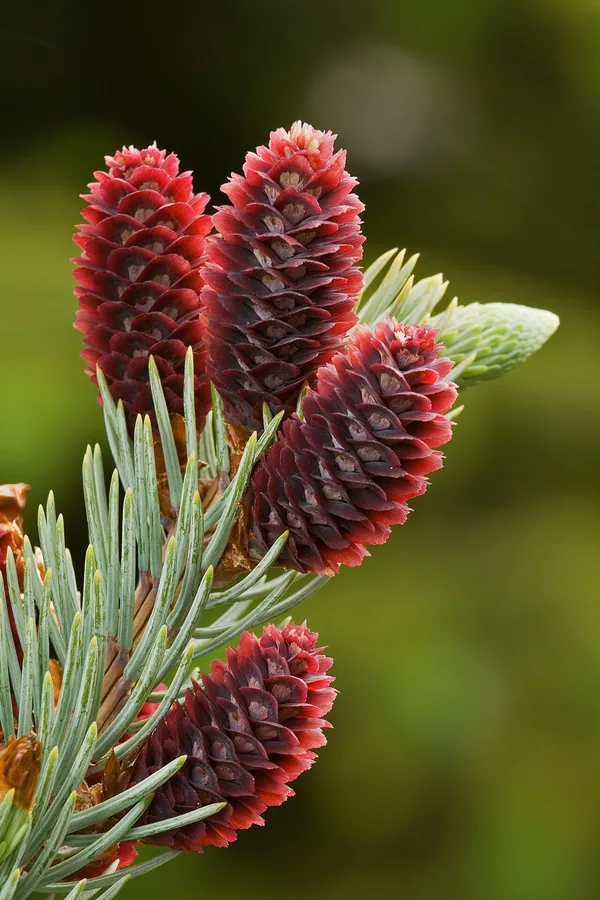
Cones: Pendant (hanging), cylindrical, light brown, about 2.5–4 inches (6–10 cm), with thin, flexible, wavy-edged, papery scales — larger and more flexible-scaled than Norway Spruce is sometimes assumed, but the key contrast is with rounder, smaller spruce cones.
Look-alikes & how to tell them apart: Distinguished from pines instantly by single needles on pegs (pines bundle 2–5 needles in a sheath). Distinguished from **firs (Abies) by its rough peg-studded twigs and sharp, square, rollable needles — firs leave smooth, round leaf scars and have flat, soft, often blunt needles that do not roll, plus upright cones. Distinguished from other spruces mainly by needle color and stiffness: Blue Spruce's needles are notably blue, very stiff, and very sharp/prickly, while Norway Spruce (P. abies) is green with longer, less prickly needles and large hanging cones, and Engelmann Spruce (P. engelmannii)** has softer, more flexible, blue-green needles that are not as sharply rigid.
Climate & USDA Zone
Colorado Blue Spruce is exceptionally cold-hardy, thriving across USDA zones 2–7 (occasionally listed to 8). It is a high-elevation, continental species that requires a genuine, cold winter dormancy — ideally roughly 20–40°F (about -6 to 4°C) during rest — to remain healthy long-term. It handles severe winter cold far better than summer heat and humidity; in hot, muggy climates it struggles and becomes disease-prone. Keep it outdoors year-round and never deny it its winter rest.
Light
Full, direct sun all day. Maximum light keeps the blue color intense, the growth compact, and the needles tight. Inadequate light leads to weak, sparse, greener (less blue) growth and increased disease susceptibility. In hot-summer regions, full morning sun with a little protection from the harshest mid-afternoon heat — and protection of the pot from baking — helps, but the canopy still wants strong light.
Watering
Moist but well-drained — this is a moisture-liking conifer, distinct from the dry-loving pines and junipers. Colorado Blue Spruce prefers consistent, even moisture and should not be allowed to dry out hard, but it will not tolerate soggy, waterlogged soil, which quickly rots the roots.
Water when the surface begins to dry, keeping the root mass evenly damp through the growing season; never let it sit in standing water. The way to deliver "moist but not wet" is through a free-draining mix that holds some water but drains the excess instantly. In winter dormancy, water needs drop sharply — roughly every couple of weeks depending on conditions — just enough to keep the roots from desiccating.
Soil & Root Care
Use a free-draining bonsai mix that still retains some moisture — for example akadama / pumice / lava in roughly equal parts (adjust akadama up slightly for more water retention than you'd give a pine, but never to the point of water-logging). Excellent drainage plus modest moisture retention is the target.
Repot in early spring as buds begin to swell, every 2–4 years for trees in development and less frequently for established specimens. Spruce roots resent rough handling — reduce roots gradually, don't bare-root, and keep some old soil and any beneficial fungi. After repotting, protect the tree from harsh sun and wind while it re-establishes.
Feeding
Feed through the growing season to support steady growth and good color, using a balanced fertilizer. Start in spring when growth is active, feed regularly into summer, and continue (often with a slightly higher-phosphorus/potassium feed) into autumn to harden the tree for winter; stop during deep dormancy. Avoid overfeeding, which produces coarse, overlong growth that is hard to refine on a needle-pegged conifer. Ease feeding right after repotting until the tree recovers.
Pruning & Styling
Refine Colorado Blue Spruce by managing NEW shoots — do NOT cut back into bare old wood. Spruce does not reliably back-bud on leafless old branches; if you cut a branch back past its foliage it will usually die rather than re-sprout. Keep green growth on every branch you intend to keep.
Technique:
- Pinch/shorten new shoots in spring: Let new candles/shoots elongate to roughly 0.5–1.5 inches (1.5–4 cm), then pinch or cut each back to an even length across the tree. Within a few weeks a new terminal bud forms, and back-buds will often appear further down that current shoot — this is how you build density and ramification (note: budding occurs on the new growth, not on old bare wood).
- Balance vigor: Reduce strong shoots harder than weak ones to even out the canopy.
- Thin congestion: Remove crowded inner shoots to let light and air into the interior and keep buds alive there.
- Structural pruning: Remove unwanted whole branches at the trunk when restyling — but never shorten a kept branch into bare wood.
- Wiring: Wire from late summer/autumn through the dormant season; spruce branches are somewhat brittle, so wire carefully and protect bark. Avoid disturbing the waxy bloom unnecessarily, as handling rubs off the blue.
Propagation & Cuttings
Ease: Difficult from cuttings; seed for species, graft for blue forms. Best methods: seed; grafting.
Picea pungens is grown from seed: cold-moist stratify ~1–2 months and sow in spring; seedlings vary in blueness. Cuttings of spruce root poorly and slowly, so they're rarely used. The intense blue cultivars ('Glauca', 'Hoopsii') do not come true from seed and are side-veneer grafted onto Picea seedling understock in winter. For bonsai, seedlings or grafted/collected nursery plants are the route; spruce back-bud on old wood only modestly, so work with the plant's growth patiently.
Pests
Common pests of Colorado Blue Spruce include spruce spider mites (a major problem — they cause stippling and bronzing of needles, worst in hot dry spells), aphids, adelgids (which can cause pineapple-shaped galls on new shoots), spruce budworm, sawfly larvae, scale, and bagworm. Inspect needles and shoot tips regularly (tap foliage over white paper to detect mites). Treat mites with an appropriate miticide and improve airflow; treat adelgids/aphids/scale with horticultural oil and prune out galls. Vigor, full sun, and good ventilation reduce pest pressure.
Disease, Fungus & Infection
Spruce are prone to several fungal problems, especially in warm, humid, or poorly ventilated conditions: root rot from soggy soil (the most dangerous, often the true cause of a "suddenly dying" spruce), needle cast diseases (e.g. Rhizosphaera and Stigmina, causing needles to yellow, brown, and drop, typically from the inside/bottom of the tree outward), cytospora canker (branch dieback with resin bleeding, usually on stressed trees), and tip blights. Prevent disease with full sun, excellent drainage, balanced (not soggy) watering, strong airflow, and removal of fallen needles and dead interior growth. Treat needle-cast and blights with an appropriate fungicide on the correct seasonal schedule and remove badly affected branches back to healthy green growth (never into bare wood). Keep the tree out of hot, stagnant, humid spots.
Most Common Causes of Death
1. Root rot from soggy soil / overwatering. Despite liking moisture, the roots rot in waterlogged soil. Prevention: free-draining mix, keep evenly moist but never wet, never let the pot stand in water. 2. Kept indoors / no winter dormancy. Blue Spruce cannot live indoors and must have a cold dormant rest. Prevention: grow outdoors year-round; provide a genuine cold dormancy (~20–40°F). 3. Cutting branches back into bare old wood. Spruce won't reliably back-bud on leafless wood — the branch dies. Prevention: refine only by pinching/shortening new shoots; always leave green foliage on kept branches. 4. Letting it dry out completely. Unlike pines/junipers it dislikes hard drought and fine roots die. Prevention: keep consistent, even moisture through the growing season. 5. Spider mites and needle-cast diseases left unchecked. Both can defoliate and kill over time. Prevention: regular inspection, full sun, good airflow, prompt treatment, sanitation. 6. Rough root work / careless repotting. Spruce resent root disturbance and brittle branches break. Prevention: repot early spring, reduce roots gradually, don't bare-root, handle gently, aftercare in shelter. 7. Heat, humidity, and stagnant air. Hot muggy conditions stress the tree and invite disease. Prevention: good ventilation, some relief from extreme heat, protect the pot, keep airflow open.
Seasonal Calendar
- Early Spring (Mar–Apr): Repot as buds swell (every 2–4 years), reducing roots gradually. Resume watering and begin feeding as growth starts. Shelter recently repotted trees.
- Late Spring (May–Jun): New shoots elongate. When shoots reach ~0.5–1.5 in, pinch/cut to even length to drive back-budding on the new growth and balance vigor. Watch for spider mites and adelgids.
- Summer (Jul–Aug): Maintain even moisture (free-draining), protect the pot from baking, keep airflow strong. Continue feeding. Vigilant mite and needle-cast monitoring in heat/humidity.
- Autumn (Sep–Nov): Feed to harden for winter, then taper. Thin congested interior growth; begin wiring as the tree slows. Reduce watering as growth stops.
- Winter (Dec–Feb): Cold dormancy required. Water sparingly (about every couple of weeks, just enough to keep roots from drying). Good time for wiring while dormant; protect the root mass from extreme, prolonged deep freezes in a small pot, but provide real cold.
Close-up photo reference
Compare your tree against these to confirm the species and spot problems early.


Sources
- Blue Spruce Bonsai Guide — Bonsai Mirai
- Care Guide for the Spruce Bonsai Tree (Picea) — Bonsai Empire
- Care and Maintenance Guide for Native US Spruce and Fir Bonsai (Picea and Pseudotsuga) — Eisei-en / Bjorn Bjorholm
- Colorado Blue Spruce Bonsai (Picea pungens): The Ultimate Care Guide — PlantBonsai
Where to buy a Colorado Blue Spruce bonsai
We don’t stock Colorado Blue Spruce at the moment. These species need similar care and we have them now — they are the closest match in our catalogue.
- Spruce — similar care, in stock now
Browse all bonsai trees for sale or find a species matched to your climate and space.
- All species
- Shop bonsai trees, tools & supplies
- How to Water a Bonsai (Without Killing It)
- Bonsai Soil: What to Buy, What to Mix, and What It Costs
- Why Bonsai Die After Repotting: Diagnosing a Failed Repot
- Pruning vs. Pinching: Shaping Your Bonsai
- Overwintering Bonsai: Cold-Season Care
- Indoor Bonsai Light and Humidity: Making a Windowsill Actually Work
- Root Rot on bonsai
- Overwatering on bonsai
- Underwatering (Drought Stress) on bonsai
- Winter / Frost Damage on bonsai
- Spider Mites on bonsai
- Ezo Spruce bonsai care
- Norway Spruce bonsai care
- Spruce bonsai care
- White Spruce bonsai care