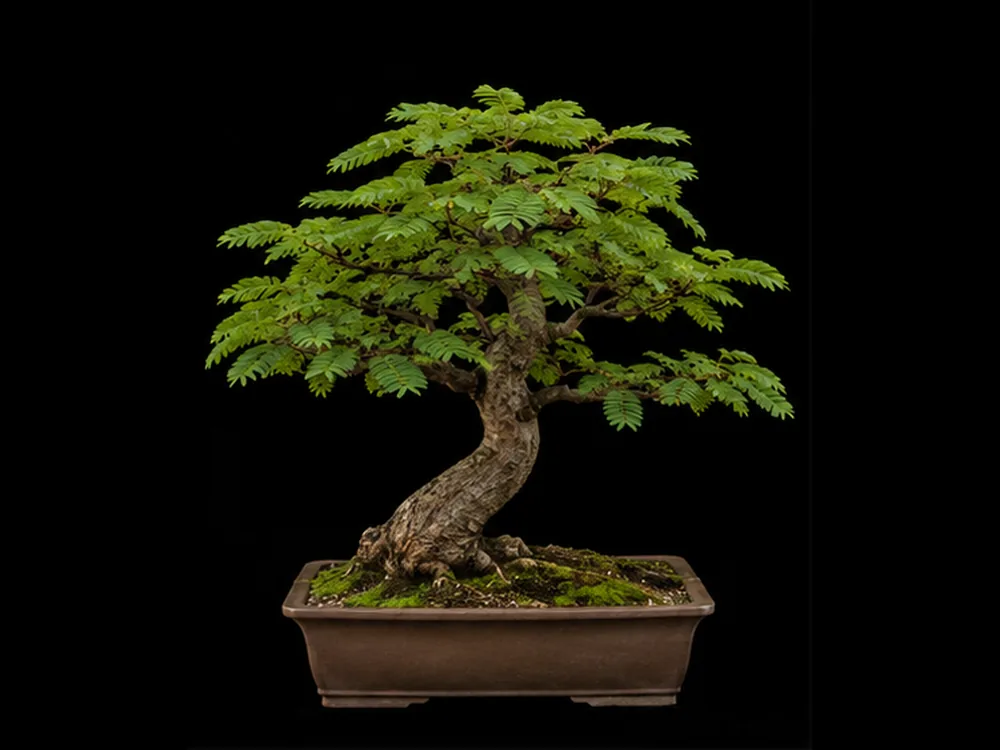
Brazilian Rain Tree Bonsai Care
Chloroleucon tortum
Zones 9 to 11, outdoor. One of the most prized tropical species in bonsai, and for good reason. Most are lost to overwatering.
Fabaceae (legume / pea family) · Tropical, evergreen to semi-deciduous flowering tree
Brazilian Rain Tree quick reference
| USDA zones | 9–11 (best in 10–11); protect below ~45 °F / 7 °C |
|---|---|
| Indoor / outdoor | Outdoor in warm months; indoor or heated greenhouse over winter in cool climates |
| Light | Very high — full sun outdoors; brightest possible window plus grow light indoors |
| Water | Evenly moist but never wet — likes moisture but is highly sensitive to soggy roots |
| Soil | Fast-draining, low-organic inorganic mix (akadama/pumice/lava or similar) |
| Repot | Every 2–3 years in spring/early summer while warm |
| Frost | None — frost-sensitive, damaged below ~45 °F and killed by freezing |
| Mature height (as bonsai) | Tree to 20 m; kept 30-60 cm as bonsai |
| Growth rate | Moderate-fast |
| Season of interest | Evergreen; leaves fold at night, white flowers |
| Leaf reduction | Excellent - tiny leaflets reduce well |
| #1 cause of death | Root rot from overwatering / too much organic soil (cold, wet roots) |
Overview & Character
The Brazilian Rain Tree is one of the most prized tropical species in bonsai, and for good reason. Native to the dry coastal forests of eastern Brazil, it develops a strikingly sculptural, fluted and contorted trunk with flaking, light grey bark that reads as ancient even on relatively young material. The foliage is delicate and fern-like, composed of tiny bipinnate leaflets, and the tree produces fragrant white powderpuff flowers under good conditions.
Its signature behaviour is nyctinasty: the leaflets fold up and the whole canopy "closes" at night, and they will also fold during the heat of the day, in low light, or when the tree is stressed or under-watered. This makes the BRT something of a living mood ring — watch the leaves to read the tree's comfort. Mature specimens are also armed with paired thorns at the leaf nodes, so handle with respect when wiring or pruning.
It is a connoisseur's tree: rewarding, characterful, and forgiving of heavy styling, but unforgiving of cold and wet feet.
Identification
Foliage: Delicate, fern-like bipinnate compound leaves — each leaf divided into pinnae, each pinna lined with many tiny leaflets, giving a feathery texture. The defining behaviour is nyctinasty: leaflets fold up and the canopy "closes" at night, in the heat of midday, in low light, or under stress/under-watering — a living mood ring. Leaflets are small and bright green.
Bark & trunk: Strikingly sculptural, fluted, contorted, "muscular" trunk with flaking, exfoliating light grey bark that peels to reveal paler inner bark — looks ancient even when young. Mature wood develops natural hollows and ridges.
Growth habit / form: Branches show a distinctive zig-zag growth pattern and are armed with paired thorns at the leaf nodes (handle with gloves). Naturally an irregular, characterful small tree.
Flowers / fruit: Fragrant white powderpuff flowers (hemispheres of fine stamens) that age to yellowish, under good warm conditions; followed by twisted, corkscrew-shaped seed pods typical of the legume family.
Look-alikes & how to tell them apart: Easily confused with other feathery-leaved legumes. The combination of bipinnate leaflets that fold at night + zig-zag thorny branches + fluted grey exfoliating trunk is diagnostic. Versus Mimosa/Silk Tree (Albizia): Albizia has much larger bipinnate leaves, pink powderpuff flowers, flat bean-like seed pods, and no zig-zag thorns. Versus true tamarind or other Pithecellobium relatives: BRT's contorted, hollowing trunk and corkscrew pods stand out.
Climate & USDA Zone
The Brazilian Rain Tree is fully tropical and is reliably grown outdoors year-round only in USDA zones 10–11, with zone 9 possible if the tree is brought in for winter. It wants warmth, humidity and strong light. Growth essentially stops when temperatures fall, and the tree begins to suffer below roughly 45 °F (7 °C). It must never be exposed to frost.
In any climate cooler than zone 10, treat it as a tender tropical: outdoors through the warm season once nights are reliably above 50 °F, and indoors (bright window plus supplemental light) or in a heated greenhouse for winter. Avoid sudden temperature swings and cold drafts, which trigger leaf drop.
Light
This species demands a lot of light. Outdoors it thrives in full sun, which keeps internodes short, foliage compact and the canopy dense. Indoors it is one of the harder tropicals to keep happy because most windows simply do not provide enough intensity — place it directly against the brightest (south-facing) window available and add a strong LED grow light for 12–14 hours a day during winter. Persistently low light produces leggy, weak growth and chronically folded leaflets.
Watering
The Brazilian Rain Tree wants to be kept evenly moist but never soggy. This is the nuance that kills many specimens: it is not a succulent that wants to dry out, yet it is acutely sensitive to wet, airless, cold roots. Do not let the soil dry out completely — that triggers stress and leaf folding — but equally do not let it sit wet.
The practical solution is a fast-draining, low-organic substrate (see below) watered thoroughly and frequently. In a proper inorganic mix you can water generously every time the surface begins to approach dryness, because the open structure lets excess drain away immediately. In hot weather outdoors this may mean daily watering; in cool winter conditions, far less. Always check the soil before watering rather than working to a fixed schedule, and back right off in winter when growth slows.
Soil & Root Care
Soil is the single most important variable for BRT survival. Use a free-draining, predominantly inorganic mix — for example akadama, pumice and lava rock, or a comparable commercial bonsai soil. The cardinal rule, repeated across every reputable source, is to avoid too much organic material: peat- or compost-heavy mixes hold water against the roots, stay cold, and cause root rot, fungus and branch dieback.
Repot every 2–3 years, always in late spring or early summer when the tree is in active growth and warm — never in cool conditions. Work gently; the roots resent disturbance when cold or dormant. After repotting, keep the tree warm, bright and slightly sheltered while it re-establishes.
Feeding
Feed actively during the warm growing season, when the tree is putting out new growth. A balanced fertiliser works well; many growers use a slightly higher-nitrogen feed in spring to push growth, then a more balanced feed through summer. Liquid feed every two weeks or a slow-release organic pellet refreshed monthly are both fine. Reduce or stop feeding in winter when growth slows, especially on indoor trees in lower light.
Pruning & Styling
The BRT back-buds readily and tolerates aggressive work, making it excellent for ramification. Pinch and trim new shoots through the growing season to build a fine, dense canopy; the more you cut, the more it divides. Hard structural pruning is best done in the warm months so the tree heals and re-buds quickly.
Wiring is effective but be mindful of the paired thorns at each node — wear gloves. Branches are somewhat brittle, so bend deliberately and protect the bark. Because the species is grown largely for its dramatic, fluted trunk and bark, styling tends to favour informal upright and naturalistic designs that show off the deadwood and movement.
Propagation & Cuttings
Ease: Moderate. Best methods: seed; cuttings.
Chloroleucon tortum is usually grown from seed: scarify the hard seed coat (nick or sand it) and soak in warm water overnight, then sow warm — germination is good and fairly quick. Semi-hardwood cuttings root at moderate rates in warm, humid conditions with hormone. Air-layering works on suitable branches. As a tropical, keep all propagation warm and bright. For bonsai the sculptural, thorny, zig-zag trunks are best developed from seedlings grown on hard, or from collected nursery stock; the species also responds well to trunk-chopping and regrowth.
Pests
Brazilian Rain Trees are quite resistant to pests outdoors, but problems appear most often on stressed or indoor trees:
- Aphids on tender new shoots
- Spider mites, especially in the warm, dry air of indoor winter quarters
- Whitefly
- Nematodes in the soil, which produce visible root nodules
Treat sap-sucking insects with insecticidal soap, neem oil or a suitable systemic; raise humidity to discourage spider mites indoors. Inspect regularly, since indoor conditions let infestations build quickly.
Disease, Fungus & Infection
The dominant disease risk is root rot driven by overwatering and water-retentive, organic-heavy soil. Symptoms include yellowing, persistent leaf folding, dieback and a sour-smelling root mass. Prevention is almost entirely cultural: fast-draining inorganic soil, appropriate watering, warmth and good light. Fungal branch dieback follows from the same wet-and-cold conditions. There are few species-specific foliar diseases of note; if the roots and watering are right, the BRT is generally healthy.
Most Common Causes of Death
1. Root rot from overwatering / organic soil. The top killer; wants evenly moist but never soggy in a free-draining mix — heavy organic soil that stays wet rots the roots. 2. Cold damage. Tropical (zones 9–11); protect indoors below ~55°F (13°C). 3. Drying out completely. Doesn't want to bone-dry either; keep lightly, evenly moist. 4. Low light indoors. Needs very bright light/strong sun; weak in dim rooms (leaflets stay folded/sparse). 5. Pests. Spider mites, scale, and mealybug under indoor stress — inspect and treat early.
Seasonal Calendar
- Spring: Repot if due (warmth); resume feeding; prune to shape (mind the thorns).
- Summer: Strong light/warmth (outdoors when warm); keep evenly moist; vigorous growth; watch mites.
- Autumn: Bring indoors before cool nights to the brightest warm spot.
- Winter: Warm (>55°F) and very bright indoors; reduce water slightly; avoid wet, cold feet.
Sources
Where to buy a Brazilian Rain Tree bonsai
We don’t stock Brazilian Rain Tree at the moment. These species need similar care and we have them now — they are the closest match in our catalogue.
- Chinese Elm — similar care, in stock now
Browse all bonsai trees for sale or find a species matched to your climate and space.
- All species
- Shop bonsai trees, tools & supplies
- How to Water a Bonsai (Without Killing It)
- Bonsai Soil: What to Buy, What to Mix, and What It Costs
- Why Bonsai Die After Repotting: Diagnosing a Failed Repot
- Pruning vs. Pinching: Shaping Your Bonsai
- Overwintering Bonsai: Cold-Season Care
- Indoor Bonsai Light and Humidity: Making a Windowsill Actually Work
- Root Rot on bonsai
- Overwatering on bonsai
- Underwatering (Drought Stress) on bonsai
- Winter / Frost Damage on bonsai
- Insufficient Light (Etiolation) on bonsai
- Bahama Berry bonsai care
- Chinese Elm bonsai care
- Chinese Privet bonsai care
- Fig (Common / Edible Fig) bonsai care