Japanese Mock Orange Bonsai Care
Pittosporum tobira
1 Japanese Mock Orange bonsai in stock, from $44.95 Shipped direct from our nursery partners, with a 48-hour live-arrival guarantee. See the trees
Zones 8a to 10b, outdoor. A genuinely useful bonsai subject that does not get the attention it deserves. Most are lost to overwatering.
Pittosporaceae · Warm-temperate broadleaf evergreen shrub or small tree; fast-growing, tolerates hard pruning
Japanese Mock Orange quick reference
| USDA zones | 8a–10b in the ground |
|---|---|
| Indoor / outdoor | Outdoors spring to autumn; bright, cool and frost-free for winter below zone 9 |
| Light | Full sun to part shade. Variegated forms need more sun to hold their pattern |
| Water | Let it dry slightly between waterings. Drought-, heat- and salt-tolerant once established |
| Soil | Wide pH tolerance, but it must drain — wet soil brings root rot |
| Repot | Not documented for bonsai; every 1–2 years while developing, given its rapid growth |
| Frost | Reported between 5°F and 23°F depending on cultivar and dormancy. Damage from about 20°F |
| Mature height (as bonsai) | To 13 ft; 'Variegata' more compact at 5–10 ft. 20–50 cm as bonsai |
| Growth rate | Rapid — noticeably faster than most species in this collection |
| Season of interest | Fragrant orange-blossom-scented cream flowers in April–May; evergreen structure year-round |
| Leaf reduction | Not documented, but it tolerates hard repeated pruning well |
| #1 cause of death | Root rot from wet soil, or unprotected winter cold in a shallow pot |
Overview & Character
Pittosporum is a genuinely useful bonsai subject that does not get the attention it deserves. It is fast, dense, evergreen, tolerates severe pruning, and carries small leathery leaves crowded toward the branch tips in neat whorls. The flowers smell of orange blossom, strongly, in late spring.
The variegated form adds cream-margined foliage, which is striking in a pot but comes with a condition: it needs strong light to hold the pattern. In shade, variegated Pittosporum drifts back toward plain green.
Its speed is its defining practical quality. It fills out quickly, which means faster results than a beech or a pine — and more frequent pruning to keep it in shape.
Identification
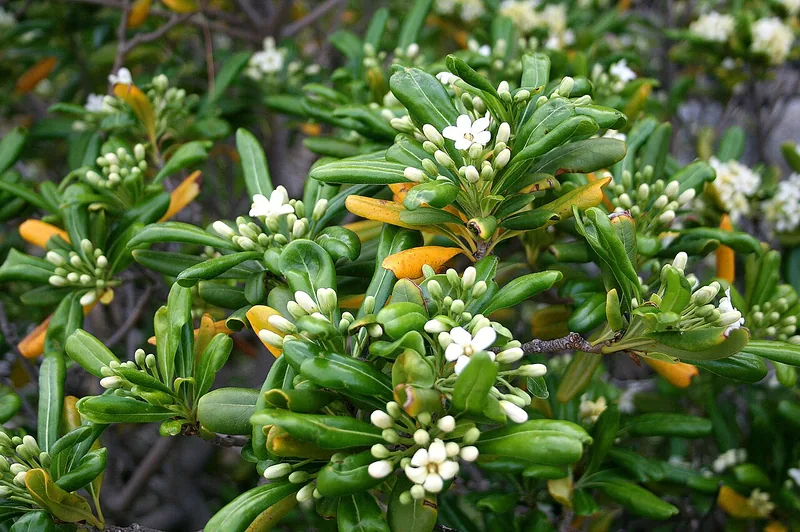
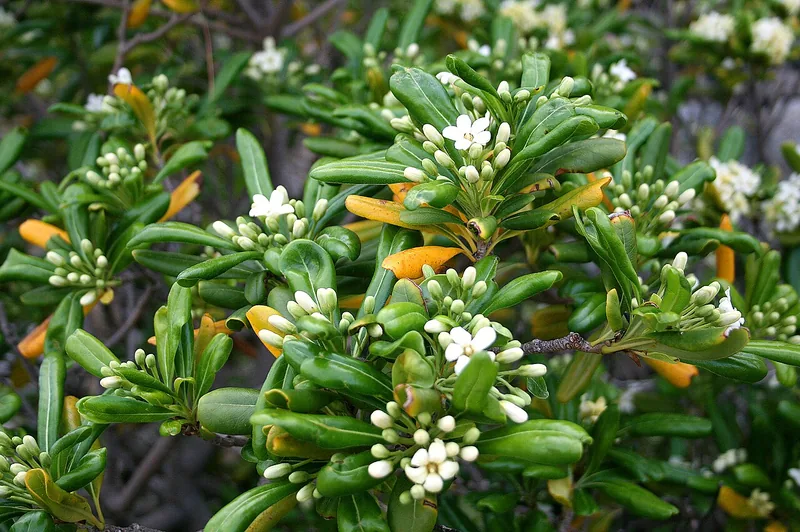
Foliage: Evergreen, obovate leaves 4–10 cm, leathery, glossy dark green with slightly inrolled margins, hairless, crowded toward the branch tips. Variegated cultivars carry cream margins.
Growth habit: Dense and compact to broadly spreading. Sympodial — each stem tip stops and a lateral bud continues the growth.
Flowers & fruit: Five-petalled creamy-white flowers turning dull yellow with age, in terminal umbels 5–8 cm across, in April and May, with a strong orange-blossom scent. Fruit is a green-to-brown three-valved capsule, largely hidden by foliage and not ornamental, splitting to reveal red seeds.
Look-alikes: NC State notes confusion with Pittosporum heterophyllum and Ternstroemia gymnanthera. The orange-blossom fragrance, leathery obovate leaves with inrolled margins, and umbel flower clusters together identify it.
Climate & USDA Zone
Zones 8a–10b in the ground. Reported frost tolerance varies with cultivar and how fully dormant the plant is — figures between 5°F and 23°F appear in the literature, with some hardier selections rated lower. Damage generally begins around 20°F.
In a bonsai pot it is meaningfully more tender than that. The shallow container exposes roots to damaging cold well before the top growth shows any stress. Anyone outside zone 9–10 should plan on moving it into an unheated greenhouse, cold frame or bright cool room for winter.
Light
Full sun to part shade; the species tolerates quite deep shade. Variegated forms are the exception — they need considerably more direct sun than the plain green form to hold their cream-and-green pattern, and revert toward solid green in shade.
Watering
Let it dry slightly between waterings. It is documented as tolerant of drought, heat and salt spray, which makes it comparatively forgiving. What it will not accept is wet or poorly drained soil, which NC State explicitly links to increased root rot risk.
A fast grower in summer will still need checking daily in hot weather.
Soil & Root Care
Wide pH tolerance — it takes acid and alkaline alike — but it must drain freely. A standard free-draining bonsai mix is fine.
Honest gap: no bonsai repotting interval is documented for this species. Given its rapid growth, every one to two years for a developing tree is the reasonable expectation, extending as growth slows with maturity.
Feeding
Feed through the growing season; a rapid grower uses it. Stop when you move it into cool winter quarters — feeding a dormant tree in a cold room does nothing useful.
Pruning & Styling
It withstands severe pruning, in NC State's words, which makes it a forgiving subject for hard structural work and aggressive cutbacks. Combined with its speed, that means you can develop a silhouette faster on this species than on most.
But mind the timing. Like Pieris, next season's flowers appear on old growth. Prune hard immediately after spring flowering finishes. Heavy pruning in autumn or winter removes next year's bloom.
On a variegated specimen, opening the canopy to let light into the interior does double duty — it improves the structure and helps maintain variegation on the inner foliage rather than just the outermost leaves.
Propagation & Cuttings
Ease: Moderate. Best method: cuttings.
Named variegated cultivars must be propagated vegetatively to stay true — seedlings revert toward plain green. NC State notes the species transplants easily, which suggests robust root regeneration.
Pests
NC State records no serious insect problems, though aphids, scale, mealybugs, root-knot nematodes and whiteflies may occur. Scale and mealybug are worth particular attention on a densely branched bonsai, where airflow is more restricted than in an open landscape shrub.
Disease, Fungus & Infection
Leaf spot, bacterial blight, and crown or root rot. The rot is specifically tied to wet, poorly drained conditions — which brings us back to substrate and watering as the controlling factors.
Most Common Causes of Death
1. Root or crown rot from wet, poorly drained soil. The documented primary risk. 2. Unprotected winter cold in a container. A materially bigger risk for this species than for the hardier temperate trees on this site — the pot exposes roots far below the plant's already modest 8–10 hardiness. 3. Permanent indoor culture. Slow decline rather than sudden death: weak leggy growth, lost variegation, and eventual failure.
Seasonal Calendar
- Spring: Flowering in April–May; prune hard immediately afterwards to preserve next year's buds while shaping. Repot if due. Move outdoors once frost risk passes.
- Summer: Full sun for variegation; frequent pinching to keep up with rapid growth; regular feeding.
- Autumn: Reduce feeding; capsules form; prepare winter quarters.
- Winter: Below zone 9, move to a bright, cool, frost-free space. Reduce watering. This is the critical season for this species.
Toxicity, Safety & Handling
NC State Extension tags this species non-toxic for cats, dogs and horses — a welcome contrast to Pieris and Nandina. No thorns or handling hazards.
Close-up photo reference
Compare your tree against these to confirm the species and spot problems early.

Sources
- Pittosporum tobira — NC State Extension Gardener Plant Toolbox
- Pittosporum tobira 'Variegatum' — Missouri Botanical Garden Plant Finder
- Pittosporum tobira — Royal Horticultural Society
Buy a Japanese Mock Orange bonsai
- All species
- Shop bonsai trees, tools & supplies
- How to Water a Bonsai (Without Killing It)
- Bonsai Soil: What to Buy, What to Mix, and What It Costs
- Why Bonsai Die After Repotting: Diagnosing a Failed Repot
- Pruning vs. Pinching: Shaping Your Bonsai
- Overwintering Bonsai: Cold-Season Care
- Indoor Bonsai Light and Humidity: Making a Windowsill Actually Work
- Root Rot on bonsai
- Winter / Frost Damage on bonsai
- Scale Insects on bonsai
- Aphids on bonsai
- Leaf Spot (Fungal) on bonsai
- Jamaican Raintree bonsai care
- Silverberry bonsai care
- Bottlebrush bonsai care
- Buttonwood bonsai care